Category: Podcasts

  • Podcast #200 — Wrapping Up the TravelCommons Journey

    Podcast #200 — Wrapping Up the TravelCommons Journey

    TravelCommons’ final stop

    Finishing up 19 years of thinking way too much about travel, I indulge in a little bit of nostalgia and talk about my personal travel philosophy. But before that, we compare three Mid-South river cities — Nashville, Louisville, and Memphis — talk about the recovery of business travel, and enjoy a full listener mail bag. All this and more – click here to download the podcast file, go up to the Subscribe section in the top menu bar to subscribe on your favorite site, or listen right here by clicking on the arrow on the player.

    Here is the transcript of TravelCommons podcast #200:

    Since The Last Episode

    • Intro music — Warmth by Makkina
    • Coming to you, for the last time, from the TravelCommons studios in Nashville, TN after a couple of road trips, one up I-65 to Louisville, KY for a pre-Kentucky Derby bike ride called (of course) Tour de Lou, and then the next week, out west along I-40 to Memphis. It’s given me a chance to compare, if I throw Nashville into the mix, three mid-sized, Mid-South river cities that I’ve lived in. Nashville is the largest of the three both in population and area; Louisville and Memphis are a bit smaller and pretty much the same size. And Nashville feels bigger — more buildings in the downtown skyline when you drive in, and more big cranes putting up more. Nashville’s neighborhoods feel more linked up, more contiguous space to walk, with fewer “flat spots,” places you feel like you should walk a bit quicker. However, the older, more established neighborhoods of Old Louisville and Midtown Memphis offered more interesting walks. Memphis’ Overton Park is the best city park, with a mix of lawns, gardens, some old-growth forest to walk through, and a concert shell built in the 1930’s where, when we passed by, a hip-hop group was doing a rehearsal walk-thru. Glad the federal and state governments failed to plow a good bit of it under back in the ‘60’s and ‘70’s when they wanted to route I-40 straight through the city.
    • As I said, all three are river cities — Memphis on the Mississippi, Louisville on the Ohio, and Nashville on the Cumberland. And maybe because the Mississippi and the Ohio are much bigger rivers, Memphis and Louisville do much more with their riverfronts than Nashville. We walked along the Mississippi through the just renovated Tom Lee Park in Memphis — guys were putting some final touches on the walking paths and garden beds — and I biked along Louisville’s Waterfront Park; both really nice spaces, almost like “front lawns” for those cities. And maybe there’s something to that. The Mississippi and Ohio Rivers are boundaries for those cities (and indeed, those states) where the Cumberland River winds through Nashville which, in many ways, seems to turn its back to the river. I mean Chicago does much more with the much smaller Chicago River than Nashville does with the Cumberland.
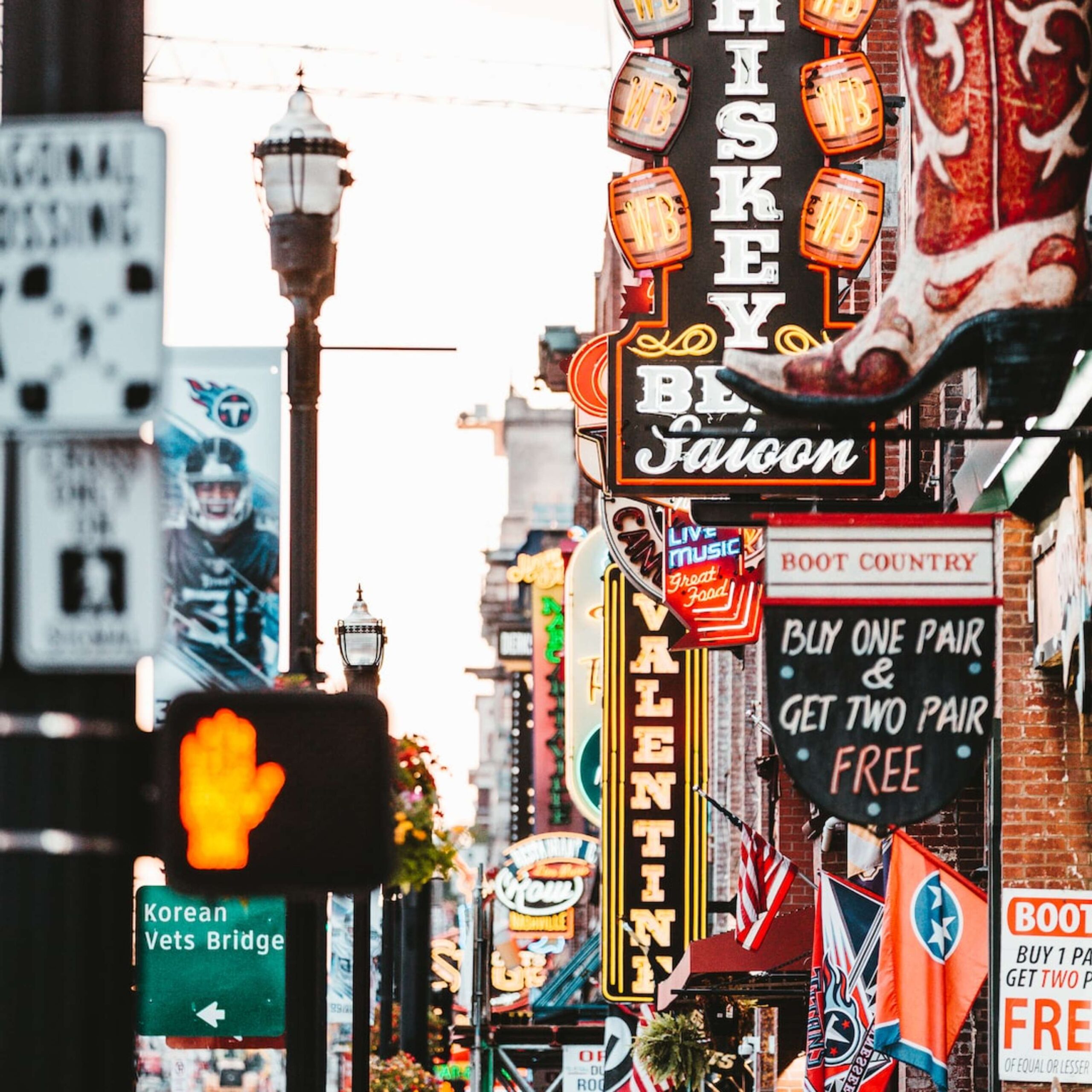
    • But, of course, Nashville’s music scene is way beyond what Louisville and Memphis offer — even beyond the honky tonk maelstrom that is Lower Broadway. Live music starts in the airport and follows you throughout the city. Irene and I joke there must be a city ordinance mandating live music in any gathering of 10 or more people. Memphis tries hard with its Beale Street district. It has a number of clubs with live blues, R&B, and rock music coming out the windows into the street, but it doesn’t have the density, the concentration of Lower Broadway, and Beale Street tails off after a couple of blocks, into one of those “flat spots” that make you want to look over your shoulder a bit more often.
    • Next road trip is out east to Chattanooga. Feels like we’re drawing a circle with a radius of a 2-3 hr drive time and hitting all the cities within it for a day or three each. Kinda trading summer TSA security lines for summer construction traffic jams.
    • Bridge music — Another Way by Psykick (c) copyright 2016 Licensed under a Creative Commons Attribution (3.0) license. http://dig.ccmixter.org/files/Psykick/52938

    Following Up

    • Long-time listener Thelma Stubelt wrote in about the last episode’s biometrics discussion
      • “I really enjoyed the last episode. I work for immigration. They are working on making Green Cards part of the Apple Wallet. I know Global Entry is doing it as well. We have also been simplifying the biometrics process. A lot of the documents being produced had a fingerprint on the card. That is no longer being put on.  I’m going to Vegas in the fall. Looking forward to seeing TSAs new system.”
      • Thelma, thanks for that. My brother-in-law still has the Green Card from when he came to the US with his Hungarian refugee parents in the late ’50’s; with his baby picture on it. We get a chuckle whenever he has to pull it out of his wallet. Somehow, I don’t see an Apple Wallet version of that doing the same job. But, as Henry and Sheldon said in the last episode, the move is toward more, not less biometrics. And Thelma’s note adds a few more data points that confirms that trend.
    • Of course, automated facial recognition might be more efficient, but is not always resilient. The UK’s facial recognition eGate system was down for 4 hours last week for a “system network issue.” They had to fall back to old-school manual facial recognition — that is, an immigration officer looking at you and then at the picture of you in your passport. This seems to be becoming an annual event in the UK. Last May, they had a similar 3-4-hour eGate outage. Note to self — don’t fly to the UK next May. But at least it’s happening in a country that prides itself on orderly queueing.
    • Back in the COVID era, in episodes in 2020 and 2021, I was skeptical of predictions like Bill Gates’ that 50% of business travel will go away; hot takes that virtual meetings are the “new normal”. The reality? First quarter earnings calls from travel companies all saying that business travel is back. Alaska Air and Southwest both said corporate travel sales grew over 20% and are back to pre-pandemic levels; as did Hilton and Hyatt. Regression to the mean, you might call it “behavioral inertia”, is a strong force. Just ask all the folks laid off from e-commerce companies.
    • And, as always, thanks to the notes from folks who listened all the way to the end of the previous episode where I said that this episode would be my last. I have to tell you that, if I was a listener, I wouldn’t have heard it. I’d be hitting the “next track” button on Overcast within the second bar of Evangeline’s Pictures of You song.
      • Thelma, in her biometrics note, also said “I have been a listener of yours for I believe 18 years. I will miss your show but wish you all the best. My old time fav was your love of bashing TSA. Another favorite thing on the podcast was the outro music. When you played the whole thing I couldn’t help but sing along.”
      • Thanks very much for sticking it out for pretty much the full duration. Either I’m mellowing with age or the TSA finally cleaned up their act 3 or 4 years ago, or maybe PreCheck has taken away the reasons for those old debates about shoe sole thickness or the definition of a solid.
      • Another lifer, Jerry Sarfati, wrote in “I’m sorry to hear that you will be ending the Travel Commons podcast. I am a LONG time listener, I guess about 18 years.  I found your podcast when I was a “road warrior”.   Now I’m retired, but still enjoy listening to you.”
      • Rob Cheshire of This Week in Craft Beer wrote “Truly the end of an era!”
      • Roger Nash left the Instagram comment — “Going to miss you, sir”
      • And @LAflyr hit me up on Twitter to say — “Sad to hear about the upcoming end of the journey.  However, reaching 200 episodes is truly an achievement.  Thanks for all the stories and entertainment over the years!”
      • Robert Fennerty wrote – “I will miss the Travel Commons podcast for many reasons. In increasingly important order, here are my top 3 reasons:
        • Travel Tips: I have incorporated many of your ideas and devices into my travel regimen. Most recently, the Super Bagel has become my go to power center and it has reduced the weight of my laptop bag, thereby allowing me to stuff other less useful junk inside. 
        • Cogent Observations: The show has had so many cathartic YES I KNOW moments. For example, every time I walk into a hotel bathroom and the bottles have unintelligible labels, I think of you. In the example below, we know that my hands will smell like magnolia after I depress the plunger on one of those bottles. But will I have washed my hands or moistened them? No one can know for sure.
        • You: Every time a new episode enters my podcast feed, I smile. Your voice is very reassuring and I think it lowers my pulse a few beats per minute. So I will miss your company, especially when I’m on the road.
    • Wow! Thank you very much Robert for that. And to everyone who wrote in. I really do appreciate your comments; they mean a lot. 
    • Now this is the point in this segment where I usually say, if you have any travel stories, questions, comments, tips, rants – the voice of the traveler, send ’em along to comments@travelcommons.com or to @mpeacock on Twitter, or to @travelcommons on Instagram or Facebook. Well, feel free to keep doing that. I’ll still be there, but it’ll just be between you and me.
    • Bridge Music — release.JOY.release by SackJo22 (c) copyright 2015 Licensed under a Creative Commons Attribution Noncommercial (3.0) license.  Ft: essesq, Haskel (hej31)

    Wrapping Up the TravelCommons Journey

    • So here’s how it started 19 years ago
      • This is the first TravelCommons podcast, so bear with us. We got kind of a lousy microphone and we’re gonna be trying some new stuff along the way, but I hope you enjoy what we gotta say. Why should you care, why should you listen, why should you even think about subscribing to this podcast? Well, if you’re interested in travel, that’s what we’re gonna talk about — the ground level experiences of a traveler, someone who’s in airplanes and hotels and rental cars every week. That’s me. We’re talking to you today from the bathroom of the Wardman Park Marriott. I don’t have fancy reverb filters and all the other great stuff. So instead, I thought I’d just surround myself with a lot of tile and hopefully this thing will sound pretty good. So, anyhow, Wardman Park Marriott in Northwest DC. 
      • I’m on kind of one of my normal triangulation trips. Last week, I was out on the West Coast. This week, I’m out on the East Coast. Started off in ORD yesterday afternoon. Typical ORD day — 6 am thunderstorm shot the entire schedule to hell in a hand basket; 60- to 120-minute delays the whole time. I tell you; it was a mess. And then today flying down from New York, taking the shuttle out of LGA, they push us back and then we sit for 45 minutes on the runway because we got caught right in the middle of one of those times when LGA takes the entire 30 airplanes that are out on the runway and tell them all to turn around and go the other way because the wind shifted. It was beautiful. It’s been a beautiful trip; kind of a normal trip actually.
    • And here’s how we’re ending it — with, if nothing else, a lot better sound quality… and a bit more effort in clean-up editing. But I do think the through line, from episode 1 to 200, has been consistent — capturing the voice of the traveler, and through being more about the journey than the destination. 
    • A few years back, Rob Cheshire turned me onto a podcast called Steal This Beer. Their tag line is “A candid discussion about beer, over beer, by a couple of guys who think about beer way too much.” Swap “travel” for “beer” and it could make a better tagline for this podcast — “A discussion about travel by a guy who thinks about travel way too much.”
    • And I would think too much about travel because, as with many road warrior listeners who would chime in over the years, travel was one of the main drivers of my day-to-day existence. There was a stretch of time — years, actually — where I would travel all but 6 or 7 weeks in a year. So 80+% of my life would be dependent on how well, each week, the FAA, the TSA, 2-4 airports, 1-3 airlines, 2-3 hotels, and Hertz did their respective jobs. The joint probability of that many independent variables all lining up in the right way for me to get to where I wanted to be on time is vanishingly small. Looking at it this way, it’s no wonder I sounded so cranky so often on this podcast.
    • Some road warriors who “think way too much” go full-on George Clooney in the movie Up In The Air, obsessively collecting “travel hacks” to swerve lines, precious metal status levels, doing whatever they can to be able to move through their travel days with minimum friction and maximum efficiency. I’ve called that over the years “living in the travel bubble.”
    • If I’d gone that way, this podcast would’ve ended maybe 100 episodes ago. I’ve talked a lot over the years about breaking out of the travel bubble — by taking subways and commuter trains instead of taxis and Ubers, searching out local beer joints, and just roaming randomly around a city — or what the cool kids call flâneuring. I always figured it’s a symptom of adult ADHD; a short attention span, a need for external stimuli. As you might guess, I’m no fun on a beach vacation. Going to a new place or digging into new bits of places like New York or San Francisco where I’ve been, what, 50 times before — seeing, experiencing new things would hit that dopamine button and make up for having to grit my teeth through the umpteenth flight delay at ORD or LGA.
    • And to lay further back on the analyst’s couch, I find that when I’m traveling, when I’m in the midst of all this new stuff, I’m often better able to dig down and think about things that, when I’m home, the day-to-day activities get in the way. Travel can keep my day-to-day stuff at arm’s length — 2 arms’ length if I’m not in an English-speaking place. I can tune out a lot of the peripheral chatter — the television in the corner, the adjacent conversations — because I don’t understand it. 
    • But even when I can’t understand what’s being said around me, I found travel still expanding my understanding, my perspectives. It’s one thing to read about the size of China’s population or the poverty in India or the humid heat in Vietnam or the homeless encampments in San Francisco, but it’s a whole next-level to see it and experience it in person. What seems black and white from a distance starts to dither into gray when it’s up close. It forces me to do a much better job of seeing the other side, to see how my actions could be perceived by others, and I hope it ends up making me a more empathetic person. Which is why I never bought into the “new normal” predictions of Bill Gates and others that travel would never be the same. There’s too many people like me.
    • But the lack of travel during the Covid shutdowns, the move to more virtual work, and my own slouching toward retirement has made it more of a struggle to generate new and what I thought was interesting content that is “more about the journey”. Two years ago, I wrote in a note “I’m definitely not making it to episode #200”. I surprised myself by making it here, but it seems like a good point to wrap it up — landmark episode number and 19 years after the first episode in May 2005. 
    • So what’s next? I’m not really sure. Actually, no. I do know that I’m going to clean up the TravelCommons website — fix the SSL certificate Robert Fenerty pinged me about last June; delete the out-of-date posts. And reconfigure it to focus more on the written work, the blog posts than the podcast because I think that’ll be what comes next — written stuff that’s more about the destination than the journey, to flip the tag line around. 
    • I’ve done it pretty infrequently in the past; the podcast took priority. The last one was about our January 2021 trip to Tucson. But I’ve found myself giving out a lot of travel recommendations recently — from guys around my age who know I’ve done a bit of travel asking me “What should I do in this place?” Like last weekend, I ran into a guy at a taproom who, when I sat next to him at the beginning of the year, asked me for recommendations for Rome. “That beer bar down that alley in Trastevere you recommended was great!” he said. “And that neighborhood too! We wouldn’t have gone there if you hadn’t suggested it.” Maybe travel writing editors have over-rotated from “tell me where to go” to “tell me a story about a place”, but it’ll be good to have something to keep me occupied.

    Closing

    • Closing music — Pictures of You by Evangeline
    • OK, that’s it, that’s the end of TravelCommons podcast #200
    • I hope you enjoyed this last show, and thanks so much to all of you who have been along on this ride. 
    • As I said earlier, you can still ping me at comments@travelcommons.com, mpeacock on Twitter, the TravelCommons page on Facebook and Instagram, and the travelcommons.com website will still be around. I’ll put links to any new posts on all the socials. If you aren’t on social media — which I can completely understand — and want to know when I post something, send your email address to me at comments@travelcommons.com and I’ll email out a link to new material. Who knows, maybe I’ll do a TravelCommons newsletter.  
    • Thelma’s comment in her note about the outro song, Pictures of You by the Scottish band Evangeline, got me digging in through the archives, all the way back to episode #14 where the band leader explained the origins of the song. It only seems right to close out this last episode with his words and his full song.
    • As always, safe travels; and thanks for stopping by the TravelCommons.
    • Willie Evans – “Hi, I’m Willie Evans from Scots Band Evangeline sending good thoughts to Mark and all the listeners of the TravelCommons podcast. Touring is a part of our job that we love. It’s exciting, it’s fun, it’s energizing, and it’s great to get out there and meet the fans and see new places. The downside, however, is that it can be a bit boring and predictable, with each day being pretty much the same as the day before. And inevitably, we all miss our friends and our loved ones back home. The song Pictures of You from our Hard Way album is about that longing for our wives and families. And whether you’re an entertainer or musician or perhaps a salesman or businessman who travels a lot, then I hope you can identify with it. Hope you enjoy the song. Have a great day.”
    • Follow me on Twitter
    • “Like” the TravelCommons Facebook page
    • Direct link to the show
  • Podcast #199 — Smile for Security: Facial Recognition in Travel

    Podcast #199 — Smile for Security: Facial Recognition in Travel

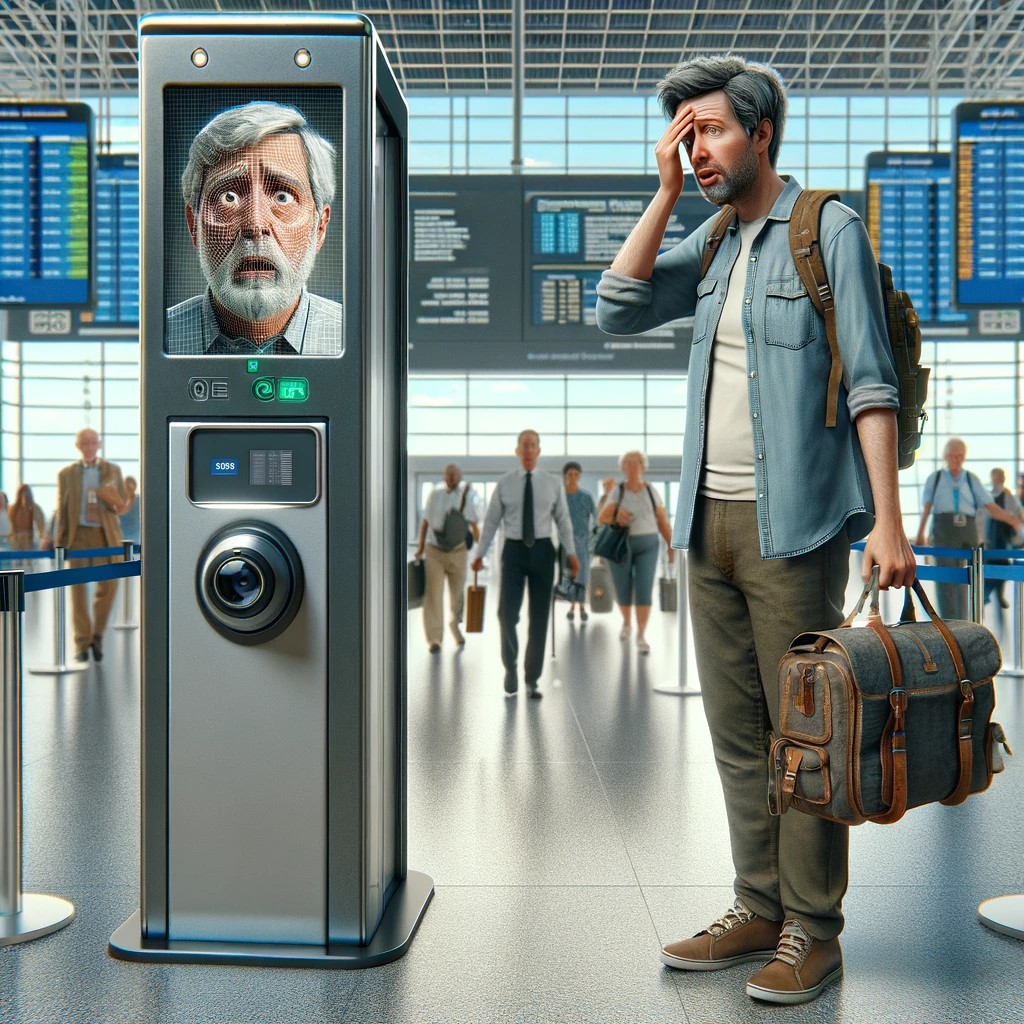
     a traveler standing in front of a facial recognition scanner at an airport. The scanner is emitting error signals, and the traveler looks frustrated.
    I knew these travel delays were aging me

    Using my face as my boarding pass to get on a flight to Oaxaca, Mexico and then as my passport to get back in the US got me thinking about how facial recognition has permeated the travel experience. To help us understand where this is going, we talk with two travel industry experts, Dr. Sheldon Jacobson and Henry Harteveldt.

    But before that, we talk about eating grasshoppers, an EV experience with Avis, and a couple of my travel tips that need to be revised. All this and more – click here to download the podcast file, go up to the Subscribe section in the top menu bar to subscribe on your favorite site, or listen right here by clicking on the arrow on the player.

    Here is the transcript of TravelCommons podcast #199:

    Since The Last Episode

    • Intro music — Warmth by Makkina
    • Coming to you from the TravelCommons studios in Nashville, TN a couple of days after a last-minute 200-mile trip up to Carbondale, Illinois, home of the Southern Illinois University Salukis… but that didn’t matter. What did matter is that Carbondale was right in the center of the solar eclipse’s path across North America, which meant we had 4 minutes of total eclipse. 
    • Looking up, straight into the sun with its corona glowing, wavering around the black disk of the moon — I’ve seen… we’ve all seen pictures of total eclipses, and of this one all across social and regular media Monday afternoon. But the pictures couldn’t do justice to being there, even if there was the far end of the Salukis stadium parking lot, backing up to a scraggly bit of woods. The experience more than made up for the 3-hr drive there and the 5½-hour bumper-to-bumper traffic back. I add it to my list of things that, even though we’ve seen seemingly an infinite number of pictures of them, experiencing them in real life was worth the hassle to physically travel to see them. The Taj Mahal, the Great Wall of China, Niagara Falls — all on the list. As opposed to, say, The Mona Lisa in the Louvre. The crowd of people with their phones in the air trying to get a picture was much better than the Mona Lisa itself.
    • Before that, the start of March, we were in Oaxaca, Mexico for a week. I’ve had Oaxaca on my “To Visit” list for 4-5 years now. For me, it was a good match — the combination of interesting food, lots of culture, and no beach. I’ve done “resort-y” Mexico — Cabo, Cancún, Puerto Vallarta — not a big fan. While there were a lot of tourists in Oaxaca, it didn’t seem to be overrun with them like, say, the center of Cabo is. Maybe because the city center is bigger, so there’s more space to absorb them, or maybe the absolute number of tourists are lower; it wasn’t an easy nor a cheap flight to get there.
    • We hit the food scene pretty hard, high- and low-brow; food stands in the market; high-end places serving up phenomenal moles. But the food that made the biggest impression is the insects. It wasn’t some tourist-baiting shtick. Walking past a group of street vendors, I saw one of the women making a snack of a couple of grasshoppers wrapped in a small tortilla. At a mezcal bar on the eastern edge of the Centro, the bartender put down a small bowl of grasshoppers as a bar snack. (If you follow TravelCommons on Instagram, you can see a picture in my Oaxaca story) “Those are good grasshoppers,” he told us. “I drive an hour up towards Pueblo to get them. They’re not farmed like the ones you get in the markets.” I have to admit that I’m not enough of an insect connoisseur to be able to pick out the finer nuances of free-range vs. farmed grasshoppers, but they were as good as Beer Nuts as a bar snack. Or maybe that was just the 3rd, or 4th, or 5th shot of mezcal talking.
    • Bridge Music — Another Girl (instrumental) by duckett (c) copyright 2009 Licensed under a Creative Commons Attribution Noncommercial (3.0) license. http://dig.ccmixter.org/files/duckett/23334 Ft: fourstones, miafas

    Following Up

    • Friend of the podcast Allan Marko swung by the website to leave this comment about the last episode:
      • “I was assigned an EV by Avis at Fort Lauderdale [at the end of February]. Curious enough to try it out for the relatively short distances I would be traveling, I got in. After starting, I noticed it only had a 10% charge, so, “check please.” I fired up the Avis app and selected a Chevy Malibu with 1,200 miles on it.  As for booking.com, we had tremendous luck using that website for most of our accommodations over a two month period in SE Asia five years ago – exclusively for hotels though.”
      • Allan, thanks for that. Expecting you to drive off with a 10% charge? Avis would never think to give you a car with just an ⅛-th of a tank. And if they did, it would take them 10 minutes to fill the tank and get it back to you. But for that EV? Even at a Tesla Supercharger, at least an hour, maybe more. No wonder they tried to get you to do it. And regards to booking.com, my experience with their hotel product is the same as yours — never had a problem. But their property rentals, never again!
    • One of my regular travel pro tips from years ago was “Don’t take the last flight out” because, if you missed your connection or your flight was canceled, you had a backup. And, as an IRROP passenger — industry lingo for “irregular operations” — you have priority on open seats on that later flight; even more so if you have frequent flier status. But nowadays, with US airlines sporting load factors over 80%, this strategy is a lot tougher to make work. Last June, back in episode #194, I talked about how United’s delay leaving Amsterdam meant we missed our connection home, and how I spent about an hour between the service agents at ORD and on the phone, saying “This is unacceptable” 2, 3, 4 times before they found two seats on the later flight to BNA that they’d been saying was completely full. And now this trip flying home from Oaxaca through DFW on American, I had gotten an email saying there could be bad weather, but I thought, “Well, there’s always that later flight.” En route from Oaxaca to DFW, I’m connected to the plane WiFi and an hour before we land, I get a notice from American — our flight to Nashville had been canceled. OK, that sucks, but no panic, they’d rebook me on the later flight. But I keep reading — no rebooking; it just tells me to go to the American app. The WiFi over northern Mexico is not the greatest, but when I do get the app to respond, it’s not showing the later flight as an option. Indeed, the options keep changing with each refresh, but nothing earlier than the next day, Friday, or sometimes, not until Saturday, two days later. It wasn’t until after we landed, passed through Immigration, and were waiting at baggage claim to pick up our luggage to go through Customs that we finally got a message through the app that they’d found us seats on the later flight. Still got home that night, but in both these instances, the customer service experience has degraded just so far. I’ve had to push very hard, and, honestly, be a bit of a jerk to get what used to come seamlessly.
    • And another travel tip that seems to need retiring — “Use Twitter as a Concierge Service”. While struggling to rebook while still in the air from Oaxaca, I pinged American on Twitter hoping for a little more help. What I got was an amazing (and depressing) amount of spam messaging masquerading as AA customer service managers. It’s easy to get fooled in the panic of trying to find a way home, but a few rules to keep in mind — only communicate with the airline’s gold-checked verified accounts; ignore messages from everyone else — like “AMERICAN AIR HELP DESK” (all in caps) or “Jason frank (uppercase Jason, lowercase case frank) American Air manger” (as opposed to “manager”); and never give anyone your phone number.
    • And there’s a quick programming note at the end of this episode, so for those interested, hold off on hitting the Skip button when you hear the music.
    • If you have any travel stories, questions, comments, tips, rants – the voice of the traveler, send ’em along to comments@travelcommons.com — you can send a Twitter (X?) message to mpeacock, post your thoughts on the TravelCommons’ Facebook page, or on the Instagram account at travelcommons — or you can skip all that social media stuff and post your comments on the web site at TravelCommons.com.
    • Bridge Music — Nube – Djiz Rmx by Kwame (c) copyright 2007 Licensed under a Creative Commons Attribution Noncommercial (3.0) license.  Ft: SylviaO

    Smile for Security: The Future of Facial Recognition in Travel

    • Over the years on the podcast, we’ve talked about how travelers are seeing more and more use of biometrics in their travel days. I’ve told the story of my first fingerprint scan back in the late ‘90’s so I could skip the US immigration line on my weekly commute home from Toronto-Pearson Airport. My colleague’s reaction — “I’m not giving the US government my biometrics!” Me — “I can skip a 3-minute line? Where do I sign up?” Which I think shows that the privacy-vs.-convenience choices haven’t fundamentally changed all that much in the subsequent 25 years.
    • But (surprise!), technology has, and it seems to be accelerating the use of biometrics, specifically facial recognition. Boarding our flight to Oaxaca, our face was our boarding pass — just look at the camera, wait for the “bing”, and move on. And coming back, the Global Entry kiosks no longer need passports, no longer have you twisting your hand just so to get the fingerprint pad to read all five fingers; just walk up, it takes your picture, and tells you to move on.
    • Which got me wondering — where is this going? To help answer this, I invited on two guys who have been digging deep into this for a number of years. First up, Dr. Sheldon Jacobson, Professor in Computer Science at the University of Illinois. Sheldon was last on the podcast in episode #189 in September 2022 talking about why another of my travel tips, “catch the earliest flight you can”, is not always right. Over the years, Sheldon has developed operations research models to optimize aviation security. So I asked him to come back on the podcast to talk about the growth of biometrics…
      • Mark: Sheldon, thanks for coming back on to the Travel Commons podcast. Wanted to talk with you about biometrics, facial recognition, all the things that seem to be increasing with regards to air travel.
      • Sheldon: The airlines, as well as the Transportation Security Administration need to know who you are when you are traveling and they relied on identification cards, driver’s license, real IDs and are continuing to be part of the future. But ultimately, the best way to determine who you are is through your face and biometrics and artificial intelligence imbued with it. In fact, it is a solution that people are recognizing; the airlines are starting to use it. And of course, the Transportation Security Administration is investing billions of dollars to advance this idea. And there’s a reason why they’re doing this. They’re doing this simply because the traditional model of airport security screening has been to detect stuff — prohibited items, knives, explosives, firearms, even, you know, full size tubes of toothpaste could be a threat based on explosives that can be embedded in them. However, the real threat are the people and facial recognition is a means to transform the platform for airport security from the detection of items to knowing your traveler. And that’s where we’re heading right now. And this is the future of airport security.
      • Mark: And how does that work? How do you think that works?
      • Sheldon: TSA has not broadcast this and I don’t even know if they’re thinking about it, but I have thought about it and I have proposed to them because I visited them in October 2023. And I told them that if they can bring facial recognition biometrics and the use of AI to truly validate and authenticate the travelers, the need for physical screening will be reduced tremendously to the point that they can create a new class of traveler, which I would call a “Super PreCheck” traveler who subjects themselves to greater background vetting. But then they would be treated like a known crew member at an airport and require no further physical screening. That is the future of airport security.
      • Mark: It’s almost like “Back to the Future”, right? It’s almost like back to pre 9/11 days.
      • Sheldon: Now, some will argue, “Oh, someone will gain the system and we will have a terrorist threat because of that.” And I would argue the exact opposite, that the only people who would be willing to subject themselves to the background check would be people who know that they’re going to get through it fine. And the ones who are truly threats cannot risk it because rarely are people acting by themselves. They’re often acting in a network. And as a result of that, for them to be exposed, they would be exposing their whole network. And the risk of doing that is far too great. What it would also do is it would parse the whole spectrum of travelers into a group of people who are willing to be known and a group of travelers that are not willing to be known. But over time, the ones who are willing to be known will be much larger, which means you can target your resources and your attention on this so-called unknown group and actually make it more secure for the air system by targeting your resources in that way. After September 11th, everybody was treated the same — one size fits all. TSA PreCheck moved away from that. Now, I’m proposing we move even further. And our original research we presented to the TSA in 2003 when we proposed this idea of differential screening to them and how it would work and why it would be beneficial. We said that you really need three classes, two would be fine, but three would be better. And it turns out that third class is what we would now call a “Super PreCheck” class of passengers. And those are the people who would be treated like crew members, the known crew members. And a lot of people would be willing to pay for that privilege and we’ve put boundaries on what that means. It wouldn’t be renewed every five years; it would be renewed potentially every year. It would be more expensive. But there’s a lot of business travelers who are willing to pay that price to basically pass through security untethered, but they aren’t a risk to the system anyway. So why waste resources and time on them? It would transform the footprint and create what I would call “security tunnels” rather than security checkpoints for many of these people.
      • Mark: That seems to make sense. What was the reaction to that at TSA?
      • Sheldon: That’s a good question. I don’t know. I don’t know if I can say that.
      • Mark: Ok, I got it.. Understood. I just had to ask. Well, that’s a great concept and I appreciate that insight around you guys’ research. You’re right. I mean, there’s something that says you just look at what people are willing to sign up with — with Clear. with Global Entry, with PreCheck. Again, frequent travelers will always look to streamline that experience. And so I would agree, I would say there would be people in a heartbeat who would raise their hand for that.
      • Sheldon: Exactly. Right now, people who sign up for Clear pay $189 on the top end for one year, being able to be identified as who they are and go to the front of the precheck line. That’s all they’re paying for and they’re not paying for anything more. If the TSA implements a new class of passengers then Clear would become superfluous and literally would go away.
      • Mark: Yes, that was what I was thinking also.
      • Sheldon: It’s just, it will not be needed anymore. And in some sense, the pathway of using what the TSA calls the “credential authentication technology” which basically validates who you are using biometrics as well as that you’re entitled to, imply that you don’t even need a boarding pass right now when they implement this, and in some airports they have it, Clear will have to find a new business model because the TSA is going to assert that model into their own operations.
      • Mark: You can kind of feel that. And indeed, I still think this most recent version of Clear — and I had originally signed up for the initial version way back 10-15 years ago (whenever it first started),  Rev 1.0, and then they went bankrupt and now we’ve got Rev 2.0. But even today, I still have a challenge to see a compelling business model for the service that they offer. Oftentimes at a lot of the airports I’ll go to, the difference between a Clear line and just the basic PreCheck line is pretty much nothing.
      • Sheldon: Exactly. I’ve never been impressed with their business model. They’ve tried to sell it for stadiums and large entertainment venues. The challenges,  it’s just been difficult and most of their money, most of their resources, most of the revenue still comes through airports and they need that. I just don’t see the future of it being very bright.
      • Mark: Is there more facial recognition coming or different facial recognition coming? Where do you see that path going?
      • Sheldon: Well, we are nowhere near the end game on this facial recognition as effective as it is. I mean, the concept is ideal and wonderful. It’s still not perfect. It misses certain people of color. It struggles at certain times, and research is continuing to bring the error rates down, lower and lower and lower, especially if you’re going to create security tunnels where people just walk through it. And your picture is being taken literally in real time matched up using recognition. And then the next thing you know, you’re at your boarding gate because everything worked out fine for you. And now it will be the majority, the vast majority of travelers. So we are nowhere near the end of this and we are at the beginning. I think the challenge right now is the perception that people do think there is a privacy concern. And like I said, I think it’s exactly the opposite. I think this is opening up opportunities where we are going to spike in one dimension of AI which is facial recognition. And then the rest of the screening aspect at airports and validation literally gets dampened and in some cases, completely eliminated. I’m a firm believer and supporter of facial recognition for airport security and air travel. I know that if they do it right, and they seem to be on that pathway, that we are going to have a very different experience at airport screening for security and even air travel in the next 5 to 10 years. It’s just going to be radically and dramatically different. And I think when people realize that and begin to experience that they’re going to be happy for it. But at this point, a lot of the rhetoric is around privacy, but our privacy is being violated so often, so frequently and in so many venues that argument is no longer holding any water. I am convinced that this is a positive future for air travel in all aspects.
      • Mark: Sheldon, thanks very much again for joining us on the TravelCommons podcast and sharing that. That’s great stuff.
    • Our second guest is Henry Harteveldt, a travel industry analyst for many years. He had the depth of experience and industry contacts to give us a grounded sense on what’s coming with regarding biometrics…
      • Mark: Henry, thanks for joining us today on the Travel Commons podcast. Wanted to talk about biometrics in and around air travel and specifically, I don’t know if this is recency bias or what, but it just seems like I’ve seen a whole lot more of, especially facial recognition over the past couple of years. What’s your cut at it from a travel industry standpoint?
      • Henry: In the Crawl/Walk/Run continuum, I would say that with biometrics, we are somewhere between crawl and walk. Think of biometrics as the baby who is crawling really fast and it’s going to start walking any day now. But in the meantime, it’s scooting all over the place. So let’s break it down… Using facial recognition cameras for boarding flights has actually been around since before COVID began. I think the trial started somewhere in the 2016-17 time frame for international flights. That’s the only time it’s used right now, and it started to roll out in 2018- 2019. Delta was one of the first to embrace the technology and JetBlue as well. And what it does when it works well, and this is something we should come back to to discuss, but when biometrics, facial recognition works as everybody wants it to, it speeds up the boarding process. It reduces the need for us to show not just a physical boarding pass but also a physical passport. And, as a result, on a wide-body jet, it can shave perhaps 10 or more minutes off the boarding time; on a single-aisle plane, a 737 or an A320-type of plane, that could shave 5 to 7 minutes off. So it speeds up the boarding process and makes everything a little bit more efficient. It’s not perfect. There are people who are uncomfortable using it. There are people who are not familiar with it. So airlines have to have a belt and suspender type of approach. They’ll have to have gate staff there for the time being. But I don’t think we are that far away from where international travel is primarily biometrics based boarding, at least in major airports. And I think we will start soon to see it being tested for domestic travel, but there’s going to be a wrinkle with that when we use the biometric readers at the gate to get on the plane. The database links back to US Customs and Border Patrol which has photographs of US citizens, resident aliens, and international visitors, and it can call up that data to validate that you are you and I am me. With domestic flights. I think only the TSA has the biometric data right now for PreCheck. So it may take a little bit of work to get to a point for that. So that’s boarding. But let’s talk about airport security. Yes, TSA is indeed testing and in some cases, I think it’s actually beyond testing, they are rolling it out facial recognition that again eliminates the need for us to take out a driver’s license or passport or any other physical ID and, importantly, eliminates the need for us to show any type of boarding pass, whether it’s a paper boarding pass or digital boarding pass. And again, in theory, it speeds up the number of people who can get into and through the security screening process and reduces the need for human agents at those checkpoints. Now again, we’re still very much at the beginning of this. And TSA is saying we are going to have a security screening officer at that checkpoint in case something goes wrong or in case someone isn’t comfortable using biometrics.
      • Mark: Yeah, that was my experience in Nashville. There was a guy standing right there.
      • Henry: And as we record this, the TSA is testing at Las Vegas, basically this walkthrough type of environment, a new type of screening which is biometrics-based to validate who you are. You put your bags on the belt, you go through, it’s a lot less invasive, a lot less intrusive and supposed to be a lot faster. I actually want to go over to Las Vegas just to check it out and see what it’s like. They have this in Dubai and they are testing it elsewhere in England and in France, they are testing it on Eurostar. Now, there are a lot of other things coming along with biometrics at a lot of European airports and in Asia as well. I was just in Singapore. There are biometrics-based scanners so that you don’t have to queue up and have a border patrol officer review your passport, stamp your passport.
      • Mark: I had it at Heathrow last November. I went through the e-gates. So I was just surprised; I walked through to the other end and I was like, “Wait, this is it?  Nobody to stamp my passport?” No, nothing. Just like, “No. Get out of here. Go, move on.”
      • Henry: Right. Now, for those of us of a certain age, part of the love of travel is hearing that clunky thunk of the passport officer stamping your passport and, every time you get a new passport, the passport service mails back your old one. Those become mementos of our lives.
      • Mark: Yes, absolutely.
      • Henry: And there is a part of me that will miss the day when we get our passports stamped just as there is a part of me that misses airline branded paper, boarding passes to show “Oh, here’s where I have been” and so on.
      • Mark: That obviously, then, pivots over to — how should the travelers think about biometric data and the storage of that and the risk of that as a condition of travel?
      • Henry: Look, it is obviously a personal decision. Our research shows that right now in the US, far more travelers would trust sharing their personal biometric information with an airline than with any government agency. So in the US right now, it’s nearly 80% of airline passengers who, and this is first quarter 2024 data fresh off the press if you will, nearly 80% of us, airline passengers, business and leisure say they’re willing to share their personal biometric data — fingerprints, iris scans, etc. — with an airline they fly regularly if it will lead to a more efficient airport experience or journey. Only a quarter of passengers say they’re comfortable sharing their personal information right now with any government agency or entity even though, again, with the same benefits of an easier journey. Now, both of those numbers are up from 2023. The government only keeps certain information for a certain amount of time, usually 30 days or less and then it is expunged. So I am in the crowd that is comfortable sharing biometric information with governments and airlines because doing so makes my journey more efficient. It’s faster, it’s less stressful. It’s fewer people that I need to interact with. Remember we’re somewhere between Crawl and Walk. But where I see it, from the analyst perspective, the time difference, the time it will take us to go from Crawl to Walk will probably be many times longer in the time that will be needed to go from Walk to Run. Because again, as improvements emerge with the technology, the hardware, as well as the software, changes in society, changes in social acceptance of biometrics, the appreciation for benefits, we will reach that so-called tipping point where all of a sudden we see massive and welcome acceleration. It’s interesting. Younger travelers are a lot more suspicious of the government than some of their older counterparts. And travelers over 65 are less willing to share personal data with the government. The sweet spot is travelers from 30 to 64-ish, call it.
      • Mark: That’s an interesting distribution.
      • Henry: And I think that an important point for anyone listening here — if you work for an airline, for a technology company, for an airport, for a government agency or, for that matter, if you work at a hotel company, cruise line or other parts of the travel industry. You cannot view your customers as a homogeneous block and you have to understand their welcoming the use of technology. The irony is as we all know, Gen Z are digital natives. They’re very comfortable using technology. They will put anything and everything on social media it seems like, but they have some very legitimate concerns in their minds about how will governments use their biometric data and could it be used against them? And I’ll just add that hotels are looking at how they evolve the check in process. You know, I think one of the dumbest questions in the world is when we are standing at the front desk of a hotel suitcase in hand, giving them our credit card and ID and the agent says “Checking in?” Like “No, I thought I would just, I have nothing better to do. So I thought I would bring a suitcase to a hotel in a different city and hand over a credit card and my personal information just to say hello.”
      • Mark: Right. “And by the way, I like standing in line. So that’s why I’ve been waiting for 10 minutes to get up and have this conversation with you.”
      • Henry: Exactly. But you know, hotels are looking at how they improve the check in process. And granted, at the five-star true luxury properties and resorts, I think they will say, “Look, we value and our guests value the human interaction,” but they’re going to be a part of that. Guests can say “Look, there’s some things I can do for myself and then I want to talk to somebody about some other stuff.” But I think with four-star and below, be prepared for more biometric-based self-service check in checkout experiences. And I think, frankly, a lot of people would welcome it because it’s a lot more secure for 99.9% of us. Eventually. I think biometrics will be more than welcome. And again, if it makes our journeys that much more efficient and less stressful, less unpleasant, there is to me, no downside.
      • Mark: Yes, I think that the cases you’ve laid out is the appropriate one, which is, it’s a combination of frictionless or making travel much more efficient than what we have today, doing away with as many lines as we can, and on the same token, being more efficient for the travel company, be it a hotel, be it an airline, be it the company running the airport so that their costs stay down and our costs stay down to travel. So the trade off on that, people are going to strike their own balance around privacy versus efficiency. Henry, thank you very much. This has been a great conversation. I’ve really enjoyed it. Thanks for coming on a TravelCommons podcast.
      • Henry: Thank you for inviting me. I enjoyed it as well.
    • Thanks to Dr. Sheldon Jacobson and Henry Harteveldt for taking the time to talk to us about biometrics, facial recognition and give us an idea of what we travelers should expect to see soon. Check out the show notes at TravelCommons.com for links to their work.

    Closing

    • Closing music — Pictures of You by Evangeline
    • OK, that’s it, that’s the end of TravelCommons podcast #199
    • I hope you enjoyed the show; the conversations with Sheldon and Henry. They had so much great insight; the editing decisions were tough. This is usually the point where I say “and I hope you decide to stay subscribed” but this is, as they say in the UK, the penultimate episode of the TravelCommons podcast; a fancy way to say “second-to-the-last”. The next episode will be #200, so a good round number to end it. I’ll unpack it all next month, but just wanted to give you all a heads up.
    • As always, you can find us and listen to the current episodes on all the main podcast sites — Apple Podcasts, Spotify, SoundCloud, and Amazon Music. Google has shut down their Podcast app, at least in the US, but you can now get the regular TravelCommons audio episodes on the TravelCommons’ YouTube channel. Go figure — I can never keep track of what bits Google is shutting down or renaming. But you can always ask Alexa, Siri, or Google to play TravelCommons on your smart speakers. 
    • You can click on the link in this episode’s description in your podcast app to get to the show notes page at TravelCommons.com for a transcript of the episode and links to Sheldon and Henry’s websites. And along the side of the page, you’ll find links to all the TravelCommons’ socials.
    • If you have a story, thought, comment, gripe – the voice of the traveler — send ‘em along, text or audio file, to comments@travelcommons.com or to mpeacock on Twitter, write them on the TravelCommons page on Facebook or Instagram, or post them on our website at travelcommons.com.  And thanks to everyone who has taken the time to send in emails, Tweets and post comments on the website. I really appreciate it.
    • And until we talk again, safe travels; and thanks for stopping by the TravelCommons.
    • Follow me on Twitter
    • “Like” the TravelCommons Facebook page
    • Direct link to the show
  • Podcast #198 — London Vacation Rental Woes; Hertz’s EV Retreat

    Podcast #198 — London Vacation Rental Woes; Hertz’s EV Retreat

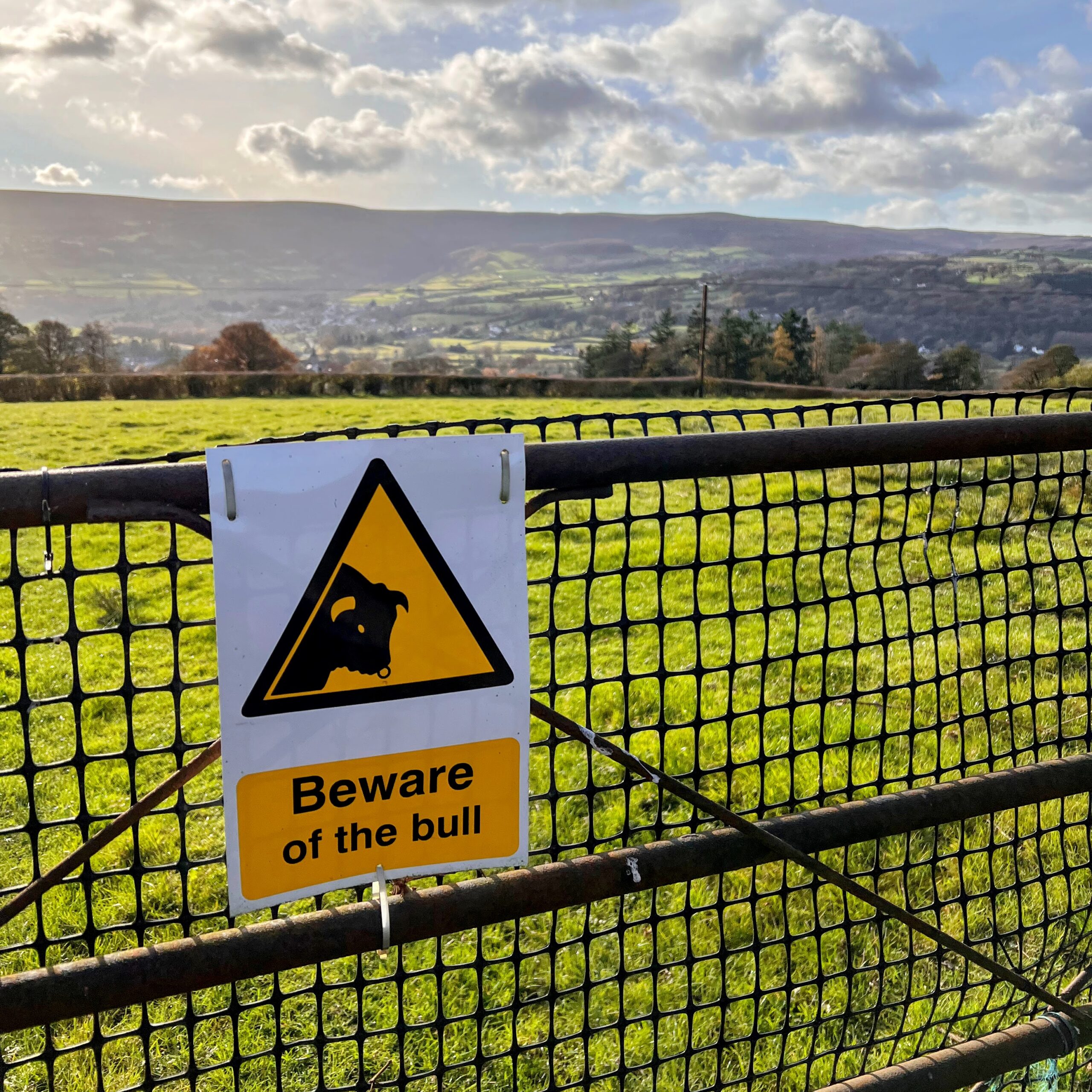
    fence gate with a sign saying Beware of The Bull
    Booking.com’s Customer Service Center?

    I walked by Shakespeare’s Globe Theatre after a weekend of wrestling with Booking.com and TravelNest‘s service agents, trying unsuccessfully to not let them screw up my London vacation rental. The Macbeth soliloquy about a tale “full of sound and fury, signifying nothing” pretty much summed up my experience — lots of talk that yielded nothing. But before that, we catch up on Hertz’s EV reversal, Sioux City, Iowa’s embrace of their SUX airport code, and a flash-in-the-pan airport delay betting app. All this and more – click here to download the podcast file, go up to the Subscribe section in the top menu bar to subscribe on your favorite site, or listen right here by clicking on the arrow on the player.

    Here is the transcript of TravelCommons podcast #198:

    Since The Last Episode

    • Intro music — Warmth by Makkina
    • Coming to you from the TravelCommons studios in Nashville, TN after an extended holiday break that had us in the UK for the back half of November — the first week in Dorset on the south coast doing a bit of muddy hiking and then knocking around London the second week. As I mentioned a few episodes back, Irene and I took BA’s direct flights between Nashville and Heathrow. Our flights were on 787’s, but apparently the route has become popular enough for BA to announce they’re upgauging it to a triple 7. Interesting given that Nashville isn’t a hub airport. Had what has become my standard flight-to-Nashville moment — helping a guy rearrange the overhead bin so he could fit his guitar in. Not sure if there are enough musicians to fill those extra seats though. Music tourists? Bachelorette parties? I dunno, but the Nashville airport will need to get their new international baggage claim hall sorted before then. When we arrived, we were told to get our luggage and then go to the immigration line — the exact opposite of every other international arrival flow I’ve ever done. There was only one Global Entry terminal and it was over by the luggage belt rather than by the immigration line. So we all queued up for it while we waited for our luggage to arrive. After a 45-minute wait (and a lot of AirTag checking), we grabbed our bags and headed over to immigration, went to the Global Entry line which seemed to act like a Clear line for TSA — we got a line cut to the next immigration agent, but still had to go through all the questions and photo taking. It was weird, inefficient, very unlike my recent arrivals at ORD and EWR. Maybe they just need more reps to work out the kinks, or bring in a more experienced manager. Whatever it is, they need to fix it before bigger jets and more people show up.
    • After that jaunt in November, we’ve pretty much stayed put, with our spare bedroom being on the receiving end of travel — our daughter Claire was here for a couple of weeks over Christmas and New Year’s, one couple who’d never been to Nashville before (amazing!) and two other couples for whom Nashville, handily enough, was 8 hours down the road on their first day driving to somewhere. You could say “Great! Chance to be a tourist in our own town!” but it’s more about being the tour guide, which, in Nashville, comes with the responsibility of having informed opinions about things like the best hot chicken joint and the best Broadway honky-tonk. Nashville’s Hot Chicken Week was a couple weeks ago, which gave me the excuse (as if I needed one) to buy the jumbo jar of Mylanta and hit every hot chicken joint to figure out the best — which for me is Red’s 615 Kitchen in the West End. I can’t say I’ve been that meticulous about my honky-tonk opinions; one can dodge only so many bachelorette parties and watch only so many cover bands. And then I’ve gotta keep finding new cool places to take our visitors the next time they pass through town. I’m telling you, this tour guide thing can be a bit exhausting.
    • Bridge Music — Funkist – cdk dub mix by cdk (c) copyright 2007 Licensed under a Creative Commons Attribution Noncommercial (3.0) license.  Ft: teru

    Following Up

    • Well… the lead topic for the last episode was “Renting a Tesla”; finally relenting to Hertz’s incessant email offers/pleas for a November. Two months later, Hertz announces they’re selling off a third of their EV fleet — 20,000 of them. Paging through hertzcarsales.com, it’s mostly Tesla Model 3s, with a few Model Ys and Chevy Bolts sprinkled in. I was a little surprised when I read it because Hertz had been hitting their fleet electrification message so hard. But now looking back on some of my observations in the last episode — the EV aisle at Logan airport full up with 10-12 Tesla Model 3’s and a couple of Polestars, the guys working there being so nonchalant about battery levels and car condition — the clues were there. But someone was driving them. Half of these EVs have 30-60,000 miles on them — which feels heavy for a fleet of 18-month-old cars, even if they’re rental cars. If nothing else, it cuts my Hertz email traffic way down.
    • Just one more thing on EVs. Also in that topic, I talked about the hassle of charging an EV. Not range anxiety — I was only driving 20 miles from Logan; but the effort to find a charger and then the time it took to charge the battery. In London, we stayed in an OK neighborhood between King’s Cross Station and Clerkenwell, typical urban streetscape of walk-up apartment buildings and cars parked bumper-to-bumper along the curb. Walking down the sidewalk the first day there, I saw a cord coming out of a parked car. Where the hell is that going? I looked down at my feet — it wasn’t running across the sidewalk into the building. No, it was plugged into the base of the street light. Pretty clever… and necessary since none of the folks living in these flats has a garage to charge in.
    • Back in November, right after I dropped the last episode in which I talked about my turboprop flight to Sioux City, IA as the “ah ha” moment justifying the price of my first pair of Bose noise-canceling headphones, the Wall Street Journal ran an article about how Sioux City, Iowa is embracing the three-letter code for their airport, SUX. And it reminded me again of that flight back in the mid-’90’s. The agent handed me the boarding pass (the age before smartphones). “SUX, Sucks? Is this a joke?” I asked. She just shrugged; I think she’d heard that before — a lot. I think the Dash 8 was the smallest prop plane United Express flew. We stopped first in Waterloo, Iowa where most everyone else got out for the big John Deere plant there. After the flight attendant buttoned the door back up, she gave the rest of us a look and then pointed us to new seats — kinda eyeballing the weight distribution; moving some of the bigger guys to seats behind the wing. The airport codes for that flight — ORD to ALO to SUX — ‘Alo to Sucks — were fun. Could’ve been better if the plane had swung through Grand Rapids — GRR — for “Grrr…, it sucks”. An itinerary starting in Fresno — FAT– would give us the non-body-positive “Fat Sucks.” Or for a much more unlikely flight — Singapore — SIN — to Sioux City for the much more righteous “Sin Sucks”. I could go on… but I won’t; it’s getting painful, even for me. Apparently, back at the turn of the century — the 21st century — Sioux City asked the FAA for a new airport code for what is officially named “Sioux Gateway Airport”. I guess they didn’t like the alternatives offered — GWU, SGV, GAY — so they kept SUX. And then people built businesses selling SUX merch — Winter SUX, Work SUX.  And probably the most apropos  — “it SUX to lose your luggage.”
    • With all the betting around the Super Bowl — the Vegas lines, every party selling squares — I circled back ‘round to something I saw in September, an app called Wingman. They call themselves a “flight delays prediction market”. Betting on flight delays — sounds like it could be fun, especially when watching the departure board at ORD or LGA. Digging past the headline, I found out it’s a Web3 blockchain dapp (decentralized application) — not sure if it could be any more buzzword-compliant — using some crypto-tokens I’ve never heard of… which maybe let’s them serve gambling laws (?); I dunno. As it is, I didn’t end up giving Wingman a spin; it required connecting a crypto-wallet to the app — which I don’t have… and probably never will. Looking at a site called DappRadar which claims to track 15,000 distributed apps, it looks like Wingman had a moment of hotness back in September after its burst of announcement publicity with 5-6-700 transactions. But in the new year, it’s had a few days with a handful — less than ten; but most days with nothing. Disappointing. I was hoping this could be a new way to fund my flight-delay bar tabs.
    • And if you have any travel stories, questions, comments, tips, rants – the voice of the traveler, send ’em along to comments@travelcommons.com — you can send a Twitter (X?) message to mpeacock, post your thoughts on the TravelCommons’ Facebook page, or on the Instagram account at travelcommons — or you can skip all that social media stuff and post your comments on the web site at TravelCommons.com.
    • Bridge Music — Jolanta Blues by Doxent Zsigmond (c) copyright 2015 Licensed under a Creative Commons Attribution (3.0) license.  Ft: Admiral Bob, Martijn de Boer

    London Vacation Rental Woes

    • Listeners who follow me on Twitter/X know that I had one of my worst short-term rental experiences during our London trip with Booking.com. And I’ll talk about what I learned from that in a moment, but it got me thinking about vacation rentals in general. For the longest time, it was a local mom-and-pop business, typically in vacation areas — ski resorts, beach towns. You called or stopped by a local realtor, or someone you knew who knew the area recommended a place, and then you rented it from the owner. Friends who rent beach houses on the East Coast tell me they’ve had the same renters for the same week in June, July, August for years. Then Airbnb started up in 2008, first as a platform to rent out spare rooms (remember couchsurfing.com?), but it pretty quickly moved home rentals out of its mom-&-pop vacation spot model into a parallel urban hotel market.
    • I’m not deep in urban planning or rental market dynamics, so I’m not getting into the pluses and minuses of short-term rentals. You can get all that and more with a simple Google search. Maybe I’m old-school (or just old), but my use of short-term rentals is pretty much the same now as it was pre-Airbnb — when it’s a bigger group and we’ll need more space to spread out than a hotel can give you. I also enjoy being able to stay in neighborhoods where there aren’t hotels, to be able to dig deeper into a city, but I also know that it can also be not great for the people who live in those neighborhoods. A couple of years back, we and another family booked into a flat in the Trastevere neighborhood in Rome. Great flat on a great street; really enjoyed the neighborhood and the time we had with our friends, being able to spend time in some place other than a restaurant or hotel bar, catching up while trying to figure out the espresso machine or the washer/dryer combo. All good. But looking across the landing to the other apartment on our floor, the sign taped to the door in Italian and Google-translated English saying “Keep it quiet”, you could tell the people living in this building weren’t having a great time. And then there’s the story our friends tell of when a condo in their building in Lincoln Park on the north side of Chicago was listed on Airbnb, and one night while at dinner, looking out their window they could see a porn movie being filmed there. Kinda put them off their meal.
    • There are loads of vacation rental horror stories, but not from me. Looking through my trip histories on Airbnb and VRBO, I’ve had a really good run — a great beach place in San Diego, a tiny house in Durango, CO, a walk up in Brooklyn’s Carroll Gardens neighborhood, a flat in Split, Croatia with a balcony where I drank my morning coffee watching the sailboats head out of the harbor…. All good, except for London. 
    • Two years ago, November 2021, we were heading over London for a couple of weeks. The morning we were leaving, maybe 5 hours before heading to the airport, we get an email from our Booking.com host — “So sorry, but a water pipe broke in the apartment, so we have to cancel your stay that starts tomorrow.” Wait, what!? Did I read that right? I read it again. Yup, I read it right; we have no place to stay when we land in London tomorrow morning. Luckily, it was just Irene and me; we didn’t need sprawl space. So I quickly pivoted from packing socks and underwear to logging onto Marriott.com to book a room before our Uber showed up, which I did, at the Montcalm East near Shoreditch. The last-minute booking was definitely more expensive, but I was confident it had a working toilet and shower — well, that and I got free breakfast with my Titanium status.
    • Fast forward to this trip, in November 2023, with our daughter joining us, we needed a vacation rental. Given our last experience, we gave ourselves a 5-month head start, booking a place in June. I found a good place in London and booked it on Airbnb. Ten days later, I get a morning email canceling our reservation, but this time from Airbnb, saying the property we booked “doesn’t appear to be legitimate.” Right after that, I get another email, from the property owner, asking me to book direct with him, sending the full payment via bank transfer. So send a couple of thousand dollars in June for a November stay to a guy I’ve never dealt with before, and for whom I couldn’t find any other information — property website, LinkedIn profile, social media presence? Felt just a bit scammy, so I took a pass. Not the last time I’d get this request.
    • Irene took over. That afternoon, she booked a flat on Booking.com. Fast forward to the beginning of November. Starting to get geared up for the trip and think maybe we should check the status of our booking. Huh — Booking.com has a new note saying our reservation now can’t be paid through them. We ping the property owner — “What gives?” We get back a blisto-gram of an email; not aimed at us, but at Booking.com. “Their fees are too high and they’re awful to work with. I told them to cancel all reservations.” Hmm, our reservation is still there, but doesn’t sound like we had a good chance of getting into the flat if we showed up. So Irene canceled it and booked a different flat.  
    • From whom, a couple of days later, we get an email asking us to cancel our Booking.com reservation and book directly with them, with full payment via bank transfer. This sounds familiar. They’re forced into this, going off-platform, they wrote, because London limits short-term rentals to 60 days a year. A quick Google search told me London’s limit is 90 days rather than 60. Not looking to dunk on these folks, but — hmm, you’d think an experienced host would get this number right. Little bit of doubt, so we took another pass on sending a stranger a couple of thousand dollars with no fraud protections.
    • So I search for another place in the same neighborhood and find one on Booking. I hit the Book button and pretty quickly get back a confirmation email from TravelNest, a vacation rental property management company. Good! No more asking me to book direct. They send me the contact info for the property owner so I can coordinate arrival logistics. I send the guy an email — it bounces. I send texts and WhatsApp messages to him — crickets. I go back to TravelNest. “Oh, don’t worry, we’ll contact him.” “With what? The same email that bounced; the same phone number that he hasn’t checked?” “Oh, don’t worry, he’ll turn up.” OK, I’ve got other things to worry about, and London was the second week of our trip, so we had time.
    • The end of our first week — we were hiking/walking down in Dorset on the south coast — I hadn’t heard anything and started to worry. I started pinging Booking and TravelNest; sending emails and calling. Nothing solved, but every time I talked to someone, it was “Don’t worry, we’ll take care of you.” I’m not going to go through every call, — maybe I’ll put all those details on a Twitter thread — but I spent 5-6 hours over 3 days on calls with these people and the problem, my problem, boiled down to this — we were past the cancelation deadline; Booking.com viewed TravelNest as their property contact, not the MIA owner; and TravelNest didn’t want to cancel the reservation and lose the revenue in hopes that the owner would show up at the last minute.
    • You know where this is going. Tuesday morning, we’re driving up to London Heathrow from Bournemouth to drop off the Hertz car and “ping” goes the Booking.com app. It’s a message from TravelNest – “I am very sorry to let you know that the owner of the property you have booked via Travelnest cannot accommodate your upcoming booking. This is due to the host having stopped advertising their property through Travelnest. And we don’t have any alternatives to offer you.” Amazing. They’re just now figuring out that the guy stopped using them. They couldn’t have checked during one of those 5-6 hours of calls a few days ago.  So after we dropped the car off, we took the shuttle bus over to Terminal 2. Irene and Claire grabbed a coffee while I got on the phone to Booking.com. “Oh, I’m so sorry, but don’t worry we’ll take care of you.” But they didn’t. They couldn’t find us a replacement property in the part of London we needed to be. So I ran the same play as two years ago, fired up Marriott.com and found us a room for the night. And then splurged for a black cab instead of the cheaper Heathrow Express so Claire and I could work our Airbnb apps to find a place for the rest of our time in London. Which we did after about the 3rd try.
    • So out of this whole shitshow, what did I learn? First, the London short-term vacation rental market just seems broken. There were so many properties on Booking.com and Airbnb that showed availability, but really weren’t. All told, it took us 6 booking attempts before we finally got one to stick. I’ve never had that happen in any other place. Second, there’s something wrong with the group that runs Booking.com’s short-term rentals. Irene uses (well, used) them a lot for hotel bookings, and we’ve never had a problem. But vacation rentals, every bad experience has been a Booking.com property. As you might guess, we won’t be using them again. Third, immediately cancel reservations where a third party like TravelNest pops up. They don’t add value to you, the traveler; they just get in the way when a problem crops up and are just another point of failure. 
    • Oh, and I guess there’s a fourth — don’t trust anyone when they say “Don’t worry, we’ll take care of you.”

    Closing

    • Closing music — Pictures of You by Evangeline
    • OK, that’s it, that’s the end of TravelCommons podcast #198
    • I hope you enjoyed it and I hope you decide to stay subscribed.
    • As always, you can find us and listen to the current episodes on all the main podcast sites — Apple Podcasts, Spotify, SoundCloud, Google Podcasts, and Amazon Music. And you can always Alexa, Siri, or Google to play TravelCommons on your smart speakers. 
    • You can click on the link in this episode’s description in your podcast app to get to the show notes page at TravelCommons.com for a transcript of the episode and links to items on the gift guide. If you’re not yet subscribed, there’s a drop down Subscribe menu at the top of TravelCommon’s home page. And along the side of the page, you’ll find links to all the TravelCommons’ socials.
    • If you have a story, thought, comment, gripe – the voice of the traveler — send ‘em along, text or audio file, to comments@travelcommons.com or to mpeacock on Twitter, write them on the TravelCommons page on Facebook or Instagram, or post them on our website at travelcommons.com.  And thanks to everyone who has taken the time to send in emails, Tweets and post comments on the website. I really appreciate it.
    • And until we talk again, safe travels; and thanks for stopping by the TravelCommons.
    • Follow me on Twitter
    • “Like” the TravelCommons Facebook page
    • Direct link to the show
  • Podcast #197 — Renting a Tesla; 2023 Traveler Gift Guide

    Podcast #197 — Renting a Tesla; 2023 Traveler Gift Guide

    road warrior renting a Tesla from a Hertz rental car lot.
    Swipe left or right to start this thing?

    It’s the sustainability episode of the TravelCommons podcast, talking about my experience renting a Tesla from Hertz and my road-tested list of Christmas gift suggestions for the frequent traveler(s) in your life. I also talk about some new TSA biometrics equipment I faced (literally) in Nashville and yet another update on the EU’s ETIAS system and the US’s Real ID. All this and more – click here to download the podcast file, go up to the Subscribe section in the top menu bar to subscribe on your favorite site, or listen right here by clicking on the arrow on the player.

    Here is the transcript of TravelCommons podcast #197:

    Since The Last Episode

    • Intro music — Warmth by Makkina
    • Coming to you from the TravelCommons studios in Nashville, TN after a pretty solid three weeks of travel — a business trip to the Boston suburbs, then down to New York to meet up with Irene and Claire for a long weekend of knocking around Brooklyn and Queens, and then, after a day of reloading suitcases and picking up the cat, driving up to Chicago for friends and family. When we got back home last Friday, I was ready to just stay put for a little bit. Which is about all it will be because we head out to the UK in less than two weeks.
    • The Boston trip came up all of a sudden and I think is only my second post-pandemic business trip — my first was down to Miami in May 2021.  Maybe I’ve timed out of my road warrior status, because everything felt a bit off. Flying BNA-BOS, my choices were JetBlue or Delta. I don’t have status on either, so I choose JetBlue because it’s the earlier flight out. No status means I also have to pay $80-100 to reserve a seat after paying $450 for a one-way ticket. I could’ve expensed it through, but the annoyance vein in my temple started to pulsate. How dare you, JetBlue! And in return for my righteous anger, I get assigned, at the gate, a middle seat in the last boarding group. I resign myself to having to gate check my carry-on. But then when boarding is called, the pre-boarding announcement is for JetBlue and American elites. Ugh! Such an amateur mistake — not keeping track of alliances and partnerships.  If I’d put my Aadvantage Platinum number into my reservation instead of my plain TrueBlue number, I probably could’ve saved myself all that righteous anger and vein throbbing. Luckily though, I always carry my physical elite cards with me, so I show my Aadvantage Platinum card to the agent, get waved on, and find an empty bin right above my seat.  I was a little concerned about fitting my big carry-on in an A220 — it was my first time on this plane — but no problem. The overhead bins on this plane are huge.
    • After my window seat neighbor got settled, I put on my Bose noise-canceling headphones, dialed up the white noise app on my iPhone, and, middle seat be damned, nodded off sitting up straight. One thing I haven’t lost while working virtually — being able to fall asleep even before my 7am flight rotates off the runway.
    • Bridge Music — funkyGarden by Jeris (c) copyright 2020 Licensed under a Creative Commons Noncommercial Sampling Plus license. http://dig.ccmixter.org/files/VJ_Memes/61356 Ft: airtone, SackJo22, Analog By Nature

    Following Up

    • It wouldn’t be a proper Following Up section without yet another update on the US’s Real ID or the EU’s ETIAS rolling delays. Let’s do ETIAS, the EU’s pre-travel authorization system that gobs of click-bait websites have mislabeled a “European Visa.” The EU has tweaked their go-live date again — from last month’s May 2025 to a less definite/more nebulous “mid-2025” — which could be May or June or July. But I’m not sure why anyone in their right mind would want to flip the switch on this in the summer, during Europe’s peak tourist season. I’m taking the over on this; I don’t see it going live any earlier than October 2025. 
    • The US, on the other hand, seems to be sticking to their May 2025 date — for now. Remember, the initial deadline for needing a Real ID to board a commercial flight was January 2018 — which then got kicked to October 2020. But then COVID hit and in April 2020, soon after just about every government building was emptied out and locked up, the bright sparks at Dept of Homeland Security decided that driving crowds of people toward closed DMVs to replace their old driver’s licenses wouldn’t be great and pushed the deadline a year to October 2021. Which, we’ll all remember, wasn’t that much better — at least with regards to DMV accessibility. I remember lining up outside, in December 2021, in Chicago at a DMV to renew my driver’s license. And so another push, 19 months to May 2023. And then last December, they pushed it another 2 years to May 2025 because — who knows. So the US has got nothing to say to the EU. But on my flights a couple of weeks ago, I started seeing new signage “RealID coming in May 2025”; even the Delta app, when I checked in for my BOS-LGA flight, had a banner about it. Huh? I mean, why wind everyone up about a deadline that’s 18 months away and, if the kabuki theater of the last 5 years is any guide, will get pushed again. 
    • Now where DHS is moving much faster is rolling out biometrics to airport and customs checkpoints. Over the years here on TravelCommons, I have talked about my experiences with biometrics usage — starting with my first fingerprint scan back in the late ‘90’s so I could skip the US customs line at Toronto-Pearson Airport, then in 2008 letting the first iteration of CLEAR scan my eyeballs in exchange for a shortcut to the front of the TSA line, then in 2011 a background check and another fingerprint scan for Global Entry so I could skip all the US customs lines — so yes, I’ll do damn close to anything to skip an airport line. But over the past couple of years, it feels like DHS has been turning it up a notch. October 2021, our first international flight in a couple of years, on AirFrance, the gate agent took our picture when boarding and didn’t need to see our boarding pass. Last April, returning from the Netherlands, the Global Entry kiosk no longer needed to scan my fingerprints; a quick side glance at the camera was enough to recognize me and let me through. And now, a couple of weeks ago, at the BNA PreCheck line, a big sign “Identity Verification Technology. Biometrics technology is available at this checkpoint. Your participation is optional.” This is new; it wasn’t there 2 months ago when we flew out to Maine. I give my driver’s license to the TSA guy standing next to something like a camera on a stick; it looks a bit like the electronic customs gates at LHR. He puts my ID in the machine, tells me to look at the camera, then looks at the screen and waves me through. A couple of things here — I’m not sure how this is different from the TSA guy looking at my face and comparing it to the picture on my license; and I didn’t see any way that my participation was optional. And I certainly didn’t get to skip any lines for the biometric giveaway. I’ve been trying since April to get someone from TSA or DHS on the podcast to talk about this biometrics push and have gotten nothing but repeated “I’ll get back to you soon” from the TSA press secretary. Now maybe this new equipment gets us to the automated checkpoints I’ve been through in some smaller European airports — which could shorten the security lines — but I had to dig pretty deep into a bunch of jargon-y PDF documents on the TSA website to get even a hint of any benefits to the regular traveler. I dunno, maybe all the benefits are waiting on Real ID. Once everyone has that little gold star on their license, it’s clear sailing.
    • And if you have any travel stories, questions, comments, tips, rants – the voice of the traveler, send ’em along to comments@travelcommons.com — you can send a Twitter (X?) message to mpeacock, post your thoughts on the TravelCommons’ Facebook page, or on the Instagram account at travelcommons — or you can skip all that social media stuff and post your comments on the web site at TravelCommons.com.
    • Bridge Music — Xena’s Kiss / Medea’s Kiss by mwic (c) copyright 2018 Licensed under a Creative Commons Attribution (3.0) license. http://dig.ccmixter.org/files/mwic/58883

    Renting a Tesla

    • After 2, 3? episodes of nattering on about electric vehicles, I decided to take up Hertz on their incessant email offers and rented a Tesla for my Boston business trip — giving EVs a try, but on someone else’s dime. The client site was only 18 miles from BOS and Google Maps told me there was a Tesla Supercharger nearby, so range risk wouldn’t be an issue. A couple of days before my flight, Hertz sent me an email which was pretty much a crash course on operating a Tesla, pictures, text, links to YouTube videos. I was both impressed and slightly overwhelmed, but I grabbed a beer out of the fridge — a 16 oz, this was going to take a bit — and ground through all the email links — which, I think, saved me time trying to figure things out in the Hertz lot. 
    • Over the past couple of years, we’ve talked about barren Hertz lots; renters queueing up for cars to appear. So when the Hertz employee pointed me to an EV aisle full up with 10-12 Tesla Model 3’s and a couple of Polestars it took me a moment to process all my options. My usual strategy, when I have a choice, is to run through the cars on the aisle and pick the one with the lowest mileage. But I wasn’t quite sure if that worked with a Tesla, and if it did, I didn’t recall from my crash course where to find the odometer. So, I chose a black Model 3 that had the least beat-up wheel rims — trying to minimize any damage arguments at return time.
    • After I got in, powered it up, and got acclimated to the massive tablet screen in the center console, I saw that the battery level was at 69%. One of the crash course’s tutorials said it’d be at 100% and I’d be charged if I returned it under 80%. I snapped a picture of the battery display and told the guy at the exit gate. He shrugged and told me to bring it back at the same level. He didn’t seem very concerned.
    • Coming out of the lot, the Tesla drove fine. After a couple of days, the battery had dropped into the mid-40s, so I decided to try out the Tesla Supercharger network. Tesla’s nav app directed me to a nearby shopping center. The chargers were in the farthest back corner of the Target parking lot. I backed in — looking at the other Teslas, it seemed the thing to do — plugged in the charger, and was a little shocked to see that it would take an hour to get me charged up to 100%. Now Irene would have no problem with this — an excuse to spend an hour shopping in Target? Bring it on. Me, not so much. Luckily, there was a Chipotle across the street, so I locked the car and walked over to grab lunch. When I got back, the car still had another 5 minutes before it got to 100%. I’m glad I didn’t wait ‘til it got down to 20%.
    • Though maybe I should’ve waited, because by my last day, I’d driven off a chunk of that 100% charge and, heading back to BOS, I wasn’t completely confident that I’d arrive with the battery at the 69% level I’d picked it up at. And I guess that’s a place where an EV rental requires a bit more logistical planning. A regular gas car — there’s loads of places I could hit to quickly splash in a couple of last-minute gallons to keep the fuel gauge on Full. An EV? The Tesla nav app vectored me way off my usual I-90/I-93 tunnel routes to BOS, taking me way east, past some marshes just off the bay, to the back corner of another Target parking lot where I backed in amid a half-dozen other Teslas, their drivers all sitting there, working their phones, waiting for their cars to charge. I waited 10 minutes, splashed in enough electricity to get the battery gauge to 75%, and lit out. But I probably didn’t need to worry. Turning the car in, I told the Hertz guy I was under 80% charge because I got the car at 69%. No problem, he said. He didn’t seem very concerned. Honestly, I’ve never seen Hertz guys so nonchalant about their cars; especially after Hertz said in their last earnings call that EV repair costs are about double what they pay for gas-powered cars.
    • On the shuttle bus to the terminal, I opened the email receipt and saw that the $15 charge from my first Supercharger visit had made it onto my invoice. A couple of things crossed my mind — definitely less than what I would’ve spent filling up a gas car, and I was impressed by the quick turnaround time because the toll charge I incurred two days before that, when leaving Logan through one of the tunnels, still hasn’t shown up and so is going to raise some eyebrows in A/P when I eventually try to expense it through. So all told, pretty good experience; kudos to Hertz. And now they’re trying to get me to rent a Polestar at LHR in a couple of weeks for our drive through the Devon countryside. Ehh, I don’t think I’ll push my luck.
    • Bridge Music — i knew by bridges (c) copyright 2008 Licensed under a Creative Commons Attribution Noncommercial (3.0) license. Ft: shannonsongs

    2023 Traveler’s Gift Guide

    • Every couple of years around this time I update my gift guide to give folks suggestions for the frequent traveler in their lives. Or, if you are the frequent traveler, a list of hints you might want to drop on family members looking for ideas. The first time I did a gift guide, I published Thanksgiving week so people would have it for the Black Friday sales. But now with the Christmas shopping season having blown past that traditional Thanksgiving Friday start and with radio stations barely able to wait for the kids to finish counting their Halloween candy haul before flipping the switch on their All-Christmas-Music format, I’ve dragged the publishing date up to the front of November. The 2020 gift guide was probably the most unique. All the restaurant lockdowns and indoor dining limits had us eating in our hotel rooms which put bring-your-own dining sets and in-room coffee brewing kits onto the gift list. The disappearance of airport and in-flight mask mandates means that #1 gift on that year’s list — comfortable masks — has also dropped off.
    • What hasn’t dropped off and is regularly at the top of my list is Battery Packs.  We’ve talked a lot about how we can’t easily travel anymore without a working mobile phone. It holds our boarding passes, gives us gate change and flight delay notifications, unlocks our car (if we’ve rented a Tesla), routes us around traffic jams, and connects us to our Airbnb hosts. So having that second or third charge immediately available is critical to making it through a long travel day. I carry a Zendure SuperMini power bank in my bag because its USB-C port quickly tops up my iPhone while the USB-A port takes care of my Samsung tablet. I’ve updated Irene’s lipstick charger to an Anker with a flip-out Lighting connector so she doesn’t have to fish around in her purse for a cable. But there are a lot of choices; just pick one.. or two. 
    • Noise Canceling Headphones are also a perennial on my gift lists. I’ve been carrying Bose headphones for at least 15 years. Back then, the QC-3’s were de rigueur for any self-respecting road warrior. The “ah ha” moment for me was on a United Express Dash 8 turboprop flying to Sioux City, IA with an intermediate stop in Waterloo, IA. I was in a window seat on the wing and the droning of the prop just encased me; I couldn’t think of anything else — until I flicked the switch on my Bose. I’m now on my 3rd pair, the Bose 700’s. They’re not compact but they continue to earn their space in my travel bag. I picked up a pair of Apple AirPod Pros on a good Prime Day sale last month and so was able to compare the Bose and AirPod noise canceling on my Boston and New York flights. The AirPods are good, but not as good as the Bose. And the battery doesn’t last as long, which makes sense given the size differential. For me, the AirPod Pros are good for a 2-2.5-hr flight, but for, say, my upcoming UK trip, I’ll be packing the Bose.
    • Apple AirTags earned a place on the list last October when I could see, sitting on the plane, that our bags weren’t going to make the connection in Newark on our way home from Rome. This didn’t get our bag to us, but it did save us the 30 minutes of suspense waiting for them to come out on the carousel, and let us instead go straight to the baggage service agent, be the first in line to file our report, and then head home after a very long travel day. They were definitely worth the purchase price just for that.
    • For someone making the transition from virtual work to physical world road warrior, how ‘bout a Black 20-inch Carry-On Bag. Black not only makes you look thinner, it makes your bag look thinner to gate agents hunting for bag-sizer bait. My daughter had a baby blue roller bag for the longest time. She loved that color, and it was easy to spot on the luggage carousel, which was a good thing because it ended up there a lot because gate agents were always pulling her out of line to gate check that bag. So get a nondescript black bag with a set of clever, neon-colored luggage tags as a stocking stuffer. If you’re flying a budget airline that’s a stickler on size, get a hard-shell bag. It’ll keep its dimensions better when overstuffed, and the polycarbonate shell will slide past the metal bars of the sizer easier than the ballistic nylon of a soft-sided bag. You could range up in size to a 22-incher, but a 20-incher should safely fit in the overhead of just about every plane. I’m a big fan of the TravelPro line; for me they strike the right balance between price and quality. But there are lots — maybe way too many — options out there for you to choose from.
    • Here’s a new list entrant — a Travel Power Strip. Potentially one of the least sexy things I could put on a gift list, but I’ve always tried to populate these with the things I actually use — and find myself needing the most when I’m on the road. And you think after, I dunno, 20 years of travelers needing to charge a bunch of electronics — PCs, mobile phones, tablets — hotels, B&B’s, resorts would put outlets that work on the top of flat surfaces like nightstands, end tables, desks, …. But I’d say that on half of my trips this year, I had to move furniture or get down on my hands and knees to find a single outlet. So you can get one of those cube-shaped travel adapters that show up on most travel gift guides, and still have to crawl under furniture every time you need to plug something new in. And that’s why I recommend a compact power strip — you move the nightstand once to reach down and plug it in, and then set the other end — the end with the outlets, the end you’ll regularly need easy access to — on top of the nightstand. Any power strip you buy nowadays will have some mix of USB and regular AC outlets. Anker has a seemingly infinite range of them. But if Anker is a little boring for you, way back in episode #159 in January 2020, long-time listener Arnoud Heijnis gave high marks to a circular power strip called the Power Bagel. Three years on, MOGICS, the manufacturer, now sells an updated version called the Super Bagel. Of course! With a lot of positive reviews confirming Arnoud’s view that the circle, the bagel shape, let you use every outlet, even when using those big wall wart power supplies
    • So there you go, 5 gift ideas to fit all budgets, and with more than enough time to beat any early on-line shipping deadline. Check out the show notes for links, and happy shopping!
    • Note: None of these suggestions are paid endorsements. This post contains links to Amazon where I can earn a small commission from qualifying purchases.

    Closing

    • Closing music — Pictures of You by Evangeline
    • OK, that’s it, that’s the end of TravelCommons podcast #197
    • I hope you enjoyed it and I hope you decide to stay subscribed.
    • As always, you can find us and listen to the current episodes on all the main podcast sites — Apple Podcasts, Spotify, SoundCloud, Google Podcasts, and Amazon Music. And you can always Alexa, Siri, or Google to play TravelCommons on your smart speakers. 
    • You can click on the link in this episode’s description in your podcast app to get to the show notes page at TravelCommons.com for a transcript of the episode and links to items on the gift guide. If you’re not yet subscribed, there’s a drop down Subscribe menu at the top of TravelCommon’s home page. And along the side of the page, you’ll find links to all the TravelCommons’ socials.
    • If you have a story, thought, comment, gripe – the voice of the traveler — send ‘em along, text or audio file, to comments@travelcommons.com or to mpeacock on Twitter, write them on the TravelCommons page on Facebook or Instagram, or post them on our website at travelcommons.com.  And thanks to everyone who has taken the time to send in emails, Tweets and post comments on the website. I really appreciate it.
    • And until we talk again, safe travels; and thanks for stopping by the TravelCommons.
    • Follow me on Twitter
    • “Like” the TravelCommons Facebook page
    • Direct link to the show
  • Podcast #196 — Cheers to Beer Tourism and Travel!

    Podcast #196 — Cheers to Beer Tourism and Travel!

    robot in a microbrewery taproom drinking a beer
    What Prompt Will Get Me a Pilsner?

    In this beer-focused episode, John Holl, editor of All About Beer, gives us his take on beer tourism and tips on how to beer travels. I talk about my experience planning my Asheville, NC taproom visits with ChatGPT. We also dive deep into the new JD Power Airport Satisfaction Survey and do a quick update about the EU’s delayed ETIAS system. All this and more – click here to download the podcast file, go up to the Subscribe section in the top menu bar to subscribe on your favorite site, or listen right here by clicking on the arrow on the player.

    Here is the transcript of TravelCommons podcast #196:

    Since The Last Episode

    • Intro music — Warmth by Makkina
    • Coming to you from the TravelCommons studios in Nashville, TN after trips to Portland, ME and Asheville, NC. We flew up to Portland International Jetport; I love that — jetport — it’s like a throwback to the ‘50’s and ‘60’s when jet airplanes weren’t assumed. Going down that clickhole, apparently Orlando International was originally called Orlando Jetport. Feels like they shouldn’t have changed; would’ve had a very EPCOT-y vibe. But anyhow, I think Portland Jetport missed a trick by not playing Steve Miller’s Jet Airliner on a continuous loop in baggage claim. But they do have a big stuffed moose there, which is probably more on-brand.
    • More… interesting were the 7-foot signs we passed walking up to the TSA lines for our flight back. I posted a picture on Twitter. The one to the left said “Are you packing? Guns of any kind are not permitted in carry-on bags”. The one on the right, “Have you checked your firearms?” The small one in between reminded people to dump their oversized liquids. I mean, Really!? We’re now 22 years on from the Sept 11th attacks and people still can’t figure this out; that you can’t take a gun on a plane — nor a sword, nor a knife. Long-time listeners will know that I am in no way an apologist for the TSA, but when I see pictures they post of some of the stuff people try to bring on — a hatchet at O’Hare, throwing knives at Milwaukee — I’m not sure how patient I’d be if I had to deal with that level of obliviousness day-in and day-out.
    • On the upside, though, I did see that the TSA would allow me to carry-on a live lobster if I wanted to take a bit of Maine back home with me. According to the TSA website “A live lobster is allowed through security and must be transported in a clear, plastic, spill proof container. A TSA officer will visually inspect your lobster at the checkpoint.” I wonder if that visual inspection includes checking that the rubber bands around the lobster claws are intact. I’d think a traveler wielding “un-holstered” lobster claws might not be armed, but certainly could be dangerous.
    • Bridge Music — Hula Hoop Party by Stefan Kartenberg (c) copyright 2016 Licensed under a Creative Commons Attribution Noncommercial (3.0) license.  Ft: Martijn de Boer, Blue Wave Theory

    Following Up

    • I would’ve loved to play 15 seconds of Jet Airliner just now for the bridge music if I wasn’t about 99% positive I’d get slapped with some copyright fine.
    • Thelma Smith stopped by the TravelCommons Facebook page to leave a comment about last episode’s discussion of renting a Hertz EV for my Portland trip, which I backed away from as I looked at charging options in the city and up in Bar Harbor. Thelma wrote
      •  Wanted to chime in on EVs. We have a Tesla Model 3. When planning out a trip of any length we use PlugShare. It helps in finding all sorts of chargers and not just Tesla fast chargers. Might help in seeing what’s out there.
      • Thelma, thanks for that. First I’ve heard of it; looks like a nice crowdsourced status map for chargers. If Hertz had referenced it, it might’ve tipped me to an EV. While it didn’t show many more Bar Harbor options, it showed a lot more chargers in Portland. Hertz continues to send me EV offers, so with this, maybe I give it a go on my next trip.
    • JD Power released their 2023 North American Airport Satisfaction Survey last week. We talked in the last episode that, according to TSA counts, we’ve gotten back to pre-COVID passenger volumes. And so it kinda makes sense then to compare JD Power’s 2023 numbers to their pre-COVID 2019 scores. And, conveniently enough, in episode #156, we talked to the survey’s author, Michael Taylor, after the release of the 2019 survey. Back then, Michael predicted:
      • Michael: Everybody’s phasing in and out of construction. They’ve got all these various plans that are revolving on the inside and the outside of the airport. And so we’re going to see this churn in the rankings quite a bit in the next few years as these projects phase in and out.
    • Well, yes and no. The top of the Mega category was pretty stable — Detroit, Minneapolis/St Paul, and Las Vegas kept their top 3 positions. But there was a bit of churn under that. San Francisco jumped 7 spots from 13th to 6th, in large part, no doubt to their huge renovations while Orlando dropped 5 spots, from 4th to 9th, and Phoenix dropped 6, from 7th to 13th; neither of which surprised me given my most recent experiences at each.
    • The benefits of finally finishing big renovations really showed up in the next category, the Large Airports. LaGuardia and New Orleans, airports that I’ve spent way too much time in, finished multi-billion dollar renovations between the 2019 and 2023 survey and the results showed. LaGuardia jumped 13 places from 27th, the last spot on the 2019 survey to 14th, which given all the inherent problems with LaGuardia’s location and the mess that is the tri-state air traffic control, I’m not sure they could’ve gotten much better. New Orleans, though, went from not much better 23rd spot in 2019 to 8th, a 15-place move. Portland, Oregon, 2019’s top Large airport plummeted 11 spots to 12th, while San Diego and Oakland each dropped 10 spots, to 23rd and 24th respectively.
    • More interesting than this, to me, was the increase in the average scores in what has been a difficult year for air travel — on a thousand-point scale, the Mega average increased 16 points, from 756 to 772, while the Large average grew 24 points, from 765 to 789. So if an airport didn’t improve its score, like Orlando or Oakland, its ranking tumbled.
    • In the last episode, I talked about the rolling delays for implementation of ETIAS, the EU’s impending version of the US’s ESTA, a pre-travel authorization system. What originally was supposed to go-live in 2021 got pushed to May 2023, which given COVID made sense, when then slipped 6 months to November 2023. Well, OK, maybe a little more testing is for the best. But then, to a more nebulous “sometime in 2024.” That’s never a good sign. And now, a month later, they’re saying May 2025. It feels like this is becoming the EU’s Real ID. Really! Because the new US Real ID deadline is also May 2025 — until they change it again.
    • And if you have any travel stories, questions, comments, tips, rants – the voice of the traveler, send ’em along to comments@travelcommons.com — you can send a Twitter (X?) message to mpeacock, post your thoughts on the TravelCommons’ Facebook page like Thelma did, or on the Instagram account at travelcommons — or you can skip all that social media stuff and post your comments on the web site at TravelCommons.com.
    • Bridge Music — Fistful of Dub (Feat. Snowflake and DJ Vadim) by spinningmerkaba (c) copyright 2016 Licensed under a Creative Commons Attribution Noncommercial (3.0) license.  Ft: snowflake and DJ Vadim

    Beer Tourism and Travel

    • Scrolling through the Episodes section of the TravelCommons website, I saw that it’s been over a year since I’ve done any beer content, and immediately began working on rectifying it. I asked John Holl, long-time beer journalist, editor of All About Beer, host of the Drink Beer, Think Beer podcast, to give us his thoughts about Beer Tourism…
      • Mark: John, thanks for coming on the podcast. We want to talk about beer tourism and travel. I’m an old guy and for the longest time the idea of beer tourism seemed to start and end with renting lederhosen and heading to Munich for Oktoberfest. And then, in the early/mid-00’s, we got specialty beer releases that morphed into festivals like 3 Floyds’ Dark Lord Day. I was living in Chicago at the time and that went from a couple hundred people queuing for a bottle release to, in 2019, 13,000-15,000 people traveling around the country to see it.
      • John: Gave people a lot of excuses to cross that Indiana border.
      • Mark: I’ve been to Munster Indiana and there’s not a lot of other reason to go there other than 3 Floyds. And then they shut the brew pub down during COVID and now there’s absolutely no reason to go there. And now, every town/region/state seems to have some sort of a beer trail. Last month, in August, I was in Portland Maine and it was the Maine Beer Trail. And then I was in Asheville, North Carolina at Asheville Ale Trail as well as their brewing district. It seems to be an area that’s really grown. What are your thoughts on that? How significant is beer tourism for local economies now?
      • John: I think it depends on the location. Where there’s a concentration of breweries, it makes sense to have a beer trail. It makes sense for a guild or an organization to get together to try to convince not only the tourists but the locals to come out as well. There’s 10,000 breweries thereabouts, maybe a little less, in the US these days and a lot of them are concentrated together. There’s strength in numbers and hopefully they’re all doing something that is diverse enough that can get folks to go from one place to the next, to the next without getting Hazy IPA fatigue. And I think Portland Maine is a great example of the breweries that are there. You have some of the old stalwarts, Geary’s and Allagash. And some of the older, newer ones like Bissel Brothers. And then, there’s some really cool ones like Belleflower that are there. So you get breweries of different sizes, of different scopes and I think it’s important for the bottom line of these places so long as they’re delivering good quality beer. But what’s cool for me is being a tourist in a new city. I get to go to different areas. I get to go see a place that is not just the picturesque downtown, it’s not just what’s on the postcards for sale at the local travel kiosk. So you get to go into neighborhoods where people live and work. And for me, that’s always a better sense of getting to know a city, of getting to know people, of getting to know a place because neighborhoods can change, especially some place like Chicago, from block to block. You’re walking into neighborhoods that have different vibes, that have different histories to them, and that feel different. And so when I’m traveling for beer, it’s fun for me to not only go and set up at a tap room and spend some time there, but also to walk the neighborhoods as well. And I think that location informs a lot of what beer makers do. I’ll keep going back to Dovetail; I’ve spent more time there than I’ll actually admit, and it’s right up against the Brown Line and they use that to their advantage. They talk about their coolship; they talk about how their windows open up to the brown line and that the beer is inoculated with whatever the transit line brings them. And I think that’s a fun thing. You’re not necessarily tasting a sense of place, but you get the idea that it might be there.
      • Mark: God only knows I’ve written the Brown Line enough times. So maybe I’ve helped Dovetail inoculate some of their coolship beers.
      • John: And go to the Pacific Northwest at this time of year, in mid-September/late October when in Yakima and in parts of Oregon, they are harvesting the hops right now. You can bounce from brewery to brewery and the air is aromatic with fresh hops. The brewers are making fresh and wet hot beers. People are coming in from around the country, from around the world. There’s an excitement and an energy that exists because of the agricultural product that is going into these beers and because of the harvest window as well. So, it doesn’t always have to be a festival; it can be for a harvest season. And I think that that’s another cool way that folks who aren’t even in the beer industry can experience a different aspect of their pints.
      • Mark: What’s the best way to find out what’s going on in a location? How do you think about where you’re gonna go?
      • John: I like not having firm plans when I’m traveling because the other thing about beer tourism — we’re talking about beer trails — is you start at one place and you say, “OK, we got five places on our list today.” So we say you’re just having a pint at each. It’s still five pints at the end of the day and even for a serious drinker like me, that’s a lot. But if you’re having a good time, I think it’s great to not have structure because if you say, “OK, we’re at stop number two and, and we have three more stops in front of us,” but we’re really liking this, and they have this other beer that I want to try, and we’re comfortable, and we’re in good seats, and the food truck is awesome and all that — just stay there, live in that moment. I feel I’ve seen too many people get caught up in this sort of ticking culture where we have to hit all of these spots for whatever sort of weird list and you miss out on the fun experiences. Beer is about camaraderie. It’s about being in the place. It’s about experiencing flavor. And if you’re rushing through it, it’s not that much fun. I think beer in the way that it’s grown over the last couple of decades — it’s not doing super-well volume-wise or sales-wise comparatively; it’s like 12-13% of the overall marketplace — but I think it has helped people appreciate flavors better. And to be a little bit more curious and to be a little bit more experimental.
      • Mark: I think there’s also a learning component too that I think you brought up, which is, you’re going to push yourself outside your normal boundaries, outside of what I’ve called a travel bubble…
      • John: That’s the cool thing about travel, right? You talk to folks all the time about when they go to a new place and they want to have the local drink or they want to have the local food because they want to immerse themselves in that culture. You can do that with beer no matter where you go. So much of what brewers are doing these days too. When you travel, if you only drink American Light Lager, or you only drink Irish Stout. So you only drink something, you know, particular. If you’re traveling, you might try the göse, you might try a lambic, you might try a barley wine or something like that because you’re feeling a little bit more loose and unencumbered from the constraints of your daily life. And that, for me, is sort of the fun thing about beer. Usually it’ll taste better from that place because you’re surrounded by the people who made it, and the people who also were excited to be there. It’s like folks who go on vacation to a tropical island and they’re drinking mai tais, and it’s the best mai tai they’ve ever had. They learn how to make the mai tai, and they come home and they do it on their back patio and they think “This doesn’t taste as good.” And it’s because you’ve lost that sense of place. And so for me, I’m always just trying to experience not just what’s in my glass, but what’s around me as well.
      • Mark: John, I appreciate you coming on and talking to us about beer tourism and beer travel. It’s something we’ve talked a lot about on this podcast only just because I really like beer. It’s been great talking to you. Thanks very much, John Hall, editor of All About Beer. Both your podcast and your website — check it out. Thank you very much.
      • John: Mark, thank you.
    • And, as always, check out the show notes on the TravelCommons podcast for links to read and listen to John.
    • Bridge Music — Misunderstood by 3lb3r3th (c) copyright 2013 Licensed under a Creative Commons Attribution Noncommercial (3.0) license.  Ft: Alchemistry

    How To Plan a Beer Trip and Beer Tourism?

    • If John Holl has you thinking about beer tourism, the next logical question — how do you plan it? Here’s John’s approach…
      • John: I plan out travel, especially for specific events like hop harvest or Oktoberfest, which I’m going to for the first time this year. I plan that out at least a year in advance because I want to make sure that when I can get hotels and transportation, and to budget out all of that. Social media is terrible in a lot of ways, but it can also be helpful in certain ways, getting you excited about traveling to new places. When I hear about annual beer festivals in Belgium or see folks who are out at hop harvest, picking hops, it gets me in a certain sort of way, if I’m sitting at my desk at home. saying “Gosh, I wish I was there.”  So then I put stuff on the calendar and start to say, “OK, well, think about this” and then go from there. When I’m traveling to a city for work, I’m usually going to visit specific breweries or specific people. But nine times out of 10, I will also call friends of mine and say, “Where are you drinking these days?” or “What’s exciting you these days?” There’s always going to be the one place that the serious beer nerd should go to,  but then you peel that onion back just a little bit and all of a sudden, it’s “Well, you know, I actually had a really fun experience at such and such place” or “I had this one beer” or “They’re doing some cool stuff” and I start to say, “All right… Well, I trust them, so what do I have to lose?” It’s either gonna be a great pint or it’s not…
    • So there you go, advanced planning for the big stuff and have beer nerd friends in every city who can point you to the out-of-the-way nuggets. The latter is probably a bit easier for John, a well-known beer journalist, than for the rest of us.
    • Back in episode #174, I talked about this with Rob Cheshire, a long time TravelCommons listener and, for the last 3+ years, a UK craft beer podcaster with his This Week in Craft Beer podcast
      • Mark: How do you plan your taproom visits?
      • Rob: It’s all driven through Google for me. I might have some idea based on previous reading about some big-name places that I want to visit in a particular city. But beyond that, I’m just going to Google. First of all, I’ll plot a Google map for the city. I’ll end up with 50-60, maybe even 100 pins on the map. Pretty quickly, I’ll go to Untappd and look at the average brewery rating. And this really makes brewers cross how much I rely on Untappd for this type of thing because I had this conversation a load of times on the podcast with them. But I do rely on brewery ratings on Untappd, and I find it very reliable. Quite frankly, if a brewery has an average rating of anything close to 4, then, obviously it’s a massive generalization to say whatever they brew, but most of their beers are gonna be great. If the brewery rating is anywhere close to 3.5, it’s going to be very mediocre at best. And somewhere in between is where most people land. So 3.6, eh…;  3.8, it’s a good brewery; 3.9 is a terrific brewery; 4 is a great brewery. And so I’m looking for those 3.8 and 3.9 average brewery ratings. But what I’m looking for, really, is that district where I can walk from one to another and really make an afternoon of it.
    • Me? I kinda mash the two up. Like Rob, I’m a pretty solid Untappd user. Rob often says it’s his “beer diary” and that’s pretty much what it is for me too. When people ask me for recommendations for a city — Budapest was the most recent ask — I can quickly pop open the app and give people a list. And when I’m in a new city trying to find a good place for a beer, I’ll open it up and look at the Nearby Activity tab to see where (and what) folks are drinking. And back to episode #194’s discussion of flâneuring, or “roaming entropy” as I like to call it, some of my best “wanders” had, as their eventual end-point, a bar or taproom that I found that way.
    • But, as John says, if you let your friends know you’re deep into beer, they’ll be looking out for you. Visiting Savannah, GA back in May, our friends couldn’t wait to take me downtown to Two Tides Brewing, a microbrewery in a 100-year-old house with great beers but no door onto the balcony because of a “door tax” way back when, where houses were taxed on the number of doors they had. So we ducked down and walked through a big window with our glasses… multiple times. Great beer and a history lesson; not sure I would’ve found that without a little help. Coming up in a couple of weeks, we’re heading back to New York City and our daughter already has an ambitious list for us.
    • Rob Cheshire and I have traded beer touring tips for our home towns. Rob took me to his favorite places in the railway arches of London’s Bermondsey Beer Mile. But when Rob hit Chicago three weeks after we’d moved to Nashville, I couldn’t reciprocate the personal tour, and so instead emailed him the couple of taproom circuits I would’ve taken him on if he’d showed up a month sooner. And actually, for all of you — my friends and listeners — since I can’t email it to you, I’ll put my Chicago taproom circuits in this episode’s show notes on travelcommons.com. Or check out my list of  “Yeah, I’d like to go back there” taprooms in the episode #187 show notes. Maybe these can help you with your beer tourism planning. 
    • The two tent poles for our Asheville trip were hiking and beer tourism. But we were the Asheville pioneers among our friend group, so I didn’t have anyone to build taproom circuits for me. So I started down Rob’s path, firing up Google Maps and Untappd, but then… wait a minute. Let’s see what AI can do. So I fired up ChatGPT and typed in “Develop a taproom circuit of microbrewery taprooms in Asheville, NC starting at the Aloft Hotel in Asheville and optimized to minimize walking distance and maximize Untappd ratings. Present it in a table with the brewery name in the first column, the distance from the previous taproom in the second column, the Untappd rating in the third column, and the type of beers served in the fourth column.” The response started with a caveat that it can’t access real-time data and so the Untappd ratings and distances are based on its last update in 2022. After that throat-clearing, ChatGPT spit out a table with 8 taprooms. Eyeballing the list, the names didn’t seem too out of whack, so then I checked the Untappd ratings. None of them were right, and indeed, so far out of whack (all on the high side) that eight months of additional check-in couldn’t have moved the ratings that much. Chalk that up to GPT hallucination, or being a people pleaser and not wanting to say “I don’t know”. Then I plotted the circuit on a map, and it wasn’t — a circuit, that is. It was a bit more of a random walk, doubling back a couple of times. And, rather than working us back to the Aloft, it ended at the farthest away brewery. So with no friend recommendations and not much help from ChatGPT, I fell back to my old ways —  flâneuring. I figured with the beer density in Asheville, a random walk was more likely than not to land me in front of a beer tap. Which pretty much proved to be the case. We did what long-time listener Aaron Woodin called it in the last episode a “walk and gawk”, or maybe  a “walk and gulp.”

    My Chicago Taproom Circuits

    • Here are the two Chicago taproom circuits I built for Rob Cheshire in the summer of 2022
    • Logan Square/Palmer Circuit — a kinda triangular circuit through 3-4 taprooms in Chicago’s “Hipster Ground Zero” neighborhood with some good food options along the way.
      • Take the Blue Line toward O’Hare to the California St stop. Walk east on Adams to Monroe and then north a half-block. It’s a $2.50 fare; like the Tube, you can tap on with a contactless credit card. It’s way cheaper than an Uber and lets you bypass a load of traffic. Follow Google Maps walking directions; you’re basically walking south on California (or one of the less-crowded neighborhood streets running parallel) down to Armitage and then west to…
      • Solemn Oath Still Life — This is kinda cheating. This is the Chicago outpost of one of my favorite suburban breweries. They have a good range of styles. They recently started up a second label, Hidden Hand, that goes deep into hazies. When you’re done, walk out the door, turn right on Armitage (going back east), cross the street at some point, and end up at
      • Middle Brow Beer — The vibe here is a bit of a crunchy granola with Democratic Socialist/Labour Momentum sprinkles (or hundreds-and-thousands if you will), but they do some interesting wild beers fermented from yeast cultured from their garden. Good for one, maybe two beers.
      • Food -if you’re getting peckish, there are some good options on Armitage on the way to the next stop.
        • Middle Brow – While you’re there, their bread and pizzas are great.
        • 90 Miles Cuban Cafe – Very good Cuban food
        • Redhot Ranch – Chicago street food; I get either a polish or a burger Chicago style
        • When you’re done, continue walking east to Western, turn right (south), pass Margie’s Candies and find the entrance to
      • Life On Marz – Another cheat, the north side outpost of the south side Marz Brewing. It’s a small place, but they do a nice selection of styles. When you’re done, head left out the door and then over to the diagonal street, Milwaukee, not the north-south street (Western). The intersection is a bit tricky. Head northwest up Milwaukee to…
      • Pilot Project Brewing – This is a brewing incubator, so there’s usually some interesting stuff on offer. The last time I was in, they were serving Indian-inspired beers from Azadi Brewing. Brewer’s Kitchen also does good stuff. Not everything works, but I’ve had a surprisingly good hit rate. Take a left out the door, cross the street (watch out for the bicyclists; this is the most Amsterdam-ish street in Chicago) and head up a block to…
      • Navigator Taproom – This is a pour-your-own, priced-by-the-ounce beer bar with a good selection of Chicago (they seem to have a lot from Pipeworks) and Midwest beers. Check out their beer menu on Untappd to see if there’s anything that interests you. Continue up Milwaukee to the last stop
      • Revolution Brewing Brewpub – This is the original Rev Brew joint; it opened before the brewery taproom a couple of miles north. If you’re IPA’d out and the temperatures aren’t in the 90’s, go for their Deep Woods offerings — the variations on their Deth’s Tar imperial stout (Josh Deth owns Rev Brew) or their Straight Jacket barleywine. If it’s too hot (or you’re too baked for those double-digit abv’s), their Hero IPA series is good; lots of variants based on different hop combos.
      • And that’s it. If you want to head straight back, you’re a couple of blocks from the California Blue Line L stop. Get on the Forest Park Blue Line to Monroe stop in the Loop. If you’re still walking straight, you can keep walking up Milwaukee through the neighborhood. It’s an interesting neighborhood. The Blue Line runs parallel to Milwaukee. The next stop is the Logan Square stop, about a 15-20 minute walk. Or you can always just call an Uber.
    • Maplewood-Based Circuit — this is less concentrated/less obvious, so I’ll put in a few branches so you can choose your own adventure
      • Maplewood — Part of its charm (a little corner tavern at the end of a neighborhood street) makes it inconvenient to get there via public transportation. So to start here, it’s probably best to Uber up.
      • Option – A bit of a walking circuit from Maplewood
        • Ravinia Brewing — Very optional. Not a bad place; I’ve had a couple of good beers sitting out on their patio after a bike ride. I wouldn’t go out of my way to go there, but it’s two blocks from Maplewood
        • Metropolitan Brewing — This is ~10 min walk north from Maplewood through a little neighborhood. It’s one of the original Chicago microbreweries, though a lager specialist which I know is not exactly on point for you. However, their patio looks down on the north branch of the Chicago River. So, if it’s a nice day, this is worth a stop for the view — and maybe a crisp palate cleanser.
        • The Beer Temple — One of our favorite beer bars. It’s what in Chicago is termed a “slashie” — a bar and a liquor store. They always have a good beer selection and they’re a verified venue on Untappd, so you can check out the menu to see if it’s worth the 7-min walk from Metropolitan.
        • Food
          • Kuma’s Corner is about a 5-min walk west on Belmont from Beer Temple. Kuma’s is a great burger place with a solid beer menu (an Untappd verified venue) and a heavy metal soundtrack.
          • Honey Butter Fried Chicken – Convenient if you’re walking up to the Rev Brew Taproom
        • Revolution Brewing Taproom — If you didn’t hit their brewpub on the Logan Square circuit, the brewery taproom is a 12-15-min walk from Beer Temple or Kuma’s.
      • Option – Uber up to the Ravenswood neighborhood’s Malt Row
        • Begyle Brewing — First brewery on Malt Row. Nice IPAs and a good barrel-aged imperial stout
        • Dovetail Brewing — The guys on the Steal This Beer podcast obsess over this brewery. Cool space; German lager-and-spontaneous ferm-focused. Walk down (south) Ravenswood Ave to the Irving Park Brown Line. Take it to two stops to the Paulina exit, walk south on Paulina St one block to…
        • Bitter Pops — Another great slashie and also an Untappd verified venue if you want to check out the tap list. Also a good place to buy a cold 4-pack to take back to your hotel room. Or cross Lincoln Ave and walk down a half block to…
        • The Green Lady — Old-time Chicago bar vibe with a great tap list.
        • Get back on the Brown Line and head down to the Loop, to the Quincy Stop which is ~1 block from the JW Marriott
      • Option – Uber up to Half Acre Beer
        • Half Acre Beer – Another original Chicago microbrewery. Augie Carton on Steal This Beer is a big fan of their Daisy Cutter pale ale, but I like their range of IPAs.
        • Spiteful Brewing – Next door to Half Acre. Good place; wouldn’t make a special trip for it, but is worth the block walk if you’re at Half Acre.
        • Probably best just to Uber back down to the JW from here.

    Closing

    • Closing music — Pictures of You by Evangeline
    • OK, that’s it, that’s the end of TravelCommons podcast #196
    • I hope you enjoyed it and I hope you decide to stay subscribed.
    • As always, you can find us and listen to the current episodes on all the main podcast sites — Apple Podcasts, Spotify, SoundCloud, Google Podcasts, and Amazon Music. No longer Stitcher, though. SiriusXM pulled the plug on it, though I think you can find TravelCommons on the other Sirius platforms — Pandora and maybe the Sirius app. But I know that you can also ask Alexa, Siri, or Google to play TravelCommons on your smart speakers. 
    • You can click on the link in this episode’s description in your podcast app to get to the show notes page at TravelCommons.com for a transcript of the episode and links to places I’ve mentioned, and to John and Rob’s websites. If you’re not yet subscribed, there’s a drop down Subscribe menu at the top of TravelCommon’s home page. And along the side of the page, you’ll find links to all the TravelCommons’ socials.
    • If you have a story, thought, comment, gripe – the voice of the traveler — send ‘em along, text or audio file, to comments@travelcommons.com or to mpeacock on Twitter, write them on the TravelCommons page on Facebook or Instagram, or post them on our website at travelcommons.com.  And thanks to everyone who has taken the time to send in emails, Tweets and post comments on the website. I really appreciate it.
    • And until we talk again, safe travels; raise a cold (or cask-temperature) one; and thanks for stopping by the TravelCommons.
    • Follow me on Twitter
    • “Like” the TravelCommons Facebook page
    • Direct link to the show
  • Podcast #195 — Checking Out Holland’s Tulip Festival

    Podcast #195 — Checking Out Holland’s Tulip Festival

    Field of orange tulips during Holland's Tulip Festival
    Just Another Tulip Field

    In this episode, I dive deep into our Dutch tulip-themed trip last April. Before the tulip festival stories, I randomly wander through a potpourri of travel topics — TSA passenger volumes returning to pre-COVID levels, having a surprisingly satisfying customer service experience with American Airlines, Hertz’s EV push, and a bit of a chuckle about the misplaced visa panic in the news coverage of the EU’s impending ETIAS system. All this and more – click here to download the podcast file, go up to the Subscribe section in the top menu bar to subscribe on your favorite site, or listen right here by clicking on the arrow on the player.

    Here is the transcript of TravelCommons podcast #195:

    Since The Last Episode

    • Intro music — Warmth by Makkina
    • Coming to you from the TravelCommons studios in Nashville, TN after a triangulating drive — Nashville to Annapolis, MD to New York City and then home. And in doing so, I have managed to miss/skip(?) the completion of the post-COVID travel recovery — at least according to TSA checkpoint passenger volumes. The TSA website continues to update a website page with numbers from 2019 to yesterday 2023 in a convenient table format for easy copy-pasting into Excel. Crunching the TSA numbers starting the Friday before Memorial Day, the generally accepted start of the summer travel season, passenger volumes are up, on average, 11% over last year and equal to pre-COVID 2019.  So volumes have recovered, but on the airlines’ Q2 earnings calls, the CEOs again reminded their listeners that not all passengers are equal. Southwest’s CEO said “It’s clear that travel patterns post-pandemic are not what they were pre-pandemic,” as the airline said they’d shift planes from business-oriented short-haul routes to longer routes aimed at leisure travelers, and move some flights from start and end-of-the-day departures that flyers like me would book for same-day out-and-back trips.
    • I’ve talked in previous episodes about how one of the things I really miss moving from Nashville to Chicago is direct flights to places. The other thing I miss — and pretty much on an equal weighting — is good Chinese food. I’ve found good Vietnamese food, solid Mexican — but haven’t found anything like what we would get in Chicago’s Chinatown. So when we hit New York City, we quickly found our way deep into Chinatown, joining the 20-30-person queue in front of a storefront bakery, Mei Lai Wah, for char siu bao, BBQ pork buns, one of our favorites — hoping they wouldn’t sell out before we got to the front of the line. Minutes tick by; the lines not moving. Then someone pops out of the bakery and yells “Anyone paying with cash, come up to the front!” As regular listeners know, I’m a knuckle-dragging cash carrier. My wallet full of twenties and I sprinted to the front. I studied the menu; the cashier said “All we have left is #1, #5, and #20.” “Fine, I’ll take two of each.” I gave her one of my twenties and walked back out to the street where my wife, my daughter, and I inhaled those fresh buns while the credit card gang kept waiting. It’s good to have options.
    • Bridge Music — Brilliant Day by Hans Atom (c) copyright 2014 Licensed under a Creative Commons Attribution Noncommercial license. http://dig.ccmixter.org/files/hansatom/47919 Ft: Lisa DeBenedictis

    Following Up

    • Long time listener Aaron Woodin left a comment on Twitter, or X, or whatever Elon is calling it this week…
      •  “Excellent podcast, Mark. I agree about Rotterdam – amazing city, underrated by tourists. I took a freighter cruise from there 5 yrs ago. Love that word Flâneuring – my pet term is “walk and gawk.”
      • Aaron, thanks for that. A freighter cruise… that’s gotta be very cool. And “walk and galk” — I like that. But I think I like it even better if I can shoehorn the word “entropy” in there because it makes me feel that suffering through engineering thermodynamics was worth something. Maybe “entropic walking and galking.” Yeah, I like that!
    • TravelCommons contributor Chris Chufo forwarded me a tweet saying “The way you say ‘representative’ to an automated system is the real you” and, as folks say nowadays, I felt seen. Mine is a crisp, demanding “Agent”, trying to pitch the tone and volume in just the right way to interrupt rather than wait through the 3 minutes of recorded verbiage. So when I had to call into American Airlines last week, it pulled me up short “Hi, Mark. In a few words, tell us what we can do for you?” And that was it. No long announcement, no litany of number presses, just silence… waiting…. “Uhh, I’d like to talk to an agent about a reservation.” “I’ll connect you to an agent. Your expected wait time is 1 hr… and 14 minutes.” OK, some things will never change.
    • I had to call American because in their most recent retumbling of their JFK flight schedules, they’d shrunk the connection time to our flight from JFK to LHR from 6 hours (way too long!) to 1 hour — a bit too snug for my liking, especially given the delays at JFK — and LGA and EWR — caused by the ongoing shortage of air traffic controllers. In the last episode, I talked about the cascade of tiny delays that caused me to lose my wager on a snug sub-2 hr connection on our way home from AMS. But it was the end of our trip, so annoying, but not critical. Here, though, missing our outbound flight would absolutely not be a great way to start the trip. Though after reading about last weekend’s 60-plane departure queue at LGA, even a more reasonable 2½-hr connection time didn’t feel safe. 
    • So I skipped the hour-plus live agent queue for the chat feature in American’s app. I was pleasantly surprised to get connected to an agent in just a couple of minutes. I banged in my confirmation code and my ask — put us back on our original flight to JFK; I’d prefer to entertain myself for 6 hours rather than miss our flight. “Please give me 3-5 minutes to review your reservation.” Felt like a canned response the agent hit a button to send — which was fine with me. Being on chat rather than a live call, I could wander around, get other things done while checking the screen every now and again for a response. Which I eventually got — “I’ll have to transfer you to one of my colleagues”. That’s fine. We’re 20 minutes in, so even with this, I’m still doing better than the live call queue. And, in a couple of minutes when the next agent popped on, asking me how he could help, I just copy-pasted my answers to the same questions from the first agent. And then I waited for it — one second, two seconds, “Please give me 3-5 minutes to review your reservation.” Just like clockwork. Eventually he came back “As your original flight isn’t available, would the direct BNA-LHR flight work?” Uh, yes, but it’s actually a British Airways flight. I’d looked at that flight, but it has a boatload more fees — fuel surcharges, landing taxes. “No additional charges?” I asked. “No, it’s free of cost,” he replied. I screenshotted the chat screen and told him I’d take it. Problem solved with an even better option — a direct flight — and all in less than the hour hold time for a live agent. Maybe not quite as personal as talking to someone, but it got it done.
    • I’m flying up to Portland, Maine and need a rental car for a side trip further up the coast, to Bar Harbor, to Acadia National Forest for a bit of hiking. So I hit the Hertz site and got a big push to rent an EV, an electric vehicle. Looking at the prices, it was more than a standard car, but not that much more. So I was intrigued. But as I walked down the booking path, it was the same as a regular car; no guidance on what I think of as EV-specific things, like how do I pay for charging — do I need to set up an account with someone, maybe download an app — and what’s the EV equivalent to having to return the car with a full tank? So I backed out, did a Google search which, as I’d expected, did a better job of landing me on the right pages on Hertz’s website than Hertz did. It’s interesting. If you use a Tesla Supercharger, Hertz passes through the charge to your card, but without a mark-up — unlike what they do with toll charge transponders. And returning the car full? Hertz wants it above 70% or they’ll charge you $35 for the EV version of a refill charge — which I didn’t think was unreasonable. So now I hit Tesla’s website looking for chargers. There’s one at a shopping mall in Portland, but nothing near my hotel downtown. And the ones around Bar Harbor are at hotels that I’m not staying at. I’m tempted, but it feels a bit more of a hassle than I want to sign up for. But it feels like they’re getting close, at least Hertz is. Maybe it’ll work out for my next rental.
    • I got a bit of a chuckle out of the recent flurry of travel stories about the coming of ETIAS — the European Travel Information and Authorization System, the EU’s version of the US’s ESTA, the Electronic System for Travel Authorization, a pre-departure authorization for travelers who aren’t required to have a visa. I chuckled because we talked about this back in January, in episode #192, when I dug into ETIAS in case we needed it for our April tulip festival trip to the Netherlands. I found out we didn’t — by that point, the May 2023 go-live had been pushed back to November 2023, and looking at the ETIAS website now, it’s been pushed again, now to much more ambiguous “sometime in 2024.” So I’m not sure what caused the sudden interest, but the number of news stories that were just plain wrong — incorrectly wailing “Oh, now we’ll need a visa to go to Europe” in spite of what is said in the first paragraphs of just about every EU website page about ETIAS (phrases like “The ETIAS authorization is not a visa”) — just makes me shake my head.
    • And if you have any travel stories, questions, comments, tips, rants – the voice of the traveler, send ’em along to comments@travelcommons.com — you can send a Twitter (X?) message to mpeacock like Aaron did, post your thoughts on the TravelCommons’ Facebook page or the Instagram account at travelcommons — or you can skip all that social media stuff and post your comments on the web site at TravelCommons.com. 
    • And a quick program note – at the end of this episode, there’ll be a bit of a meta-discussion — the podcast talking about the podcast — about having to DIY my own podcast metrics reporting. Probably not terribly interesting for most folks, hence me stuffing it in the ending, the part most folks skip over. But if you’re interested, hold off on hitting the “skip track” button when you hear the “Pictures of You” wrap-up music.
    • Bridge Music —  Natchoongi (New Hope Remix) by Suenjo (c) copyright 2007 Licensed under a Creative Commons Attribution Noncommercial (3.0)

    Notes on Holland’s Tulip Festival

    • As I mentioned in the last couple of episodes, Irene and I did a 10-day swing through the Netherlands in April, all centered around the tulip festival — the tulip parade, the tulip gardens — and then building other stuff around that. Which meant that the usual Holland tourist destination, Amsterdam, wasn’t; and instead our entry and exit point with a night or two tacked on to make the logistics easier; especially after we couldn’t score tickets to the big Vermeer (Girl with the Pearl Earring) exhibit at the Rijksmuseum. Having said that, we still managed to hit a couple of places for some unique Dutch-ness — Van Dobben, a 70-some-year-old sandwich joint that’s known for their beef croquettes which, I’m told, is classic Dutch bar food —  a 3-4 inch long rectangle of deep-fried, breaded creamed beef served on a bun with mustard. They were fine, though they seem like the kind of food best  appreciated at 2 in the morning rather than noon. The better thing about Van Dobben was sitting at the counter, watching the waitresses give their customers — a mix of construction workers, local shop owners, office workers, and not too many tourists — a good natured hard time. We then had to walk off those little gastric depth charges because we had dinner that night at Vinkeles, a great restaurant that received its second Michelin star the week we visited. The food was great — highly recommended. We showed up early for a pre-dinner cocktail at the bar, which Irene did. But I audibled at the last minute, telling the bartender I’d never had genever — the Dutch ancestor to gin — and asked for his direction. He brought over two small tulip glasses filled to the rim, one with a clear liquid, the other a light amber, a barrel-aged genever. There was no room for ice in those little tulips; the genevers were served neat, at room temperature. It was a nice introduction. I managed to fit in a few more of those full little tulip glasses before the end of our trip.
    • We actually organized the whole itinerary around Haarlem because it seemed more or less ground-zero for our tulip-ing: the Tulip Parade, kinda the Dutch version of the Rose Parade, ended there Saturday night after an all-day wander through villages to the south; and it wasn’t far from the big tulip displays at the Keukenhof Gardens. Heading down to the Keukenhof was the only time app-based travel payment didn’t work. The bus line had an app, but it didn’t seem completely connected to their web site, which is where I bought our tickets. And the web site said we had to have physical printed tickets; showing the PDF on our phone wouldn’t work. Lucky for us we were staying at a hotel in Haarlem rather than an Airbnb. The desk clerk happily printed our tickets for us.
    • Ticket hassles aside, the Gardens were great. Walking through the parking lot, through the ranks of tour buses; I started to appreciate what a big thing this tulip festival is. But I also had a building sense of dread. Is this going to be a repeat of last year’s shoulder-to-shoulder crowds in Italy? No, it wasn’t. The Keukenhof was a big enough place to absorb everyone, with tulip beds everywhere, to spread everyone out across the grounds. 
    • But we didn’t really need to stay in Haarlem just to see these gardens; half the tour buses in the parking lot were day trips from Amsterdam. The next day, Saturday, we took advantage of Haarlem’s location, renting bikes and riding back down toward Tulip Ground Zero. Doing a spur-of-the-moment bike ride in the Netherlands is so easy — lots of bike rental places with reasonable day rates, lots of bike lanes (and bike-aware drivers), and mostly flat terrain — means you can have a good day out without needing to pack the whole Mamil — middle-aged men in lycra — kit. We headed southwest, pointed vaguely in the direction of the Tulip Barn, a tulip farm where you can pay to go wander and Instagram your way through their tulip fields. But a couple of miles from the Tulip Barn, I stopped at a big cycle network map to figure out our next turn. I could figure out that the red arrow labeled “U Staat Hier” meant “You Are Here”, but was taking a little longer to figure out the rest. In the meantime, Irene looked past the trees down one of the streets and saw a huge tulip field. We parked our bikes and joined, for free, the maybe 30 other people — families, couples — wandering around the tulip beds. Pink, red, orange, yellow, white — it was rows of tulips to the horizon. But it was also a working tulip field. Guys were putting on and pulling off bed covers, and, wildest thing, driving a little machine through the beds that snipped off the tulip flowers, leaving the tall stems; friend-of-the-show Chris Chufo said it looked like a tulip zamboni. I mean, “What the hell?” Turns out that this field and all the outdoor fields we saw, raise tulip bulbs, not flowers. The cut flowers are grown in covered fields and greenhouses. The tulip zamboni knocks off the outdoor blooms so the plant puts its energy into growing the bulb. I’m glad we got there when we did, and that there was only one guy running the zamboni. Check the show notes; I’ll see if I can post my video of the tulip topping.
    • Later that night — much later, the Tulip Parade finally made it to Haarlem. A band warmed up the waiting crowd playing ‘50’s and early ‘60’s rock-and-roll using a vintage Cadillac convertible as their stage — which would’ve fit in in, say, Nashville, but seemed a bit odd in western Holland. But only to me, I guess, because the crowd loved it. When the floats finally arrived, they did not disappoint. The craftsmanship was excellent; they were all decorated, their surfaces completely covered with floral materials — tulips, daffodils, hyacinths, even cut-up bulbs and nut shells for brown and black colors, hence my earlier comparison to the Rose Parade. It also reminded me of smaller Mardi Gras parades in New Orleans — the float sponsors seemed very local — nearby car and farm equipment dealerships — local marching bands. No bead tossing, but a lot of folks running over to hand out things to the people lined up along the route. It was just the right size — big enough to support the craftsmanship needed for high-quality floats, but not so big that the local sponsors get elbowed out by big multinational corporations. One more advantage of our Haarlem location — at the end of the parade, they parked the floats along the road at the end of the route. At the end of the night and again the next morning, we were able to walk up close to them, which made me appreciate the craftsmanship even more. 
    • I’m in no way, shape, or form, any sort of gardener. I have, at best, a black thumb. And I’m not a big flower guy. I saw lots of guys with big full-frame digital cameras setting up tripods over tulip beds for what I can only imagine was an effort to capture the perfect flower pic — whatever that may be. But I came back way more impressed than I expected to be with the beauty of the flat Dutch countryside in bloom.

    Closing

    • Closing music — Pictures of You by Evangeline
    • OK, that’s it, that’s the end of TravelCommons podcast #195
    • I hope you enjoyed it and I hope you decide to stay subscribed.
    • You can find us and listen to us on all the main podcast sites — Apple Podcasts, Spotify, SoundCloud, Google Podcasts, and Amazon Music. Or you can also ask Alexa, Siri, or Google to play TravelCommons on your smart speakers.
    • And across the bottom of each page on the web site, you’ll find links to the TravelCommons’ social  — Facebook, Twitter, Instagram, and the YouTube channel. And while you’re at TravelCommons.com, you can check out the show notes page for a transcript and any links I’ve mentioned. Or you can click on the link in this episode’s description in your podcast app to get to the show notes page.
    • OK, now to the promised meta-content. I’ve used Chartable for a couple of years now to give me some basic episode download metrics — how many downloads in the first 7 days, in the first 30 days of an episode posting, in total — whatever comes with the free version. Nothing fancy — I’m not trying to sell ads; it’s for my own edification and enjoyment. The standard pattern is a big spike in downloads on the day I post the episode and then a steady growth after that. Usually the total downloads after 7 days number is 40-45% of an episode’s total downloads after a year. So anyhow, for the last episode, the Day 1 number was 6. Huh. Maybe Chartable is having some backend hiccups; I’ve seen it take a day for numbers to start populating. So I look again the next day — same thing. Huh. Same thing every day that week. Now this behavior I haven’t seen before. Where did everyone go? I recheck all my podcast apps — Overcast, Apple Podcasts, Pocket Casts, Podcast Addict — yup, the episode is there. So what happened? Since I self-host TravelCommons — because back in 2005 when I started, there was no other alternative — I can look at the server logs. So look at the June and July logs — yup, I can see more than 6 downloads of episode #194. Which then sends me down a new rabbit hole — why rely on Chartable when I can do it myself, maybe write my own download counting program? But I’m not any sort of programmer… which led me again to ChatGPT. Everyone’s talking about how generative AI will replace programmers, so I thought I’d give it a go. I typed “Write a python program to print out total counts of downloaded podcasts reported in an Apache web log file” into the box at the bottom of the ChatGPT web page, clicked the little arrow icon, and Boom!, out burped a program. And it actually ran, and did what I asked. Turns out my ask needed a bit of refinement, but after maybe 30-45 minutes, I had a pretty solid output, which I then pulled into Excel to slice and dice and graph and pivot because I kinda got tired of torturing ChatGPT… or myself; I’m not sure which. But anyhow, generative AI won’t completely replace programmers and the like (at least not yet), but it does work… at, maybe, 80% of its current hype. Just thought I’d share a little of my own personal experience.
    • If you have a story, thought, comment, gripe – the voice of the traveler — send ‘em along, text or audio file, to comments@travelcommons.com or to @mpeacock on Twitter/(X?), or post them on the TravelCommons’ Facebook pageInstagram account,  or website at travelcommons.com. Thanks to everyone who has taken the time to send in e-mails, Tweets and post comments on the website
    • Follow me on Twitter
    • “Like” the TravelCommons Facebook page
    • Direct link to the show
  • Podcast #194 — Best Laid Travel Plans; Roaming Entropy

    Podcast #194 — Best Laid Travel Plans; Roaming Entropy

    Robot using a laptop to make travel plans while on a beach
    Future of Travel Planning

    Back behind the microphone after, despite my finely tuned travel plans, I had to resort to being stubbornly cranky to fix a ORD connection drama when coming home from a tulip-peeping trip in Holland. We also wander into the world of flâneuring, aimlessly walking around a city as a way to swerve over-tourism. Listeners weigh in on Priority Pass lounge access and online passport renewal experiences, and I count all the apps I needed to go cashless in Holland. All this and more – click here to download the podcast file, go up to the Subscribe section in the top menu bar to subscribe on your favorite site, or listen right here by clicking on the arrow on the player.

    Here is the transcript of TravelCommons podcast #194:

    Since The Last Episode

    • Intro music — Warmth by Makkina
    • Coming to you from the TravelCommons studios in Nashville, TN after a good bit of travel – 10 days in the Netherlands bracketed by road trips to Louisville, Savannah, GA, and Chicago, and then a tough week of beer drinking here in Nashville when the Craft Brewers Conference touched down. So, I’ve been keeping occupied since the last episode. But it’s all been personal travel; all of my business travel has been replaced with Zoom and Teams sessions. I may be a bit of an outlier, but none of the US airlines’ Q1 earnings announcements were great, in no small part because business travel still isn’t back to pre-pandemic levels. Delta is hoping it’ll settle at 75% of 2019 levels while United’s CEO said  “We believe demand is just structurally different than it was pre-pandemic, and we’re still figuring out that new normal.” Maybe not quite the Bill Gates “over 50 percent of business travel… will go away” prediction, but with our 2-year crash course in virtual work, having the post-pandemic setpoint for business travel volume be 20-25% lower doesn’t seem too far fetched.
    • And even with the non-business “revenge” travel boom filling seats, personal travel is a lot more price sensitive, or elastic as economists like to say, than business travel. My travel patterns are a testament to that — with higher airfares but a more flexible schedule (I can Zoom from anywhere), it’s been more road trips than plane flights. I’ve had some pretty drives, like through East Tennessee and central Kentucky, but also some real grind-outs, like I-75 pretty much from the Tennessee-Georgia border through Atlanta, all the way down to Macon. 
    • But driving does make packing easier, without the space constraints of a carry-on bag. Which caught up with me, I think, on our Netherlands trip. I was out of practice, sloppy; forgetting to pack so much of what would be my normal kit — collapsible umbrella, gloves, hat — so that when the cold rain shifted to snow our first day in Amsterdam (it had been in the 70’s when we left Nashville), our standard throwaway line “If we’ve forgotten it, we’ll just buy it there” became very real. I was very happy to find a couple of sporting goods stores a block down from our hotel. I gotta do some remedial packing training before my next flight.
    • Bridge Music — Sunset Boulevard by Doxent Zsigmond (c) copyright 2015 Licensed under a Creative Commons Attribution Noncommercial (3.0) license. Ft: Siobhan Dakay, unreal_dm

    Following Up

    • Robert Fenerty hit the TravelCommons website to comment on last episode’s thoughts about ponying up for a not-quite-Amex Platinum card from Chase or Capital One, one that includes a Priority Pass membership. He said
      • “You need to fix the cert on travelcommons.com, Safari is complaining.” Yup, I know. Converting the site to https has been on my to-do list for a long time. I’ll get to it, I promise… some day.
      • “Given the paucity of direct flights from Nashville, I suppose lounge access makes sense. But please don’t get a credit card just for Priority Pass access. I’ve had one for years through my Chase Sapphire Reserve card. But even as a 1K flier, I rarely use it. With Priority Pass, you’ll encounter capacity-controlled second-rate lounges where travelers on certain flights stroll past you while you’re being added to the 45-minute wait list. And after your 45 minute wait you’ll be treated to a sardine-packed lounge where the primary benefits are lack of blaring TVs, cat food sandwiches, and a second-rate chair that might adjoin an electrical outlet.
      • “Every time I buy a bold $20 glass of Cabernet at a Vino Volo or sip a remarkable east coast hazy at an airport bar with 20 taps, I think about how happy I am to not be begging for a second rate drink at a second rate lounge.”
      • Agree that Priority Pass members definitely seem to be on the bottom of the “priority” list. I’ve been on the other side of that 45-minute wait list, walking into a lounge in ORD’s international terminal, bypassing the queue of Priority Pass holders because I had an AirFrance business class ticket. I’ve also encountered the cat-food sandwich phenomenon. I guess that’s why Amex’s Centurion Lounge is so popular — great food, nice local beers and top-shelf liquor — and so crowded and now charging for each guest. Food and drink costs during connections — another thing I forgot to factor in when I moved to a non-hub city.
    • Jim McDonough hit the TravelCommons Facebook page to pile onto my rant about the US’s stop-start on-line passport renewal efforts.
      • I have dual citizenship with the US and Ireland. Getting an Irish passport was a bureaucratic nightmare and took a couple of years from beginning to end. I saw it was expiring at the end of 2022 and went on-line to see how to renew it. Turns out there was a simple application to fill out on-line, got my wife to take a photo of me against a neutral background and uploaded it, paid by credit card, and had a new Irish passport in my mailbox five business days later. It can be done, USA. Try harder.
      • Jim’s comment got me looking… and sure enough, I can renew my UK passport online also. And checking the US passport renewal page just before recording says the online renewal portal is still paused — we’re coming up on the 4th month of that pause. Maybe the US State Dept just needs to buy Ireland’s or the UK’s system rather than trying to build their own.
    • One of the TravelCommons’ thru lines over the past 5-6 years has been the move to a cashless society and me being a bit of a knuckle dragger about it. It’s a stuttering progress — tripping over small cash-only family-run restaurants in Chicago and here in Nashville, card-only places in Amsterdam; a long weekend in Croatia last fall, before they switched to the euro, that had me hunting down ATMs because not only were there signs saying “Cash Only” but also “Kuna Only” — the currency that would be defunct in a couple of months. The Netherlands, like I said, was all about the tap — double-click the iPhone, tap the little block, and hear the ding. I hit an ATM for €200 through force of habit and after 10 days, came home with €40-50 of it. But looking at my iPhone halfway through the trip, it looked like I’d traded cash for apps. I tweeted a screenshot of my phone; I’d added 9 apps to my phone just for those 10 days. Four were for different transit systems – one for Amsterdam, one for Rotterdam, one for the bus from Haarlem down to the tulip gardens, and one for the trains between them. There was Bolt, the Uber/taxicab mash-up, and Donkey Republic to unlock rental bikes. I can go cashless — as long as my phone battery holds out.
    • Back in December, right after ChatGPT was released/unleashed (?) on the world, I wrote a blog post comparing its holiday travel tips to mine. I thought the ChatGPT recommendations were fine, but mine were way more insightful. Now that Google and Microsoft have joined the AI chat game, I thought I’d ask all three “What’s the TravelCommons Podcast like”
      • First, ChatGPT’s response: “The TravelCommons podcast is a podcast that focuses on travel experiences and insights. Hosted by travel enthusiast and former consultant Mark Peacock, the podcast covers a range of topics related to travel, from the latest news and trends to personal travel stories and tips.
      • “Listeners can expect to hear Peacock’s own experiences and anecdotes about his travels, as well as interviews with other travel experts and enthusiasts. The podcast often covers topics related to technology and travel, such as the latest travel apps and gadgets, as well as discussions about travel safety, sustainable travel, and more.
      • “One of the unique aspects of the TravelCommons podcast is that Peacock often records episodes while he’s on the road, providing listeners with a firsthand account of his travel experiences. This adds an element of excitement and immediacy to the podcast, making it feel like you’re right there with Peacock as he explores new destinations.
      • “Overall, if you’re a travel enthusiast or just looking for some inspiration for your next trip, the TravelCommons podcast is definitely worth checking out.”
      • Not bad, though it’s been a while since I’ve recorded on the road. Maybe I need to get back to that to recapture some of the “excitement and immediacy” of the older episodes.
      • Next up, Google’s Bard: “The TravelCommons podcast is a weekly podcast for frequent travelers. The host, Matt Kepnes, shares his insights and advice on all things travel, from planning and booking trips to navigating airports and hotels. He also interviews experts in the travel industry, such as airline pilots, hoteliers, and travel writers.
      • “The podcast is well-produced and informative, and Matt’s enthusiasm for travel is contagious. He makes even the most mundane travel topics interesting, and he always has a few tips up his sleeve to help you make the most of your trips.”
      • Uh, no. Somehow Bard has transferred TravelCommons to Nomadic Matt. I think I need to check and make sure I still own the travelcommons.com domain name.
      • And finally, Microsoft’s Bing Chat which is powered by the most recent version of ChatGPT: “TravelCommons is a podcast that focuses on the experience of travel. It is hosted by Mark Peacock, who is a frequent traveler himself. The podcast covers a wide range of topics related to travel, including tips for packing and planning, reviews of airlines and hotels, and discussions about the latest trends in travel. The podcast has been around since 2005 and has a loyal following of listeners who appreciate its honest and informative approach to travel.”
      • That’s pretty spot on! I may have to update the TravelCommons media guide with that.
    • And if you have any travel stories, questions, comments, tips, rants – the voice of the traveler, send ’em along to comments@travelcommons.com — you can send a Twitter message to mpeacock, post your thoughts on the TravelCommons’ Facebook page like Jim or the Instagram account at travelcommons — or, if you can fight thru the Safari security warnings like Robert did, you can post your comments on the web site at TravelCommons.com.
    • Bridge Music — Memories (infiniti loop) by Vidian (c) copyright 2015 Licensed under a Creative Commons Attribution Noncommercial (3.0) license. Ft: TheDice

    Best Laid Travel Plans…

    • The first topic in the last episode was “Still Overthinking Travel Planning” — which I do because, well, I’ve spent a good bit of my waking life traveling. But kinda like how generals always fight the last war, I’m probably not doing a great job of accounting for the changes in today’s travel landscape — full planes and hotels, limited flexibility, taking what you can get.
    • Living in Nashville, a non-hub city, means, more often than not, I have to plan for a connection, especially when choosing our flight home from Amsterdam in April, having to factor in the time needed to pass through Customs, maybe having to transit from an international to a domestic terminal, having to clear TSA security again — all in addition to some cushion for a late flight. But when I looked across all our possible connections, the times were either snug, less than 2 hours, or boringly long, 4-6 hours. So I decided to risk it, taking the snug layover through ORD. I figured we knew the airport, so no time lost trying to figure out the terminal connection, and most importantly, if we did get caught up somewhere and missed our connection, there was another flight to Nashville at 6pm, some 4 hours later.
    • As you might guess, all didn’t go smoothly because if it did, I wouldn’t be talking about it on the podcast. There’s not much interesting about “I booked a snug connection and everything was fine.” It actually started to go off the rails a few days before our departure, on our last night in Rotterdam. We stayed at the Hotel Pincoffs on the left bank — highly recommended — and after dinner, we hit the lounge where ordered a glass of what was labeled a Dutch coastal gin called Hermit, skipping the tonic as I talked about in episode #192, so I could taste the botanicals and the salty water they plugged on the label.  I liked it a lot, so much so that I ordered another glass, and then spent 3 hours the next day rummaging through Amsterdam liquor stores ‘til I found a bottle to take home. Which meant I was now checking my bag on my flight to ORD.
    • Two days later, our snug connection begins to decay. The inbound United flight was late which dominoed out our departure time by 20 minutes. The captain said not to worry, he’d push the throttle and make it up in the air. I’ve heard that promise before, and sure enough, we hit the gate 20 minutes late. OK, snug-ger, but still doable. The Global Entry kiosk was fast, almost too fast. ORD has new facial biometric kiosks. I walked up and before I figured out how to use it, it had recognized my face and told me to move on. Slightly creepy, but that’s a topic for another episode.
    • We find the luggage carousel just as the bags with the orange Priority tags start popping out. I let myself feel a bit optimistic. I’m watching for my gin-bearing bag. And watch. And watch. Non-priority bags come out. Still I’m watching. And feeling optimism decay. We work through the Customs exit line only to walk straight into an even longer line to recheck our bags for our Nashville flight. Only 2, 3 people are working it. I’m feeling like Stevie Ray Vaughn when he sings “tick tock, people, time’s ticking away.” I tweet a picture to United saying “I’d be pretty thrilled if I made my ORD-BNA connection after our AMS-ORD flight arrived late.” No response. We finally get up to the bag checker. She scans the bag tag; I can see her screen flash red. “Nope,” she says, “You won’t make your flight” and then turns to the next person in line. 
    • We stand there for a moment and then drag our bags over to the line for the re-booking agent. But as I’ve said many times on this podcast, work all the channels. My usual Twitter play didn’t seem to be working (United’s social media hub must be short-staffed), so I dial up the Premiere line and tell my entire tale of woe to the phone agent while still in line for the in-person one. Getting up to the ORD agent, I tell her the same thing; United’s delay caused me to miss my connection, so just book me on the 6pm to Nashville. Seems easy enough — but not in today’s travel world. The rebooking agent tells me there are no seats left to Nashville today… on any carrier. “This is unacceptable,” I said. She goes palms up and turns to the next person in line. “Wait,” I said, “if you can’t get me home tonight, United owes me overnight accommodations.” She stopped, thought for a moment, and then wrote down a number. “You need to call them.” It was the same number I’d called while in line.
    • But though all that, I hadn’t hung up on that phone agent; she was still there. “I’m sorry but there are no seats to Nashville, but I can get you to Memphis.” She’s trying to help, but I don’t think she realizes that Tennessee is a long state — Memphis is a 3-hour drive to Nashville. “This is unacceptable,” I said. She apologizes again. 15 minutes into the call, she offers to transfer me to her supervisor. I tell her my story with perhaps a little frustration creeping into my tone. “Can I put you on hold?” she asks. Sure, why not? In the meantime, Irene is checking on Southwest flight; apparently United agents can’t see them. The supervisor eventually comes back, “Would the 6pm flight be OK for you?” 6pm today? After 36 minutes on the phone and saying “This is unacceptable” 2 or 3 times, they scrounged up the seats I’d been asking for all along. We hopped on the AirTrain to get over to Terminal 1 and Tortas Frontera, my favorite ORD restaurant, for a couple of unplanned margaritas. While checking the United app for my new boarding pass, I saw that United twitter had finally responded. “We’re sorry about the stressful day you’ve had today. As a gesture of goodwill, we’re able to deposit 2,500 miles into each of your accounts.” Using a 1.5¢/mile conversion rate, that just about covered our Frontera tab. In today’s travel world, that’s probably the best outcome I could’ve hoped for.
    • Bridge Music —Dawn at the Top of the World ft. copperhead & Robert Seikawitch by Ivan Chew (c) copyright 2016 Licensed under a Creative Commons Attribution Noncommercial (3.0) license

    Roaming Entropy

    • Well before this “revenge” travel boom, over-tourism was a trending topic. I talked about it on many past episodes – biking up to Delicate Arch in Moab, Utah to find a swarm of photographers setting up to get their “golden hour shot” at sunset; trying to get in front of unloading tour buses along Iceland’s Golden Circle, and most recently squeezing through narrow streets in Rome when I made the mistake of agreeing to meet a friend at Trevi Fountain.
    • But, as you might guess, that’s not my preferred touring style. Instead, I tend to do what my family calls my “solo toro” routine — going off on my own to wander a city, randomly walking, letting traffic lights make the call when it’s time to make a turn. Often I’ll have some end-point in mind — a taproom, a church — but my path getting there won’t be the most direct.
    • I didn’t think this was unique, but still, I’ve been pleasantly surprised to run across a couple of articles that put a proper name to this — flâneuring, from flâneur, the (of course) French word from the 19th Century that means “a stroller, a loafer, a wanderer,” someone who walks around a city without a fixed destination or purpose, just observing and enjoying the sights, sounds and smells. The English author Virginia Woolfe called it “street haunting” which I like, but I think my favorite term is “roaming entropy,” coined by some NYU researchers whose work showed a positive correlation between someone’s mood and how many new/varied/unexpected locations they visited.
    • “Roaming entropy,” “experiential diversity,” they say, promotes cognitive development — which makes sense to me. In many ways, this is one of the main reasons people travel, to experience something new. Way back in episode #166, Emily Thomas talked about how philosophers such as Descartes and Montagne thought experiencing “otherness of travel” was important to broadening your mind, forcing you to think past your familiar experiences. But many folks want to experience something new, but without the risk of disappointment — or something worse — that the term “roaming entropy” implies. And there’s nothing new to that. Guidebooks have been around forever. When Irene and I started traveling through Europe, we’d always carry a Green Michelin guide, and we’d check off the 1-, 2-, and 3-star sites as we’d hit them. Not really all that different from people today queuing up for selfies at an Instagram-famous spot.
    • But ticking off a list of Insta-sites or starred spots doesn’t open you to the possibility of serendipitous delight, the joy of discovering something unexpected. On the flip side, it does tend to keep you out of serendipitous disaster. I don’t recall my wanders putting me in harm’s way, but there have been a few times where I felt I’d pushed the envelope a bit far — in Cape Town, J’burg; in Brussels — and so beat a very direct, non-random retreat to someplace safer. 
    • The NYU researchers also talked about “sociodemographic experiential variability,” which is their polysyllabic way of describing walking around in different ethnic/cultural neighborhoods during flâneuring. I’m always hitting up food carts for, say, tamales in Mexican neighborhoods, or not-really-well-defined meats on skewers in Asian night markets, or Cuban coffee joints in Miami. Come to think of it, a lot of my sociodemographic experiential variability involves food or booze. Though in my defense, if you keep stopping to buy stuff, you then have to carry it around with you the rest of the day, weighing you down, maybe forcing you to shorten your walk. And that’s not what “roaming entropy” is about. It’s all about riding the random wave. 

    Closing

    • Closing music — Pictures of You by Evangeline
    • OK, that’s it, that’s the end of TravelCommons podcast #194
    • I hope you enjoyed it and I hope you decide to stay subscribed.
    • You can find us and listen to us on all the main podcast sites — Apple Podcasts, Spotify, Stitcher, SoundCloud, Google Podcasts, and Amazon Music. Or you can also ask Alexa, Siri, or Google to play TravelCommons on your smart speakers.
    • And across the bottom of each page on the web site, you’ll find links to the TravelCommons’ social  — Facebook, Twitter, Instagram, and the YouTube channel. And while you’re at TravelCommons.com, you can check out the show notes page for a transcript and any links I’ve mentioned. Or you can click on the link in this episode’s description in your podcast app to get to the show notes page.
    • If you’re already subscribed, how ‘bout leaving us a review on one of the sites? Or better yet, tell someone about TravelCommons. That word-of-mouth thing; it’s really the only way to grow.
    • If you have a story, thought, comment, gripe – the voice of the traveler — send ‘em along, text or audio file, to comments@travelcommons.com or to @mpeacock on Twitter, or post them on the TravelCommons’ Facebook pageInstagram account,  or website at travelcommons.com. Thanks to everyone who has taken the time to send in e-mails, Tweets and post comments on the website
    • Follow me on Twitter
    • “Like” the TravelCommons Facebook page
    • Direct link to the show
  • Podcast #193 — Making the Most of Miles; Nashville vs Nash-Vegas

    Podcast #193 — Making the Most of Miles; Nashville vs Nash-Vegas

    Honky Tonk signs on Broadway in Nashville
    Trapped in Nash-Vegas

    Doing a bit of winter travel, the bar tab from waiting out a weather delay got me rethinking the economics of airport lounge memberships. Doing yet more travel planning but with a focus on making the most of the points and miles we accumulated on credit cards during the pandemic. And after eight months in Nashville, I compare the two sides of the local music scene — the Nash-Vegas honky tonks vs the smaller, eclectic off-Broadway scene. All this and more – click here to download the podcast file, go up to the Subscribe section in the top menu bar to subscribe on your favorite site, or listen right here by clicking on the arrow on the player.

    Here is the transcript of TravelCommons podcast #193:

    Since The Last Episode

    • Intro music — Warmth by Makkina
    • Coming to you from the TravelCommons studios in Nashville, TN after a couple of bits of travel; to Chicago at the end of January because, really, that’s the garden time of the year in Chicago — waking up to subzero temperatures, wind howling off the lake. Yup, good times; really missed it.  But the next month, flying to and from Albuquerque, NM for some skiing in Taos, reminded me of something I really miss about Chicago — direct flights to almost everywhere in the US. ABQ is about the same distance from Chicago as it is from Nashville. But what’s a 3¼ hour direct flight from Chicago turned out to be a 6½ hour journey from Nashville, complete with a coffee stop in Houston. Back in episode #187, I talked about having to adjust my mental travel calculus, my travel reflexes, to not living in an airport hub city — for the first time in about 40 years. Those extra 3 hours made that adjustment very real.
    • When we landed, we met up with our daughter Claire and hopped the bus to the rental car center to see what Hertz had waiting for us. There were 5 of us skiing, so I wanted to get the biggest vehicle they had, but I was playing a bit of chicken with Hertz. I had enough Hertz points to cover a large car for the week, but they’d only let me cover 1 day of a specialty class like an SUV. With all the car rentals quoting $100/day, I slammed my points down on the large car and hoped there was some sort of an SUV in the Five Star row when we got there. So when we rocked up to the Hertz lot, my heart sank just a bit; there was nothing in the Five Star row. After a minute of staring at the empty spaces, a woman came out of the office “Oh, we’ve upgraded you to President’s Circle. I turn 90 degrees and see an entire row of SUVs. We picked the biggest one, a Ford Explorer with 16,000 miles and captain’s chairs for everyone. Started the trip off on the right note.
    • The trip home at the end of the week, everyone’s flight was blown sideways by the big winter storm two days before. It didn’t surprise us; it had blown off the mountain with 50-70 mph winds, so we weren’t surprised when the flight delay notices started dinging our iPhones. United hit us with a 2-hour delay (our plane didn’t make it out of Fresno the night before), but since we had a 3-hr layover in DEN, the only thing that changed was which airport bar we were killing time in.
    • Claire caught the worst of it, though, trying to get home to New York. With no direct flights between ABQ and LGA, she had to connect through ORD. The flight out went without a hitch. The flight back… the first leg, ABQ-ORD, was fine. It was the ORD-LGA leg that went badly wrong, which surprised me because those flights, between ORD and LGA, are like a shuttle, every hour, like clockwork. But for Claire, the shuttle broke… literally. After an hour delay, they loaded up the plane, de-iced the wings, and then found out an engine was broken, so back to the gate where — you guessed it — it can’t be fixed. 2½ hours past departure time, Claire pings me — “it’s starting to snow; I doubt I’m getting on any plane tonight.” “Don’t write it off yet”, I told her. “It’s not a weather issue, so American will have to pay for a hotel and breakfast for the 120 or so people on that plane. That fact alone will cause them to look hard for another plane for you.” And that’s exactly what they did. It took them a few hours to scrounge one up but Claire got home that night… or rather that morning, at 3am. Always amazes me how an airline can figure out a solution when it’s their money on the line.
    • Bridge Music — Ianiscus by Javolenus (c) copyright 2013 Licensed under a Creative Commons Attribution (3.0) license. Ft: Wired_Ant

    Following Up

    • Back to waiting out that flight delay in ABQ, my bar tab from waiting out the 2-hr delay got me re-thinking my stance on airport lounges, especially now that the US ones have upped their game on food and alcohol. It wouldn’t have changed anything in ABQ. It’s too small; no lounges. Indeed, I think we were at the only bar. But elsewhere… when we fly internationally, I usually get lounge access through my United or American status. In the US, I gave up my American and then United lounge memberships years ago because I wasn’t using them. I love American Express’s Centurion Lounges but charging $50 to bring a guest in and hiking the annual fee for the Platinum card to $695, the math just didn’t work for me. I could just do day passes; maybe use Loungebuddy for that. Or run the math on the not-quite-Platinum cards from Chase and Capital One, the ones that include Priority Pass membership. I dunno; a couple of avoided bar tabs may cover their annual fees. 
    • In the last episode, wading into the debate between booking direct with an airline or hotel or through a 3rd party, I told the story about how a — how do I say this politely? — false/misleading/just plain wrong property listing on Booking.com tricked us into booking a night in a place that looked to be much more geared to hourly stays, if you know what I mean. And how Booking.com did absolutely nothing to resolve our dispute. Long-time listener Nick Gassman pointed me to a Guardian article where a Booking.com customer wrote to the consumer affairs reporter with a very similar experience (dare I say “scam”?) — misleading listing, shock when opening the door to the actual place, walking/running away to find another place to stay, getting dinged with a night’s charge for being a “no show”, and then Booking.com going “palms up” when asked to fix it. The interesting twist on this one was — with the host reporting them as “no shows”, they couldn’t leave a review on the property to warn others. Nick also sent me a link to a Reddit post about a guy going to arbitration with Airbnb, also disputing a “no show” when he canceled a place that had security cameras on the inside of a studio apartment. These are reminders that, for all their web pages and press releases with large boldface headlines, “trust and safety”, their legal terms & conditions in a much smaller font says that all they do is connect hosts and guests; they’re not party to that transaction and don’t have any control over the quality or safety of your experience. I’m not saying don’t use them. We use Booking and Airbnb all the time, and have had 1, maybe 2 or 3, bad experiences. What I am saying is, go in eyes wide open. In this very hot travel market, Booking and Airbnb feel they need to take care of hosts right now more than they do guests.
    • In episode #191, I said “In more travel document good news, the US State Department opened up on-line passport renewals on what they’re calling a ‘limited release’.” Well, listener Rob Holbrook isn’t feeling the good vibes. Rob said “I tried the renewal portal but it was constantly down, and then they shut it down completely. I’m not sure if the pilot outlived its usefulness, if passport renewal is too complex to do on-line, or if it opened up unexpected security risks.” The State Department shut down the renewal portal in early February to “implement customer feedback to improve the process.”  Back then, they said it would be back up in March; now they’re saying “TBD” I’m just hoping they’re not using the same IT gang that coded up the first version of the Obamacare HealthCare.gov site. So we’re back to sending paper forms in, and the wait time is slowly creeping up — before spring break season, State was saying 8-11 weeks; last week, they added 2 weeks; now estimating 10-13 weeks. If you’re planning to hit Europe this summer, you need to sprint down to Walgreens for that passport photo right now!
    • And if you have any travel stories, questions, comments, tips, rants – the voice of the traveler, send ’em along to like Nick and Rob did to comments@travelcommons.com — you can send a Twitter message to mpeacock, post your thoughts on the TravelCommons’ Facebook page or the Instagram account at travelcommons — or you can post comments on the web site at TravelCommons.com.
    • Bridge Music — In Peace (Somewhere Else Mix) by cdk (c) copyright 2015 Licensed under a Creative Commons Attribution (3.0) license. Ft: Snowflake

    Still Overthinking Travel Planning

    • Last summer, back in episode #188, I talked about getting a great frequent flier deal on my Croatia-Italy flights, completely busting through the traditional 2¢/mile benchmark. It got me thinking that maybe the inflation in award redemption requirements hadn’t kept up with the real dollar cost increases for flights, and that I was shooting that gap to get a smokin’ deal. Well, when booking flights to go over to the Netherlands next month, I’m here to tell you — that gap has snapped shut. I first started looking at KLM, the Dutch airline, and its SkyTeam partner Delta in hopes of a decent flight selection and, as importantly, I have a slug of Amex Membership Rewards points I’m looking to burn off, and KLM and Delta are transfer partners. But after a couple of hours of twisting our travel plans in knots around their flight matrices, the best I could get was ¾ of a cent/mile — so those Amex points are still there. Next up, British Airways because they have a direct flight to LHR from Nashville, but I quickly ran into the same problem I always have with BA Avios points — they don’t cover fuel surcharges and, for some reason, BA prices their fares low and slams a big fuel surcharge on top of it. I dunno why they do it — maybe there’s a tax angle there somewhere. The final ticket price comes out the same as other carriers, but a flight booked with a similar amount of miles ends up requiring a huge cash payment, like 2-3 times what other carriers want. So the Avios points also stay put; maybe I’ll push them over to Iberia for a trip to Spain or Portugal next year. What started with a couple of numbers scrawled on a piece of paper quickly turned into a spreadsheet with columns for the different possible travel windows — leaving on a Weds vs. a Thurs, returning on a Fri vs. Saturday — 3 rows for each carrier, the first cell in the matrix the cost of buying the ticket straight out, the second cell split between miles and cash payment, the third cell the cents per mile calc — is it worth burning the points or just buying the ticket. After all that, the best deal was on United at 1.54¢/mile — a bit off 2¢/mile, but looking at valuation tables on The Points Guy, Bankrate, and Frequent Miler websites, I could see it was a solid deal and booked it. 
    • Although, I have to say that I paid more attention than usual to the United routings after reading a NY Times article that long-time listener and contributor Chris Chufo sent me about the hassles people are having getting refunds or compensation from Lufthansa, United’s trans-Atlantic Star Alliance partner. Reading through the litany of complaints surprised me. I’ve flown Lufthansa a lot — I feel I know their hub, Frankfurt Airport, better than any other European airport — and I can’t recall any big issue I’ve had with their service. Indeed, back in 2013 when flying Lufthansa home from a family vacation, a weather delay in… Amsterdam caused us to miss our connection home from Frankfurt. I talked about it in episode #106; we had no problem getting hotel and food vouchers and getting re-booked on the next morning’s flight out. Great service, no arguments — and we were flying on United miles. It was the complete opposite treatment we’d expect from, say, United. But that was then. This NY Times article quotes a German travel industry exec saying that Lufthansa got aggressive about swerving EU customer protection laws during COVID. Was this just their reaction to a pandemic-caused cash crunch? Or is it a new set point, cutting costs in customer service to fund lower fares to match up better with European budgeteers like Ryanair and WizzAir and Easyjet? I hope not. But still, when booking this trip to Amsterdam, I clicked through to the flight details to make sure I hadn’t booked a Lufthansa code-share, that I was flying on United metal. Which is quite the change; 10 years ago, it was the other way around; when I was looking for what I thought was much better Lufthansa service.
    • Bridge Music —Blue Like Venus by spinningmerkaba (c) copyright 2012 Licensed under a Creative Commons Attribution (3.0) license. Ft: Admiral Bob

    Nashville vs. Nash-Vegas

    • As I mentioned at the start of episode #188,  in July we relocated the TravelCommons studio — and the rest of our worldly belongings — from Chicago to Nashville. After 25 years into my 4th tour of duty in Chicago, I  wanted a change of scenery. And it definitely has been that — moving from the 3rd most populous city in the US to the 20th; from the 8th highest population density to the 178th most dense of the US’s top 200 cities. We joke that whenever we put an address into Google Maps, it could be completely on the other side of the city, but no matter how far away it looks, we’d hit the Directions button and be told it’s only a 15-minute drive. It took us 15 minutes just to get out of our neighborhood in Chicago.
    • When we told friends our move plans, just about everyone replied, “Oh, we love Nashville. We look forward to visiting.” Once we got down here and started knocking around, we realized that what they were all talking about was “Nash-Vegas” — the 5 blocks of honky tonks on Lower Broadway, the 3 blocks over to the Country Music Hall of Fame, the open-air party buses cruising the perimeter full of bachelorette partiers yelling out at every red light. It’s definitely something to be seen, and it brings a steady stream of tourists. I’m always amazed how full the Broadway sidewalks are at, say, 11:30am on a Tuesday. As you might’ve guessed, we’re not often on Broadway.
    • But that’s not to say the tourists have it completely wrong; Nashville is Music City with a capital “M”. If you fly in on Southwest or American, it starts with walking past live music at Tootsie’s as you walk up Concourse C. And then it just continues. Irene and I are convinced that there’s a law requiring any gathering of 10 or more people to have a stage with a live performer. The first couple of months we were down here, we hit all the area farmers’ markets we could find, and just about every one had a stage with a singer/songwriter and a guitar or a full-on band. Peak Nashville for us was when we were in line at a local hot chicken joint watching a guy with a guitar set up his gear and start to place just inside the entry door. It was like having live music at a McDonald’s. I was talking to a bartender at an East Nashville place called Vinyl Tap — a beer bar/vinyl record store/live music venue (of course). We got talking; he’d moved down from New York City to be a session trombone player. And that’s not an uncommon conversation. In New York and LA, bartenders are working between acting gigs. In Nashville, they’re musicians between sessions.
    • And so we’ve waded into the live music scene, much more than we did in Chicago. In January, we made the rounds of Monday night singer/songwriter open mic nights. Some were pretty informal – at a microbrewery, Tennessee Brew Works, the MC put out a legal pad at 5pm for people to sign up and then took them in that order, each person doing 2 songs. At Bluebird Cafe, very famous place, a bit more structure — on-line sign-ups opened at 11am. That night, there were two lines to get in — to the left of the front door, the folks who made it on the list, lined up to play their best song to the people who lined up to the right of the door, who showed up to listen. And everyone, listeners and signers, sat together in the audience. Irene and I ended up at a two-top right in front of the stage. On our left was a guy who drove in from Clarksville, TN to play and his wife. Behind us was a table full of Canadians including a woman from Quebec who sang in French, and a guy who’d flown in from Vancouver that morning just to play his song on that stage. And he wasn’t the only one; there were people on the stage who had driven in from Houston, Little Rock, Michigan, Nebraska…. I hadn’t realized how big a draw this music scene is.
    • Maybe 3 weeks ago, I saw a blurb on Twitter about a show put on by the “Pedal Steel Guitar Arts Council.” Now that felt very Nashville. At $15/ticket, how could we go wrong? Plus, it was at the performance space at Jack White’s Third Man Records which had been on Irene’s list of places to check out. So, we went. Back to my bartender discussions, one thing I noticed early on going to shows in Nashville is how many working musicians there are here — not hobbyists, not passion project people, but people whose main paying job is to play music — session musicians, live backing musicians. And some of these smaller shows are session musicians getting up on stage with their friends to play, often to an audience of other friends and family. At this show, when the first steel guitar player hit the stage, a little girl behind us called out “Hey, grandpa!” It ended up being a very interesting show, one that immediately attacked the stereotype of pedal steel guitars as twangy country music instruments. Grandpa was followed by a father-and-son pedal steel-and-cello duo, who were followed by a guy doing pedal steel ambient music. Very interesting stuff, and stuff I’m not sure I’d see anywhere else.
    • Maybe it’s those Broadway honky tonk cover bands and the mainstream country music recording sessions that pay the bills, and so let’s these musicians play different (some might say “weird”) stuff on their own time. But if/when you get down to Nashville, spend an afternoon, a night on Lower Broadway — because how can you say you’ve been here and not do that — but save some time to check out the smaller places, the open mic nights. Make sure you see the Nashville music scene, not just the Nash-Vegas one.

    Closing

    • Closing music — Pictures of You by Evangeline
    • OK, that’s it, that’s the end of TravelCommons podcast #193
    • I hope you enjoyed it and I hope you decide to stay subscribed.
    • You can find us and listen to us on all the main podcast sites — Apple Podcasts, Spotify, Stitcher, SoundCloud, Google Podcasts, and Amazon Music. Or you can also ask Alexa, Siri, or Google to play TravelCommons on your smart speakers.
    • And across the bottom of each page on the web site, you’ll find links to the TravelCommons’ social  — Facebook, Twitter, Instagram, and the YouTube channel. And while you’re at TravelCommons.com, you can check out the show notes page for a transcript and any links I’ve mentioned. Or you can click on the link in this episode’s description in your podcast app to get to the show notes page.
    • If you’re already subscribed, how ‘bout leaving us a review on one of the sites? Or better yet, tell someone about TravelCommons. That word-of-mouth thing; it’s really the only way to grow.
    • If you have a story, thought, comment, gripe – the voice of the traveler — send ‘em along, text or audio file, to comments@travelcommons.com or to @mpeacock on Twitter, or post them on the TravelCommons’ Facebook pageInstagram account,  or website at travelcommons.com. Thanks to everyone who has taken the time to send in e-mails, Tweets and post comments on the website
    • Follow me on Twitter
    • “Like” the TravelCommons Facebook page
    • Direct link to the show