Tag: customer service

  • Podcast #194 — Best Laid Travel Plans; Roaming Entropy

    Podcast #194 — Best Laid Travel Plans; Roaming Entropy

    Robot using a laptop to make travel plans while on a beach
    Future of Travel Planning

    Back behind the microphone after, despite my finely tuned travel plans, I had to resort to being stubbornly cranky to fix a ORD connection drama when coming home from a tulip-peeping trip in Holland. We also wander into the world of flâneuring, aimlessly walking around a city as a way to swerve over-tourism. Listeners weigh in on Priority Pass lounge access and online passport renewal experiences, and I count all the apps I needed to go cashless in Holland. All this and more – click here to download the podcast file, go up to the Subscribe section in the top menu bar to subscribe on your favorite site, or listen right here by clicking on the arrow on the player.

    Here is the transcript of TravelCommons podcast #194:

    Since The Last Episode

    • Intro music — Warmth by Makkina
    • Coming to you from the TravelCommons studios in Nashville, TN after a good bit of travel – 10 days in the Netherlands bracketed by road trips to Louisville, Savannah, GA, and Chicago, and then a tough week of beer drinking here in Nashville when the Craft Brewers Conference touched down. So, I’ve been keeping occupied since the last episode. But it’s all been personal travel; all of my business travel has been replaced with Zoom and Teams sessions. I may be a bit of an outlier, but none of the US airlines’ Q1 earnings announcements were great, in no small part because business travel still isn’t back to pre-pandemic levels. Delta is hoping it’ll settle at 75% of 2019 levels while United’s CEO said  “We believe demand is just structurally different than it was pre-pandemic, and we’re still figuring out that new normal.” Maybe not quite the Bill Gates “over 50 percent of business travel… will go away” prediction, but with our 2-year crash course in virtual work, having the post-pandemic setpoint for business travel volume be 20-25% lower doesn’t seem too far fetched.
    • And even with the non-business “revenge” travel boom filling seats, personal travel is a lot more price sensitive, or elastic as economists like to say, than business travel. My travel patterns are a testament to that — with higher airfares but a more flexible schedule (I can Zoom from anywhere), it’s been more road trips than plane flights. I’ve had some pretty drives, like through East Tennessee and central Kentucky, but also some real grind-outs, like I-75 pretty much from the Tennessee-Georgia border through Atlanta, all the way down to Macon. 
    • But driving does make packing easier, without the space constraints of a carry-on bag. Which caught up with me, I think, on our Netherlands trip. I was out of practice, sloppy; forgetting to pack so much of what would be my normal kit — collapsible umbrella, gloves, hat — so that when the cold rain shifted to snow our first day in Amsterdam (it had been in the 70’s when we left Nashville), our standard throwaway line “If we’ve forgotten it, we’ll just buy it there” became very real. I was very happy to find a couple of sporting goods stores a block down from our hotel. I gotta do some remedial packing training before my next flight.
    • Bridge Music — Sunset Boulevard by Doxent Zsigmond (c) copyright 2015 Licensed under a Creative Commons Attribution Noncommercial (3.0) license. Ft: Siobhan Dakay, unreal_dm

    Following Up

    • Robert Fenerty hit the TravelCommons website to comment on last episode’s thoughts about ponying up for a not-quite-Amex Platinum card from Chase or Capital One, one that includes a Priority Pass membership. He said
      • “You need to fix the cert on travelcommons.com, Safari is complaining.” Yup, I know. Converting the site to https has been on my to-do list for a long time. I’ll get to it, I promise… some day.
      • “Given the paucity of direct flights from Nashville, I suppose lounge access makes sense. But please don’t get a credit card just for Priority Pass access. I’ve had one for years through my Chase Sapphire Reserve card. But even as a 1K flier, I rarely use it. With Priority Pass, you’ll encounter capacity-controlled second-rate lounges where travelers on certain flights stroll past you while you’re being added to the 45-minute wait list. And after your 45 minute wait you’ll be treated to a sardine-packed lounge where the primary benefits are lack of blaring TVs, cat food sandwiches, and a second-rate chair that might adjoin an electrical outlet.
      • “Every time I buy a bold $20 glass of Cabernet at a Vino Volo or sip a remarkable east coast hazy at an airport bar with 20 taps, I think about how happy I am to not be begging for a second rate drink at a second rate lounge.”
      • Agree that Priority Pass members definitely seem to be on the bottom of the “priority” list. I’ve been on the other side of that 45-minute wait list, walking into a lounge in ORD’s international terminal, bypassing the queue of Priority Pass holders because I had an AirFrance business class ticket. I’ve also encountered the cat-food sandwich phenomenon. I guess that’s why Amex’s Centurion Lounge is so popular — great food, nice local beers and top-shelf liquor — and so crowded and now charging for each guest. Food and drink costs during connections — another thing I forgot to factor in when I moved to a non-hub city.
    • Jim McDonough hit the TravelCommons Facebook page to pile onto my rant about the US’s stop-start on-line passport renewal efforts.
      • I have dual citizenship with the US and Ireland. Getting an Irish passport was a bureaucratic nightmare and took a couple of years from beginning to end. I saw it was expiring at the end of 2022 and went on-line to see how to renew it. Turns out there was a simple application to fill out on-line, got my wife to take a photo of me against a neutral background and uploaded it, paid by credit card, and had a new Irish passport in my mailbox five business days later. It can be done, USA. Try harder.
      • Jim’s comment got me looking… and sure enough, I can renew my UK passport online also. And checking the US passport renewal page just before recording says the online renewal portal is still paused — we’re coming up on the 4th month of that pause. Maybe the US State Dept just needs to buy Ireland’s or the UK’s system rather than trying to build their own.
    • One of the TravelCommons’ thru lines over the past 5-6 years has been the move to a cashless society and me being a bit of a knuckle dragger about it. It’s a stuttering progress — tripping over small cash-only family-run restaurants in Chicago and here in Nashville, card-only places in Amsterdam; a long weekend in Croatia last fall, before they switched to the euro, that had me hunting down ATMs because not only were there signs saying “Cash Only” but also “Kuna Only” — the currency that would be defunct in a couple of months. The Netherlands, like I said, was all about the tap — double-click the iPhone, tap the little block, and hear the ding. I hit an ATM for €200 through force of habit and after 10 days, came home with €40-50 of it. But looking at my iPhone halfway through the trip, it looked like I’d traded cash for apps. I tweeted a screenshot of my phone; I’d added 9 apps to my phone just for those 10 days. Four were for different transit systems – one for Amsterdam, one for Rotterdam, one for the bus from Haarlem down to the tulip gardens, and one for the trains between them. There was Bolt, the Uber/taxicab mash-up, and Donkey Republic to unlock rental bikes. I can go cashless — as long as my phone battery holds out.
    • Back in December, right after ChatGPT was released/unleashed (?) on the world, I wrote a blog post comparing its holiday travel tips to mine. I thought the ChatGPT recommendations were fine, but mine were way more insightful. Now that Google and Microsoft have joined the AI chat game, I thought I’d ask all three “What’s the TravelCommons Podcast like”
      • First, ChatGPT’s response: “The TravelCommons podcast is a podcast that focuses on travel experiences and insights. Hosted by travel enthusiast and former consultant Mark Peacock, the podcast covers a range of topics related to travel, from the latest news and trends to personal travel stories and tips.
      • “Listeners can expect to hear Peacock’s own experiences and anecdotes about his travels, as well as interviews with other travel experts and enthusiasts. The podcast often covers topics related to technology and travel, such as the latest travel apps and gadgets, as well as discussions about travel safety, sustainable travel, and more.
      • “One of the unique aspects of the TravelCommons podcast is that Peacock often records episodes while he’s on the road, providing listeners with a firsthand account of his travel experiences. This adds an element of excitement and immediacy to the podcast, making it feel like you’re right there with Peacock as he explores new destinations.
      • “Overall, if you’re a travel enthusiast or just looking for some inspiration for your next trip, the TravelCommons podcast is definitely worth checking out.”
      • Not bad, though it’s been a while since I’ve recorded on the road. Maybe I need to get back to that to recapture some of the “excitement and immediacy” of the older episodes.
      • Next up, Google’s Bard: “The TravelCommons podcast is a weekly podcast for frequent travelers. The host, Matt Kepnes, shares his insights and advice on all things travel, from planning and booking trips to navigating airports and hotels. He also interviews experts in the travel industry, such as airline pilots, hoteliers, and travel writers.
      • “The podcast is well-produced and informative, and Matt’s enthusiasm for travel is contagious. He makes even the most mundane travel topics interesting, and he always has a few tips up his sleeve to help you make the most of your trips.”
      • Uh, no. Somehow Bard has transferred TravelCommons to Nomadic Matt. I think I need to check and make sure I still own the travelcommons.com domain name.
      • And finally, Microsoft’s Bing Chat which is powered by the most recent version of ChatGPT: “TravelCommons is a podcast that focuses on the experience of travel. It is hosted by Mark Peacock, who is a frequent traveler himself. The podcast covers a wide range of topics related to travel, including tips for packing and planning, reviews of airlines and hotels, and discussions about the latest trends in travel. The podcast has been around since 2005 and has a loyal following of listeners who appreciate its honest and informative approach to travel.”
      • That’s pretty spot on! I may have to update the TravelCommons media guide with that.
    • And if you have any travel stories, questions, comments, tips, rants – the voice of the traveler, send ’em along to comments@travelcommons.com — you can send a Twitter message to mpeacock, post your thoughts on the TravelCommons’ Facebook page like Jim or the Instagram account at travelcommons — or, if you can fight thru the Safari security warnings like Robert did, you can post your comments on the web site at TravelCommons.com.
    • Bridge Music — Memories (infiniti loop) by Vidian (c) copyright 2015 Licensed under a Creative Commons Attribution Noncommercial (3.0) license. Ft: TheDice

    Best Laid Travel Plans…

    • The first topic in the last episode was “Still Overthinking Travel Planning” — which I do because, well, I’ve spent a good bit of my waking life traveling. But kinda like how generals always fight the last war, I’m probably not doing a great job of accounting for the changes in today’s travel landscape — full planes and hotels, limited flexibility, taking what you can get.
    • Living in Nashville, a non-hub city, means, more often than not, I have to plan for a connection, especially when choosing our flight home from Amsterdam in April, having to factor in the time needed to pass through Customs, maybe having to transit from an international to a domestic terminal, having to clear TSA security again — all in addition to some cushion for a late flight. But when I looked across all our possible connections, the times were either snug, less than 2 hours, or boringly long, 4-6 hours. So I decided to risk it, taking the snug layover through ORD. I figured we knew the airport, so no time lost trying to figure out the terminal connection, and most importantly, if we did get caught up somewhere and missed our connection, there was another flight to Nashville at 6pm, some 4 hours later.
    • As you might guess, all didn’t go smoothly because if it did, I wouldn’t be talking about it on the podcast. There’s not much interesting about “I booked a snug connection and everything was fine.” It actually started to go off the rails a few days before our departure, on our last night in Rotterdam. We stayed at the Hotel Pincoffs on the left bank — highly recommended — and after dinner, we hit the lounge where ordered a glass of what was labeled a Dutch coastal gin called Hermit, skipping the tonic as I talked about in episode #192, so I could taste the botanicals and the salty water they plugged on the label.  I liked it a lot, so much so that I ordered another glass, and then spent 3 hours the next day rummaging through Amsterdam liquor stores ‘til I found a bottle to take home. Which meant I was now checking my bag on my flight to ORD.
    • Two days later, our snug connection begins to decay. The inbound United flight was late which dominoed out our departure time by 20 minutes. The captain said not to worry, he’d push the throttle and make it up in the air. I’ve heard that promise before, and sure enough, we hit the gate 20 minutes late. OK, snug-ger, but still doable. The Global Entry kiosk was fast, almost too fast. ORD has new facial biometric kiosks. I walked up and before I figured out how to use it, it had recognized my face and told me to move on. Slightly creepy, but that’s a topic for another episode.
    • We find the luggage carousel just as the bags with the orange Priority tags start popping out. I let myself feel a bit optimistic. I’m watching for my gin-bearing bag. And watch. And watch. Non-priority bags come out. Still I’m watching. And feeling optimism decay. We work through the Customs exit line only to walk straight into an even longer line to recheck our bags for our Nashville flight. Only 2, 3 people are working it. I’m feeling like Stevie Ray Vaughn when he sings “tick tock, people, time’s ticking away.” I tweet a picture to United saying “I’d be pretty thrilled if I made my ORD-BNA connection after our AMS-ORD flight arrived late.” No response. We finally get up to the bag checker. She scans the bag tag; I can see her screen flash red. “Nope,” she says, “You won’t make your flight” and then turns to the next person in line. 
    • We stand there for a moment and then drag our bags over to the line for the re-booking agent. But as I’ve said many times on this podcast, work all the channels. My usual Twitter play didn’t seem to be working (United’s social media hub must be short-staffed), so I dial up the Premiere line and tell my entire tale of woe to the phone agent while still in line for the in-person one. Getting up to the ORD agent, I tell her the same thing; United’s delay caused me to miss my connection, so just book me on the 6pm to Nashville. Seems easy enough — but not in today’s travel world. The rebooking agent tells me there are no seats left to Nashville today… on any carrier. “This is unacceptable,” I said. She goes palms up and turns to the next person in line. “Wait,” I said, “if you can’t get me home tonight, United owes me overnight accommodations.” She stopped, thought for a moment, and then wrote down a number. “You need to call them.” It was the same number I’d called while in line.
    • But though all that, I hadn’t hung up on that phone agent; she was still there. “I’m sorry but there are no seats to Nashville, but I can get you to Memphis.” She’s trying to help, but I don’t think she realizes that Tennessee is a long state — Memphis is a 3-hour drive to Nashville. “This is unacceptable,” I said. She apologizes again. 15 minutes into the call, she offers to transfer me to her supervisor. I tell her my story with perhaps a little frustration creeping into my tone. “Can I put you on hold?” she asks. Sure, why not? In the meantime, Irene is checking on Southwest flight; apparently United agents can’t see them. The supervisor eventually comes back, “Would the 6pm flight be OK for you?” 6pm today? After 36 minutes on the phone and saying “This is unacceptable” 2 or 3 times, they scrounged up the seats I’d been asking for all along. We hopped on the AirTrain to get over to Terminal 1 and Tortas Frontera, my favorite ORD restaurant, for a couple of unplanned margaritas. While checking the United app for my new boarding pass, I saw that United twitter had finally responded. “We’re sorry about the stressful day you’ve had today. As a gesture of goodwill, we’re able to deposit 2,500 miles into each of your accounts.” Using a 1.5¢/mile conversion rate, that just about covered our Frontera tab. In today’s travel world, that’s probably the best outcome I could’ve hoped for.
    • Bridge Music —Dawn at the Top of the World ft. copperhead & Robert Seikawitch by Ivan Chew (c) copyright 2016 Licensed under a Creative Commons Attribution Noncommercial (3.0) license

    Roaming Entropy

    • Well before this “revenge” travel boom, over-tourism was a trending topic. I talked about it on many past episodes – biking up to Delicate Arch in Moab, Utah to find a swarm of photographers setting up to get their “golden hour shot” at sunset; trying to get in front of unloading tour buses along Iceland’s Golden Circle, and most recently squeezing through narrow streets in Rome when I made the mistake of agreeing to meet a friend at Trevi Fountain.
    • But, as you might guess, that’s not my preferred touring style. Instead, I tend to do what my family calls my “solo toro” routine — going off on my own to wander a city, randomly walking, letting traffic lights make the call when it’s time to make a turn. Often I’ll have some end-point in mind — a taproom, a church — but my path getting there won’t be the most direct.
    • I didn’t think this was unique, but still, I’ve been pleasantly surprised to run across a couple of articles that put a proper name to this — flâneuring, from flâneur, the (of course) French word from the 19th Century that means “a stroller, a loafer, a wanderer,” someone who walks around a city without a fixed destination or purpose, just observing and enjoying the sights, sounds and smells. The English author Virginia Woolfe called it “street haunting” which I like, but I think my favorite term is “roaming entropy,” coined by some NYU researchers whose work showed a positive correlation between someone’s mood and how many new/varied/unexpected locations they visited.
    • “Roaming entropy,” “experiential diversity,” they say, promotes cognitive development — which makes sense to me. In many ways, this is one of the main reasons people travel, to experience something new. Way back in episode #166, Emily Thomas talked about how philosophers such as Descartes and Montagne thought experiencing “otherness of travel” was important to broadening your mind, forcing you to think past your familiar experiences. But many folks want to experience something new, but without the risk of disappointment — or something worse — that the term “roaming entropy” implies. And there’s nothing new to that. Guidebooks have been around forever. When Irene and I started traveling through Europe, we’d always carry a Green Michelin guide, and we’d check off the 1-, 2-, and 3-star sites as we’d hit them. Not really all that different from people today queuing up for selfies at an Instagram-famous spot.
    • But ticking off a list of Insta-sites or starred spots doesn’t open you to the possibility of serendipitous delight, the joy of discovering something unexpected. On the flip side, it does tend to keep you out of serendipitous disaster. I don’t recall my wanders putting me in harm’s way, but there have been a few times where I felt I’d pushed the envelope a bit far — in Cape Town, J’burg; in Brussels — and so beat a very direct, non-random retreat to someplace safer. 
    • The NYU researchers also talked about “sociodemographic experiential variability,” which is their polysyllabic way of describing walking around in different ethnic/cultural neighborhoods during flâneuring. I’m always hitting up food carts for, say, tamales in Mexican neighborhoods, or not-really-well-defined meats on skewers in Asian night markets, or Cuban coffee joints in Miami. Come to think of it, a lot of my sociodemographic experiential variability involves food or booze. Though in my defense, if you keep stopping to buy stuff, you then have to carry it around with you the rest of the day, weighing you down, maybe forcing you to shorten your walk. And that’s not what “roaming entropy” is about. It’s all about riding the random wave. 

    Closing

    • Closing music — Pictures of You by Evangeline
    • OK, that’s it, that’s the end of TravelCommons podcast #194
    • I hope you enjoyed it and I hope you decide to stay subscribed.
    • You can find us and listen to us on all the main podcast sites — Apple Podcasts, Spotify, Stitcher, SoundCloud, Google Podcasts, and Amazon Music. Or you can also ask Alexa, Siri, or Google to play TravelCommons on your smart speakers.
    • And across the bottom of each page on the web site, you’ll find links to the TravelCommons’ social  — Facebook, Twitter, Instagram, and the YouTube channel. And while you’re at TravelCommons.com, you can check out the show notes page for a transcript and any links I’ve mentioned. Or you can click on the link in this episode’s description in your podcast app to get to the show notes page.
    • If you’re already subscribed, how ‘bout leaving us a review on one of the sites? Or better yet, tell someone about TravelCommons. That word-of-mouth thing; it’s really the only way to grow.
    • If you have a story, thought, comment, gripe – the voice of the traveler — send ‘em along, text or audio file, to comments@travelcommons.com or to @mpeacock on Twitter, or post them on the TravelCommons’ Facebook pageInstagram account,  or website at travelcommons.com. Thanks to everyone who has taken the time to send in e-mails, Tweets and post comments on the website
    • Follow me on Twitter
    • “Like” the TravelCommons Facebook page
    • Direct link to the show
  • Podcast #144 — Outside Airports; Hospitality Mentality

    Podcast #144 — Outside Airports; Hospitality Mentality

    Greetings…

    Back in front of the mic after 12 days of skipping across northern Europe — Copenhagen, Brussels, and Scotland. In this episode, we get nostalgic about outside airports in California, talk about how a hospitality mentality is pervasive in hotels but not in restaurants, missing customer service responses from United Airlines and Marriott, and European perspectives about Chicago.  All this and more at the direct link to the podcast file or listening to it right here by clicking on the arrow below.

    Here is the transcript of TravelCommons podcast #144:

    • Intro music — Warmth by Makkina
    • Coming to you today from the TravelCommons studios outside of Chicago, IL after 12 days bunny hopping through Northern Europe — first Copenhagen, then Brussels, and finally St Andrews, Scotland to drop my daughter off for her 4th and final year at University of St Andrews. Prior to that, I had a couple of US trips — back to Charlottesville, VA — always a nice place to visit — and a day trip to Omaha. And while all my European flights last week were fine — including the 40-min connection in Amsterdam that included a trip through passport control — late August summer storms forced to call audibles on both trips. As opposed to last month, when my CVG-ORD flight was jacked up by storms in Miami, these flights were cratered by rain that I could see outside the window — the terminal window or the airplane window.
    • They both left me less than impressed by United’s notification service. The Monday of my Charlottesville flight, it had been steadily raining in Chicago — heavily at times. I kept checking the status of the flight — on-time, on-time on-time. Finally, I headed to ORD, got through security, and then checked again – 3 hour delay? Really, you only just figured that out an hour before departure time? Looking out the window, the rain wasn’t letting up. I could see where this was going. I grabbed dinner and then settled in at the gate to do some work. Every once in a while, I’d check the flight status in the United app — 3-hr delay, 3-hr delay, 3-hr delay, then wait for it — cancelled. I wasn’t surprised at the cancellation, but the lack of push notification. Normally, I’d get a message and an e-mail from Amex Travel. Nothing this time. Like I said, though, I wasn’t surprised, and I didn’t have a critical meeting the next morning in Charlottesville. United had “helpfully” booked the same flight out the next night, but a) I couldn’t lose a whole day at the client; and b) I felt United had lost the right to my money for this flight. So, I booked the next morning’s flight on American, caught a cab back home and slept that night in my own bed. Annoying, but, hey, I got over it.
    • Next week’s trip to Omaha was on yet another rainy day. It was just a day trip, so I drove to ORD and saw the dark grey line of weather coming toward me. I mentally settled in for delay. This one, though, would be more problematic because I was flying into Omaha for a workshop, and flying out to Copenhagen the next evening. That dark grey line hit ORD as we were boarding, so I walked into that workshop about 30 minutes late. We walked outside at noon to grab lunch from a food truck. I could see an even darker grey line of weather. Back in the conference room, I’d check the United app every 30 minutes or so — on-time, on-time, on-time, cancelled. What?! Again, no notice if I hadn’t been checking. And this was a bit more problematic than last week. I found earlier SW and American flights that weren’t cancelled. I gambled on the AA flight which left a bit later but would save me the crosstown MDW-ORD Uber ride to collect my car. I excused myself early from the workshop and headed back to the airport. Arriving late; leaving early. Not sure that’s the way to make a good first impression
    • Bridge Music — You are (funky mix) by Zapac

    Following Up

    • Steve Frick, a long time TravelCommons listener, left a note on the website about the last episode
      • Lots of content as well as comments on this episode. Thoroughly enjoyed the Chicago Midway Layover Southside Taproom Tour video tour, when it comes to travel and Midway, though, all I can think about is delays.
      • Chicago, I recently sent all the members of my tribe there sans, myself (Someone had to watch the dog, or vice-versa). When my wife travels she always checks baggage….. we’ve only been married 8 years. Upon arrival, I grabbed her bag off the belt and it was unusually heavy. The reason it contained 2 six-packs of Revolution Brewery beer, God bless this woman.
      • Travel and health, this one hit home. Somehow I’ve managed to “keep it tight”… somewhat. I hired someone about three years ago, and while he doesn’t drink he managed to partake in every meal that he was invited to. So much so that the rest of us had an over/under on how fast he could gain 30lbs (Yes, we’re that cruel & shallow). After two broken pants buttons, he managed to get control.
      • Sorry for the long comment, but keep up the great work!
    • Steve, thanks for that; no apologies needed. And you guys are not the only cruel and shallow ones. I may have told this story before, but I had a project in Memphis and one of the team members had kind of a similar problem as your new hire, except his weakness was barbecue ribs. The team would go out one night a week for ribs — Corky’s, Central, Germantown Commissary, but then this guy would also do a take-out slab another night. The weight gain was obvious — our over/under was when he topped 300 on his cholesterol reading.
    • I was 1 for 2 last month on TravelCommons Chicago meet-ups. I wasn’t able to connect with Keith Love and his son when they were in town early in August, but I did meet up with Rob Cheshire and his UK crew for a bit of a taproom crawl on Chicago’s Near West Side on a Friday night at the end of the month. I even got Rob to relax his anti-AB InBev stance and spend an hour in the Goose Island taproom, complete with a round of Bourbon County Stout. At 14%, it’s a bit larger beer than you’d typically see in a UK pub.
    • More telling, though, was the discussion I had with Drew, Rob’s friend on his first visit to the US. “Where are the dangerous parts of the city, where all the shootings are?” he asked. Fair question. Three weekends before, 66 people were shot in Chicago; 12 people died. “You’re fine here,” I told him, “but I wouldn’t want to go another mile west.” The next Thursday, I was sitting in a Copenhagen bar waiting out the rain — my wife and daughter were waiting out the rain clothes shopping; to each their own — and got talking to the bartender, a young woman who had never been to the US. “Where are you from?” she asked. “Chicago” “I read somewhere that’s the most dangerous city in the world.” I told her my experiences — my family and I haven’t been impacted, but we also don’t hang out on the South or West sides where all the gang bullets are flying. But given the press about the August shootings, she asked a fair question. Both conversations got my attention; I’ve gotten a bit numb to all the gun violence reporting, which is not a good thing. Travel is all about getting different perspectives, even if they’re about your own home.
    • In the last episode, I relayed Keith Love’s questions about good airport apps, ones that, he said, “actually guide you through airports and their amenities/services.” Chris Christensen of the Amateur Traveler Podcast dropped a lin e saying that he uses GateGuru, run by the same team that does SeatGuru. I haven’t tried it yet, but will download it and give it a go. Narita Airport in Tokyo is taking a different angle. Their free Wi-Fi service comes with a chatbot — Bebot — to help travelers. The press release didn’t give any chat samples — “Bebot, where can I find a non-Asahi beer in this terminal?” “I’m sorry, there is none” — but it could be useful — or at least entertaining.
    • Back in the July episode, I mentioned how tight the United Polaris business class seats were on the Triple 7’s that I took between ORD and Frankfurt. Last Monday, Irene and I flew a new American 787 back from London, and it didn’t seem any roomier. We flew back on miles, so were in the Main Cabin Extra section, but walking through Business Class to get there, I almost had to turn my body a bit to get down the aisle, and I’m not that big of a guy. When I got to my seat, the leg room was fine, even with the seat in front of me reclined. But the seats were narrow. The couple in the window and middle seats next to me were larger folks, and I could see it was a less-than-comfortable 8 hours for them.
    • In the last episode, while not thrilled with American’s on-time performance between ORD and CVG, I was impressed by the customer service I got from their Twitter crew. Indeed, the next day, I added a final note to my tweet stream — “BTW, while it was an operational failure last night, the Twitter customer service was not. I appreciated the delay explanation and backing me up on the next flight”. And any more, I typically get solid, timely service from Twitter customer service. Indeed, one constant on my Top 10 Travel Tips list is “Use Twitter as a Concierge Service”. So I was surprised when a colleague said to me “I gotta get some more followers so companies pay attention to me on Twitter”. He said he never gets any replies. Anybody else have this problem?
    • Now while I get good quick responses from the airlines, my recent experience with Marriott was very different. I was trying to get the receipt/the folio from a stay in Colorado Springs. The e-mailed bill never came. Then I went to the website but the download link didn’t work. I submitted a folio request on the website and hit Marriott on Twitter. Twitter was faster, though it took them a full day to respond, which was better than the 12 days it took them to respond to my website query. Neither of which actually resulted in me getting a copy of my bill. I only got that when I gave up on all the digital channels and called the Colo Springs front desk. Now, I knew that would be the fastest way — and it was; I got an e-mail from them in about 5 minutes. But I’m always interested in seeing how all the new channels work… or don’t. Maybe Marriott needs a chatbot…
    • And if you have any travel questions, a story, a comment, a travel tip – the voice of the traveler, send it along. The e-mail address is comments@travelcommons.com — you can send in an audio comment; a Twitter message to @mpeacock, post your thoughts on the TravelCommons’ Facebook page or our new Instagram account at travelcommons — or you can always go old-school and post your thoughts on the web site at TravelCommons.com.
    • Bridge Music — Two Guitars by Admiral Bob

    California Outside Airports

    • A college friend of mine posted a status on Facebook, saying that he was flying home to Boston from Long Beach Airport in Southern California. His comment — “New favorite airport – outdoor terminals and boarding!!” It was an immediate shot of travel nostalgia for me. My first job out of school, in the mid-80’s, had me regularly traveling from Dallas to San Jose. My folks lived in Huntington Beach, CA and American had direct flights from DFW to Long Beach. So whenever I had to be in San Jose, I’d triangulate through Long Beach for the weekend — fly in Friday afternoon, hang out on the beach for the weekend, and then catch a 7am Monday morning Alaskan Air flight out of Orange County to San Jose.
    • I loved that triangle of airports — LGB, SNA, and SJC. Compared to LAX or SFO, they were compact — maybe even cozy, if you can apply that adjective to an airport and keep a straight face — uncrowded, and all of them took advantage of the California climate to be outdoor airports. No jetways, and in LGB’s case, even the baggage carousel was outside. I remember the first time walking out to pick up my luggage at LGB, waiting by a palm tree for my bag to show up. This was right after surviving 2 of the coldest winters in Chicago while going to business school. LGB instantly became my favorite airport.
    • When you arrived at SJC, the gate agent would meet you at the bottom of the steps and guide you under a covered walkway into the terminal — almost like a Japanese tour guide, holding her clipboard up. I’d walk through the terminal to the car rental lot, to the little Hertz hut in the middle. I got to know the woman working in the hut, and in those days before Hertz Gold and President’s Circle, that’s all I needed to get an upgrade. Later trips through Palm Springs Airport — pleasure rather than business — and I loved that airport too, walking outdoors past the palm trees between terminals. Hard to imagine after 9/11 forced airports to harden their perimeters.
    • SNA and SJC are no longer outside airports. Big renovations in the ‘90’s replaced the covered walkways with jetways, doing away with that one thing that made them a little special. The renovation of LGB’s terminal 6 years ago installed fire pits and outdoor dining, but no jetways. It’s still an outside airport, as is Palm Springs.
    • Not that outdoor airports are California-only things. Charlottesville airport, which I’ve been frequenting over the past couple of years, is sort of a quarter to a half outdoors. There’s 4 gates — 1 or 2 of them have jetways, the rest are outdoor boarding and baggage claim for gate-checked bags. And there’s a nice 2nd-floor outdoor terrace that I do phone calls from when it’s not too hot, or raining.
    • One of the things I like about outdoor airports is there’s no waiting for gates. The plane lands, parks, they wheel up the stairs — maybe even two; front and back if you’re lucky — and off you go. No ORD treatment — landing and then waiting 20 minutes for your gate to open up. However, the last time I flew into CHO, we landed and stopped short of the usual parking spot. The pilot keyed the mic — “Our gate is full; we’ll have to wait a couple of minutes.” All us passengers looked at each other — gate, what gate? Turns out he meant some fancy new ramp thing; instead of stairs, they pushed over some huge covered ramp, complete with a switchback so the descent wasn’t too steep. I dunno, call me old-school (or just old) but in my book, you have to have a proper set of stairs to be a true outdoor airport. Palm trees are optional, but highly recommended.
    • Bridge Music — Garden Of The Forking by J.Lang

    Hospitality Mentality

    • Nowadays, it seems that most hotels have got their front desk training pretty well down. I can’t remember the last time I hit an indifferent front desk person when checking in. And given the number of different hotels I stay in, it leads me to the conclusion that this, what I call, a hospitality mentality is a key part of their training, because, based on every other retail experience I have, I know I wouldn’t naturally run into this many nice people in a row. Not that I have a problem with this. It’s nice whenever I’m dragging myself into a hotel late because of flight delays or whatever, that the person checking me in is pleasant, wants to take care of me, walks out from behind the desk give me my key and to point me to the elevators, and seems genuinely concerned about my well-being. Even in hotels that otherwise are a bit “meh”, I find that my standard TripAdvisor review says “But the service was great.”
    • Which is a huge contrast with the typical service I get at a restaurant where I would expect a hospitality mentality, but am surprised when I get it. Last Sunday night, Irene and I were overnighting in London on our way back from St Andrews, and walked to an Indian restaurant, Dishoom, up behind King’s Cross station. There was a queue outside the restaurant, typical for a popular place. A guy came out with an iPad, took our name, and told us it would be about a 30 minute wait. That was fine, we wanted a drink before dinner anyhow. They give us a pager — again, typical stuff — but now it gets a bit different. Instead of pointing us to a scrum around a bar, someone escorts us to two open seats, asks if the seats are OK for us, and right behind her was a waitress to take our order. Right at about 30 minutes, as we’re finishing our drinks, the pager goes off. We’re collecting our stuff to head back to the hostess stand when a guy walks over to us — the same guy who took our name in line — took our glasses and walked us to our table, chatting along the way — where are you from, Oh I have friends in Chicago, how long are you in London…. We get to the table, but before we sit down, he asks us “Is this table OK for you?”
    • I can’t remember the last time a busy restaurant asked me if I was happy with the table. Normally, the hostess expects you to be happy she actually seated you. The food was good, but what really impressed me about Dishoom that here was a big, mass-service restaurant with a hospitality mentality. Easy to do at a small place, or a Michelin-starred restaurant (though don’t get me started about French Laundry), but here, in London, a place not necessarily known for great customer service, they had it nailed. Oh, and the chicken curry — they nailed that too.

    Closing

    • Closing music — Pictures of You by Evangeline
    • OK, that’s it, that’s the end of TravelCommons podcast #144
    • I hope you all enjoyed this podcast and I hope you decide to stay subscribed.
    • Find TravelCommons on Stitcher, SoundCloud, TuneIn and iTunes
    • If you have a story, thought, comment, gripe – the voice of the traveler — send ‘em along, text or audio file, to comments@travelcommons.com or to @mpeacock on Twitter, or post them on the TravelCommons’ Facebook pageInstagram account,  or website at travelcommons.com. Thanks to everyone who has taken the time to send in e-mails, Tweets and post comments on the website
    • Bridge music from dig.ccmixter.org
    • Follow me on Twitter
    • “Like” the TravelCommons Facebook page
    • Direct link to the show
  • Podcast #119 — Digital Security On The Road; US Airports Getting Better?

    Podcast #119 — Digital Security On The Road; US Airports Getting Better?

    Cat-based cyber-security solution
    Cat-based cyber-security solution

    Here’s a little something to keep you entertained while you navigate the holiday airport lines. We talk about digital security on the road — what’s the right balance between hassle and hack? We also dig into JD Power’s latest airport satisfaction survey. They report a tick up in traveler experience and, for the most part, I think they have it right. We also cover Spirit Airlines’ growth and the planned expansion of US immigration pre-clearance. All this and more at the direct link to the podcast file or listening to it right here by clicking on the arrow below.


    Here are the transcript of TravelCommons podcast #119:

    • Intro music — Warmth by Makkina
    • Coming to you from the TravelCommons studios outside of Chicago, IL, cranking out one last episode to keep you occupied while you navigate the holiday security lines while trying to get to — or away from family. Myself, I’m settling for the Christmas break after doing a day trip yesterday to Philadelphia. I’m taking a break from O’Hare until January.
    • No really remarkable travel since the last episode, just trips to Cleveland, Vegas, and Boston. When I was flying out of Vegas last week, I hit the Amex Centurion Lounge for a couple of conference calls before boarding. It’s free entry with a Platinum Card, and so far and beyond any Admirals Club or Sky Club or United Club. It’s not quite as hip/a bit more button-down than Virgin Atlantic’s Upper Lounge in Heathrow, but the comfort, the free buffet and open bar just are just as good. Highly recommended. I just wish there were more of them.
    • When I’m flying into Boston, I’m actually heading out 45 minutes west, close to Worcester. Now that’s a 45 minute drive out I-90 when I land at 9 or 10 in the morning. When I land at 5 in the evening, it’s a whole different story. I touch down at Logan, flip out of airplane mode and immediately open Waze. How bad is the traffic? How about an hour and 45 minute drive? Not looking forward to that parking lot, so I threaded my way over to Chelsea. Found a great little microbrewery complete with real live Boston Irish patrons and sample 1, 2, 4 of their beers. Then I walked up a couple of blocks to a Central American joint underneath a highway overpass. Had a great plate of food for less than $10.  I’ve spent a few dinner times wandering around nearby neighborhoods — Charlestown, the Seaport District as well as Chelsea — waiting for Waze to tell me when I-90’s traffic tantrum had subsided.
    • Probably the biggest travel event this week wasn’t mine but my daughter’s. It’s her first solo flight — returning from her first semester at Univ of St Andrews, flying Aer Lingus from Edinburgh to Chicago by way of Dublin. It’s a big adjustment in a couple of ways. First, of course, she has to figure out a new airport by herself. She’s never been through Dublin before, but I thought a smaller airport would be a better first solo than trying to navigate the start of holiday traffic at Heathrow. But she does now have to pay attention to what’s going on rather than just following in my slipstream. The second adjustment is a bit more of a First World problem — flying as as plain old passenger, a villager, rather than tagging along with me through the Gold or Platinum baggage check lines and pre-boarding. It’s a tough come-down, but I did soften the blow a little bit. I paid her Global Entry fee as a going away gift.
    • Bridge Music — Dive Deep (Loveshadow remix) by spinningmerkaba (c) 2015 Licensed under a Creative Commons Attribution Noncommercial  (3.0) license. http://ccmixter.org/files/jlbrock44/50488 Ft: Loveshadow

    Following Up

    • Not really any commentary on the last episode, though Ian Morgan swung by the Facebook page with adding to the support about British Airways’ stricter carry-on policy
      • “Just listened to your October episode! Picked up your post about BA hand luggage. They have just changed their policy on this to clamp down. I agree it is frustrating especially on lightly loaded widebody aircraft. However, as a regular BA traveller I have lost count of the number of times BA flights have been delayed whilst cabin crew offload hand luggage, especially since BA introduced “hand baggage only” fares. Before the change, I never saw BA using the size gauges – these days they use them much more frequently. It’s part of the steady decline of BA from a full service airline to a low cost carriers. Just be grateful that you got a 767 instead of an A321 with new ‘spacesaver’ seats with a 29″ seat pitch!!
    • Ian, I think you’ve nailed it — the descent of full-service carriers into the low-cost, low-service ring of travel hell created by Ryan Air and Spirit Airlines.  I’ve talked about this before — a frequent traveler can’t fathom why someone would subject themselves to the hassles that Ryan and Spirit travelers endure. A recent Crain’s Chicago article about Spirit said just over half — 58 % — of their flights into ORD arrived on time in the first 9 months of this year. I fly at least 3 weeks out of 4. American Airlines’ 79% on-time percentage into ORD is only just acceptable; I’d go postal at 58%. But yet Spirit is now the 3rd largest airline at ORD after United and American. Working out of just two shared gates, it’s bigger than Delta. But then I remembered some comments made by the president of American Airlines during an analysts call right around the time American was doing the final merger of res systems with US Air. He said that half of American’s revenue last year came from the 87% of its customers that only flew them once. 50% of American’s revenue came from passengers that see air travel as a commodity and are looking for the lowest cost carriage between two points. And so for 50% of their revenue, American isn’t competing against United or Delta, they’re competing with Spirit.  It explains Delta’s Spirit-like Basic Economy offering, and the expectation that American and United will follow in 2016. And, I assume BA’s “hand baggage” fees that Ian mentions. The challenge, though, is how do you compete for the 87% of your passengers buying a commodity while also serving the remaining 13% of your passengers, who contribute the other 50% of your revenue, and value the little things like a seat that reclines a bit and a flight that arrives on time — all in the same plane? Spirit doesn’t have that problem because they’ll never get that 13%. American, BA, Delta have the tougher problem.
    • Connecting through Dublin airport, my daughter cleared US immigration and customs in there in Ireland and then just popped out at the one domestic baggage claim in ORD’s Terminal 5 — the International Terminal. Kinda similar to what they’ve been doing at Toronto’s Pearson Airport since forever — or at least the 90’s when I was flying through there weekly. But there, American’s YYZ-ORD flight would land in Terminal 3, just like a flight from, say, Buffalo, and you’d make your connection or just walk out to the cab line. Handy for the regular traveler, but if you’ve dropped the $100 Global Entry fee, immigration lines at, say, ORD, aren’t any worse than they are in Toronto or Dublin. Indeed, my daughter was bummed that she went through US Preclearance so soon, because food and shopping choices on the US side of Preclearance were a lot thinner than on the Irish side. And I think that’ll be the problem if the TSA follows through on their announced expansion of Preclearance — from what is mostly Canadian, Irish, and Caribbean airports to 10 much larger airports, including Tokyo, Amsterdam, Madrid, London Heathrow. If you’re flying US carriers out of European airports, you’re already being put into a de facto American ghetto — typically flying out of the most remote gates, with the longest walks from security and airport lounges, and the fewest food and shopping amenities. Walling it off to create the secured facilities to support Preclearance just formalizes it.  The DHS secretary calls it a “win-win” for travelers. I think it’s just squeezing the balloon — making wait time go down in the US, but go up in places like Narita and Heathrow. It’s one thing to miss a connection in ORD due to immigration delays. Odds are there’s another flight you can catch within a couple of hours. It’s a whole other thing if you miss that once a day flight home from, say, Amsterdam.
    • Thanks to El Niño, it’s been a warm start to the winter — at least in North America. But soon enough, the temps will drop and the winter coats will start competing with carry-ons for overhead bin space. Last winter, while de-planing (what a weird verb construction!), someone handed me my black overcoat — it was wedged in front of their suitcase. I threw it over my arm as I stepped out into the aisle, grabbed my carry-on, and hoofed it out of the plane, power-walking toward the cab line. It wasn’t until I stepped outside that I stopped to put my coat on and… it wasn’t my coat. I should’ve checked when it was handed to me, but I didn’t want to be that guy who stops in the aisle to put his jacket on. I went to Lost & Found. The clerk called the gate, where the guy with my coat was standing, trying to find his coat. We got lucky. It took us about 10 minutes to sort everything out. He came down to Lost & Found to swap coats. If it had been warmer out, like this week, I might not have put my coat on at all and gotten home for noticing the switch. Black bags, black coats. Love that black hides a lot of sins — scuffs, dirt, extra pounds. Don’t love its ubiquity on an airplane. Keep your eyes on your stuff in these holiday crowds. Don’t want “Lost” to be the new black.
    • And if you have any thoughts, questions, a story, a comment, a travel tip – the voice of the traveler, send it along.  The e-mail address is comments@travelcommons.com — you can use your smartphone to record and send in an audio comment; send a Twitter message to mpeacock, or you can post your thoughts on the TravelCommons’ Facebook page — or you can always go old-school and post your thoughts on the web site at TravelCommons.com.
    • Bridge Music — Absolutely Clear (ft Jeris & Goldfish) by SackJo22 (c) 2014 Licensed under a Creative Commons Attribution (3.0) license. http://ccmixter.org/files/SackJo22/45578 Ft: Jeris, Goldfish

    Digital Security On The Road

    • Digital security, cyber security. I don’t know about you, but I’ve kinda hit security breach fatigue. On Thursday, yet another company announced a credit card breach. This time it’s Landry’s who runs Bubba Gumps and Morton’s Steakhouse and another 15 or so restaurant brands. I don’t frequent Landry’s brands that much, so I’m hoping that this breach doesn’t mean I have to replace one of my credit cards and again have to go through the goat rodeo of changing account numbers for all my autobills. But it still does reinforce that feeling the cyber security is not a matter of “if” but “when”
    • But even if it’s a matter of “when”, I’d still like to postpone the “when” as long as possible. And traveling — certainly during the holidays — there’s a lot of opportunity to bring on the “when” if you’re not just a bit thoughtful. There’s also a balance between inconvenience — the cost of being more digitally secure — and the probability of being “breached” (can I say that without having to flag this as “explicit” in iTunes?).
    • You could always go “old school” — like 10 years ago when there was damn little public WiFi, no iPhones — nothing to keep us entertained as we shuffled through the TSA lines other than trading snarky remarks with other line sufferers. Or you could go the “burner” route — using disposable phones and a temporary PC, which is what many business travelers to China still do — doing a complete wipe of their phones and PCs before and after each visit because they just expect to get hacked no matter what anti-virus and other safety precautions they take. But if all you’re doing is going from, say, San Francisco to Boston to see your family, these seem a bit “overkill” — definitely not balancing the cost-benefit trade-off. I’m fairly lazy about this stuff, but there are a few precautions I do take.
    • First, I never do any financial stuff over public WiFi — no checking my bank account or credit card activity over an airport or Starbucks WiFi, or a hotel network at all — whether WiFi or jacked into an Ethernet port. Even if the URL is showing https — a encrypted web connection — there’s just too many ways those networks or web sites can be misconfigured. Some folks will tell you to use a VPN. I used one in China, but it seems a bit too much in the US. If I have to do some banking, I’ll use my iPhone over the mobile carrier network — AT&T in the US, Orange when I was in Spain, …. I know it’s not perfect, but, as the cyber security guys like to say, it “reduces the attack surface” at what is considered one of the most vulnerable points.
    • I rarely use hotel PCs — the ones set up in lobbies or the concierge lounges. I mean, if I have a smartphone, a tablet, and a PC, why do I need to use a public PC that’s open to anyone loading up a key-logger that’ll capture anything you type — including logins and passwords. If I do, for some odd reason, need to use one, I never log into anything. Maybe just search for a restaurant, but that’s about it.
    • I always make sure that I’ve configured my phone and PC e-mail clients to use encrypted communications between servers — using IMAP and SMTP over SSL (>now we’re talking security because we used more acronyms than words in that last sentence) for my own mail servers; GMail does it automatically for you. But I don’t encrypt the message itself — no PGP or signed MIME. There’s nothing in my e-mails that is that confidential to go through that hassle.
    • I have recently, though, turned on two-factor authentication for every service that offers it — GMail, some of my financial accounts, Dropbox, …. I resisted it for a long time — again, thought it was more hassle than it was worth. But then I started getting some odd password reset e-mail requests — that I didn’t request.
    • I go back and forth on using smartphone or printed boarding passes. Smartphone boarding passes are quicker — you can get it while in the cab to the airport rather than queueing up for a kiosk — but I’ve had more than a few times when my boarding pass disappeared from the app during an extended flight delay. Printed boarding passes are easier to scan at the gate — especially when juggling a backpack, a hot coffee, and a winter coat — but there’s recently been a bit of a stir about the amount of personal information someone could pull out of the bar codes. Maybe I’m not paranoid enough, but that one feels a bit of a stretch. I do whatever’s the most convenient — usually the smartphone route. But when I do print out a boarding pass, I keep it in my jacket pocket — just to be sure.
    • Bridge Music — Drops of H2O ( The Filtered Water Treatment ) by J.Lang (c) 2012 Licensed under a Creative Commons Attribution (3.0) license. http://ccmixter.org/files/djlang59/37792 Ft: Airtone

    US Airports Getting Better?

    • While I poked at London Heathrow a couple of episodes back, it’s an article of faith among international travelers that North American airports pale in comparison to airports in Asia/Pac — anyone flying from Beijing or Singapore to LAX needs a light sedative to cushion the shock — and pretty much trail behind most European airports too. But JD Power, in their airport satisfaction survey released last week, said that things are getting better. Not hugely better — a 5-8% increase in their satisfaction score, but any improvement is good news.
    • Power rated large- and medium-sized North American airports — 60 US airports and Toronto Pearson, Calgary, Montreal, and Vancouver. They surveyed travelers around 6 attributes of their airport experience. In order of importance, they are: the state of the airport facilities themselves, how easy it is to get to the airport, security, baggage claim, the check-in experience, and available food and shopping. A frequent traveler might re-shuffle the order — maybe drop baggage claim and the check-in experience to the bottom because we rarely check a bag — but I think it’s a good list.
    • And I think some of Power’s conclusions line up with things I’m seeing on the road. Like improvements in terminal facilities. In the last episode, I gave United a shout-out for the upgrade of their gate space in Boston Logan. I also think San Francisco’s complete rebuild of Terminal 2 is excellent and stands up to any airport in Asia or Europe.
    • Power found what is a pretty logical connection between satisfaction and the time you spend in lines. As I said earlier, I rarely deal with check-in lines, but I think the TSA’s rollout of Precheck has provided a quantum level improvement in the security experience — though at times, it feels like its popularity is on the verge of overwhelming it and sliding back. But even for those in the regular lines, I’ve seen TSA folks working hard to re-balance lines — especially at ORD.
    • Power split their ratings between large and medium airports. Their winning large airport is Portland, Oregon. I’ve done a bit of flying into PDX and while I wouldn’t have, unprompted, chosen it as the top large airport, I don’t argue with their conclusion. It’s a nice facility; easy mass transit (a TravelCommons’ fixation) via the MAX light rail; I disagree with its top marks for security check, but in how many other airports can I buy a growler of craft beer to go? The bottom four — those I could’ve ticked off with missing a beat — LaGuardia, Newark, LAX, and O’Hare. Old terminals, awkward layouts, leaking roofs, lousy food. Interesting they’re also the major airports for the US’s largest cities.
    • The medium airport winner was a tie between Dallas’ downtown Love Field and Fort Myers’ Southwest Florida. This one, I dunno. I’ve used both of these airports a lot. Love has gone through a good sized facelift and I haven’t been through it since they finished, so I may be working off out-of-date impressions, but even though it’s close to downtown, it’s a pain to get to. Now Fort Myers is easy to get to — and I love the short walk to the rental car facility — but security screening can back way up and the food choice isn’t great. From my personal experience, I’d give top marks to Nashville. I mean, how can you go wrong with live music — good live music — as you’re walking down the terminal.
    • Power’s most obvious finding is that dissatisfied customers are very vocal. Those who rate overall satisfaction 1 (on a 10-point scale) make an average of 13 negative comments about their experience. Anyone who follows me on Twitter knows how true that is.

    Closing

    • Closing music — iTunes link to Pictures of You by Evangeline
    • OK, that’s it, that’s the end of TravelCommons podcast #119
    • I hope you all enjoyed this podcast and I hope you decide to stay subscribed.
    • If you have a story, thought, comment, gripe – the voice of the traveler — send ‘em along, text or audio file, to comments@travelcommons.com or to @mpeacock on Twitter, or post them on our website at travelcommons.com. Thanks to everyone who has taken the time to send in e-mails, Tweets and post comments on the website
    • Bridge music from dig.ccmixter.org
    • Find TravelCommons on Stitcher, SoundCloud, and iTunes
    • Follow me on Twitter
    • “Like” the TravelCommons fan page on Facebook
    • Direct link to the show
  • Podcast #113 — 2014 was a Bad Year to Fly; Restaurants Go Local

    Podcast #113 — 2014 was a Bad Year to Fly; Restaurants Go Local

    Authentically lacking seating
    Authentically lacking seating…

    Can frequent travelers just write off 2014? We all knew we were abused by the airlines with high prices and lousy service. I guess it’s somewhat comforting to know that analysis of 2014’s data proves us right. I’m not sure there’s much more we can do than enjoy the little things and hope 2015 is better. Once we get to where we’re going, the restaurant food has gotten a lot better and with trends toward local sourcing and flavors, a lot more interesting.  We also talk about a couple pieces of hotel industry news — hoping that IHG’s acquisition of Kimpton doesn’t screw up the “anti-chain”, and continued puzzlement as to why Marriott wanted to block your WiFi hot spots. You can listen to all this and more using the direct link to the podcast file or listening to it right here by clicking below.


    Here are the transcript of TravelCommons podcast #113:

    • Intro music — Warmth by Makkina
    • Coming to you from the San Antonio Northwest Marriott in San Antonio, TX.  Doing a quick down-and-back after the flight cancellations caused by the New York snopocalypse that wasn’t blew up my travel plans for the beginning of this week.
    • I tried to get a podcast done over the Christmas holiday, but the eating and drinking and then the sleeping got in the way. Funny how that works. But after my traditional 2 week hiatus from travel, my first trip of the new year — on Monday the 5th — started about right — with an hour departure delay out of ORD. I couldn’t complain too much, though. The plane was there; the crew was there. We were just waiting on the fuel truck which the morning’s sub-zero temperature had slowed down a bit. Frustrating, but understandable. Walking down the jetway, the cold just took my breath away — even in a heavy coat. I can imagine the guys running the fuel trucks needed more than a few warming breaks.
    • I was heading down to New Orleans, though were the temps were about 50 degrees higher than Chicago’s single digits
    • It is that time of year that you think a bit more strategically about your travel choices — if you can. A bit more interested in making sales calls in Phoenix or San Antonio rather than, say, Minneapolis; preferring United’s Houston hub over Denver for transcontinental connections.
    • Or vectoring through airports with good places to pass the time in case of delays. I’ve been connecting through Nashville recently on Southwest and stumbled across an outpost of Tootsie’s, the well-known downtown music joint, as I was walking through Concourse C — complete with live music. And then in the middle of Concourse C — near the walk-by Yazoo City Brewery stand — is another stage with live music.
    • Of course, you can have too much of a good thing. Like back in mid-November, United had a piano player in ORD at gate C17 playing Christmas tunes — a 5-tune repertoire that got old real quick during a 45-min flight delay…
    • Bridge Music — Indian Blossom by Ruben van Rompaey

    Following Up

    • Spelunking through my Twitter feed…
    • A couple of weeks before Christmas, I had to swing through New York on a last minute trip and, being near the holidays, the rates were absurd. It was a struggle to get a decent room for less than $300/night. It just amazes me, because I had paid less than $100/night earlier that week in New Orleans. Anyhow, I ended up at a Kimpton Hotel — 70 Park Avenue — in the Murray Hill neighborhood of Manhattan. I’ve been a big fan of the Kimpton chain since I set up camp for 3 months in the Hotel Monaco in downtown Portland a couple of years ago. Kimpton’s schtick is to be sort of an “anti-chain” — embracing the quirks of each locale, each building rather than trying to replicate a standard brand experience; what Marriott has done with the refreshed Courtyards — same furniture, same lobby, same footprint in each property. Kimpton makes a big point of being pet-friendly. In Portland, just about every morning I was there, the elevator would open and a dog would walk in (with their owner). Most were reasonably sized, but there were a couple of times some sort of bull mastiff walked in and made for tight quarters. Not a normal experience at your typical Starwood property. Another notable Kimpton quirk is their leopard print bathrobes. Again, a bit different from the typical white terry numbers you get elsewhere. Walking into my room at 70 Park, it was laid out on the bed. I posted a picture to Twitter — and it drew quite the set of comments. They also have some fun loyalty perks, like “Raid the Minibar”. I got into New York late, so the $30 credit 70 Park gave me came in very handy — especially since it was one of the better stocked mini-bars I’ve seen in a while. My only beef is that Kimpton isn’t in many of the place I’ve been going — New Orleans, Memphis,…. I’m lifetime platinum on Marriott and platinum on Starwood, but I always look to stay at a Kimpton property when there’s one available.
    • So I was very concerned the next week when I saw the announcement that IHG — the Holiday Inn people — bought Kimpton. One of the blandest hotel chains in existence buys one of the quirkiest. I think the last Crowne Plaza I stayed in was 6 years ago in Joburg, SA.  IHG’s last attempt to be hip was the Indigo chain. How many of you have stayed there? I’m gonna be keeping my eyes on this deal. I hope they don’t screw up Kimpton.
    • I’m glad Marriott is giving up their misguided attempt to get FCC approval to block individual WiFi hotspots. It’s kinda weird. I can’t figure out why they want to so obviously poke their customers. And it can’t be that much of a revenue thing because they’re giving away WiFi to just about everyone — I’ve been getting it free for a while as an upper tier Rewards member as have everyone at the lower end brands like Residence Inn and Courtyard, and as of the middle of this month, so do all Marriott Rewards members at their Marriott brand. Which seems to be a trend. Kimpton does the same thing. Indeed, if you hit the Kimpton WiFi log on screen and aren’t a member of their Karma program, you’re taken to an enrollment screen.
    • Which is important because hotel loyalty programs seem to be losing their grip. In a recent Google study, an increasing number of business travelers say that hotel loyalty programs have less impact on the travel planning this year than last year. The same study also found that most business travelers would switch programs for better perks. Given that free WiFi is one of the most popular perks with frequent travelers, what Kimpton is doing makes sense — and what Marriott tried to do just doesn’t.
    • Now, Marriott’s stated reason — it’s all about security, wanted to protect their guests from rogue WiFi hotspots. Very buzzword-compliant — cybersecurity is hot right now. And of course, travelers do need to be careful about which WiFi access points they connect to. Sweden’s Pirate Party pulled a cute prank earlier this month highlighting this. They set up an access point named “Open Guest” at a Swedish conference and over 100 delegates — government officials, journalists, security experts — connected to it, using it for e-mail, web browsing, Skype, eBay, …. just about everything. The Pirate Party logged all the traffic. Are people that gullible — or cheap — or both? Even more of a reason to use your own hotspot.
    • The Monday before Christmas, I wrote up the holiday airport etiquette tips from the last episode as a stand-alone blog post. It seemed like a timely post going into the holiday travel season. It was a pretty popular post. Rob, a long time TravelCommons listener and Untappd friend, gave it a nice re-tweet — “A bit brusque, but the best travel tips I’ve read this year”. And he was right. I didn’t sugar coat it a lot — just venting a bit from what I typically see — gumming up the PreCheck line, the Starbucks line, the concourse hallways. Probably not the best holiday spirit.
    • But what I thought was in the holiday spirit was a sign I saw on the bell stand of the Minneapolis Marriott — “Br-r-r-r!! It’s cold out! We have warm coats to lend you, available upon request. Please see your friendly bell staff person. Thank you, and stay warm!” I asked one of the bell men how often people take them up on their offer. “Oh, a lot,” he said. Really? What part of “You’re coming to Minnesota in December so dress warmly” do people not get? He just shrugged and gave me that “Minnesota nice” smile.
    • And if you have any travel experiences — technology or otherwise, or just general observations, thoughts, questions, a story, a comment, a travel tip – the voice of the traveler, send it along.  The e-mail address is comments@travelcommons.com — you can use your smartphone to record and send in an audio comment; send a Twitter message to mpeacock, or you can post your thoughts on the TravelCommons’ Facebook page — or you can always go old-school and post your thoughts on the web site at TravelCommons.com.
    • Bridge Music — Afternoon in the Sun by John Williams

    2014 Was A Bad Year To Fly

    • PJ-BZ531_MIDSEA_16U_20150114114822A couple of weeks ago, the Wall Street Journal posted its 2014 airline scorecard. Now, every travel columnist seems to do one of these, but I liked the Journal’s. I apologize to my international listeners, but this scorecard is just focused on the US. And indeed, just the US majors — Spirit and Hawaiian aren’t in the mix, though Frontier, Alaska, and Virgin America are. I posted the scorecard graphic on the TravelCommons Facebook page when it came out; I’ll also put it in the show notes. It scores the carriers across 7 operational measures — on-time arrivals, cancelled flights, extreme delays, 2-hr tarmac delays, mishandled baggage, involuntary bumping, complaints — and then generates an overall rank. The top 3 were Alaska, Virgin America, and Delta. The variability across the 7 operational measures for these top performers was interesting. Alaska, the top overall, had the best scores for on-time arrivals, extreme delays, and complaints, but were 5th out of 8 in mishandled baggage. United, on the other hand, was more consistently the worst airline — ranking last (8th) in 4 measures and 7th in the other 3.
    • Which kinda doesn’t surprise me because their customer service just kept getting worse in a sort of cavalierly indifferent sort of way. I get to LaGuardia early one afternoon and want to move up to an earlier flight that’s wide open. That’ll cost you $75 — to move from a full flight to an empty flight. Or the guy who plopped down next to me in the middle seat one day. He originally had aisle seat. Then United upgraded him to First Class. But then, oops, the First Class passenger showed up, so the guy had to go back to coach — except they’d already given away his aisle seat and all that was left was this middle seat. So there he was stuck — with nothing but some shrugged shoulders and a mumbled “Sorry”. You’d think they could’ve given him a couple hundred frequent flyer points, or a drink coupon. Even the most basic restaurant will comp you a dessert if things aren’t right.
    • It was entertaining, then, in a twisted sort of way, when I got an e-mail from United the following week offering to upgrade me from Premiere Gold to Platinum for $2,600. With these sorts of scores, you think they’d be paying me — or at least making it something closer to an impulse purchase. But then again, they’re probably looking at my other choices in Chicago — American with an overall score of 7 or Southwest, scoring 5 out of 8. Chicago hub airlines are kinda like Chicago football and baseball teams — fighting it out for the cellar — except without the silver lining of high draft picks.
    • If you really think about it, 2014 was an awful year to fly. The airlines finally got market discipline; through acquisitions — Delta buying Northwest, United buying Continental, American buying US Airways (or was that the other way around) — they got the oligopoly working which pushed up prices and utilization — high fares and crowded planes. Add to that the consistent ratcheting down for the base level of services — unbundling — charging an increasing amount for bags, change fees, pets, children traveling alone, decent seats.
    • All this while the actual experience got worse. The Wall Street Journal article gives data to prove what we already knew — we’re paying more for less. US airlines cancelled 66,000 more flights in 2014 than in 2013 and lost or delayed 2.1 million bags, a 17% increase. Which explains the 26% increase in complaints filed with the US Dept of Transportation. Not surprising, then, that American’s CEO told financial analysts and press during Tues’ Q4 earnings call “We are not asking our customers to be happy with anything.”
    • We can always hope that 2014 will turn out to be the bottom. That the newer planes the major carriers are buying will mean fewer mechanical delays and fewer cancellations. That more profitable airlines will stop demanding givebacks from their employees, which would mean much more pleasant flight attendants and pilots, and more enthusiastically productive mechanics and baggage handlers.
    • Until then, I’ll be try to be happy with the little things — the unexpected first-class upgrade on my United flight down to San Antonio. The nearly empty mid-day flight from New Orleans to Chicago. The flight attendant told us we could change seats when we wanted, but nobody moved. We each had our own rows. The early arrival into Nashville that changed a tight connection into a leisurely stroll with time to catch a beer between gates. I’ll enjoy these little things, hoping that the bigger things get better in 2015.
    • Bridge Music — Arsenal is by The West Exit

    Restaurant Trends Go Local

    • So while the trip to where you’re going has gotten more miserable, odds are the food is a lot better once you get there. Every year I go to the National Restaurant Show looking at dining trends because frequent travelers have to eat and it’s typically in a restaurant.
    • One of the interesting trends, though, is the expansion of what a restaurant is. At the most recent NRA show — that’s National Restaurant, not Rifle, Association — there was a good-sized section devoted to food trucks. And depending on where you’re traveling, you’ll see more and more of them in the wild. Of course, food trucks are old hat in places like Manhattan and Center City Philadelphia. And in Portland, I’m not sure you can really call them food trucks — the ones set up in downtown parking lots don’t look like they’ve moved in years. But elsewhere, they’ll touch down outside of office building or universities around lunch time and offer up some very cool/innovative and often locally-unique food that’s provides some nice variety.
    • Which ties into another big trend — the shift to local — locally-sourced fish, meat , vegetables; locally-made beer or spirits, house-made pickles and charcuterie, …. Which is kind of a throwback. If you think about the 70’s and the 80’s, big franchise chains expanded in the US and then globally, pushing out standard menus with the same dishes everywhere. Now the good side of this was it took the guess work and the risk out of picking a place to eat. No surprises — which is both good and bad. If you stopped at a Kentucky Fried Chicken along the road or took a client out to a Morton’s Steak House, you knew what you were going to get and you could reasonably expect a certain level of quality. But you weren’t going to discover anything new; get anything unique to where you were visiting. That’s OK when food is fuel — I want to stop being hungry. It isn’t when food becomes something more — an experience, an expression of place, which it is now with these hyper-local trends. Yes, when overdone, it can feel like you’ve somehow slipped into a bad Portlandia episode, but when done right, it can make you happy you gutted out the lousy flight to get there.
    • One trend I keep hearing about, but I don’t really see much in travels, is using tablets and smartphones to replace menus and servers and checks. Every year at the NRA show, there are rows and rows of vendors showing iPad menus and smartphone apps that allow diners to order, split the tab, and pay without seeing a waiter or a bartender. I’ve seen these in the wild exactly twice — an iPad wine list at Restaurant Revolution in New Orleans. And it was actually kind of intrusive — lighting up the face of the reader in an otherwise lower lit dining room. And at a restaurant/bar in MSP where the bartender reached over to do the ordering for me. Now this is different from alternative payment methods — touch-and-pay with Apple Pay or using a bar code on the Starbucks app. Those are just different ways to end the transaction. What I don’t see, in spite of 2-3 years of trend hype, is a move in a restaurant to self-service ordering or paying.
    • Indeed, if anything, I see a move to more interaction with service staff with seemingly more folks taking full meals at the bar — your server, the bartender, is never further than 6 ft from you and, on a slower night, is good for a little conversation. I guess if I’m coming to a place for local cuisine made from local produce, I’m not sure why I’d want to skip talking to the local people.

    Closing

    • Closing music — iTunes link to Pictures of You by Evangeline
    • OK, that’s it, that’s the end of TravelCommons podcast #113
    • I hope you all enjoyed this podcast and I hope you decide to stay subscribed.
    • If you have a story, thought, comment, gripe – the voice of the traveler — send ‘em along, text or audio file, to comments@travelcommons.com or to @mpeacock on Twitter, or post them on our website at travelcommons.com. Thanks to everyone who has taken the time to send in e-mails, Tweets and post comments on the website
    • Bridge music from Magnatune
    • Follow me on Twitter
    • “Like” the TravelCommons fan page on Facebook
    • Direct link to the show
  • Podcast #106 — Summer Vacation in Amsterdam; Restaurant Trends

    Podcast #106 — Summer Vacation in Amsterdam; Restaurant Trends

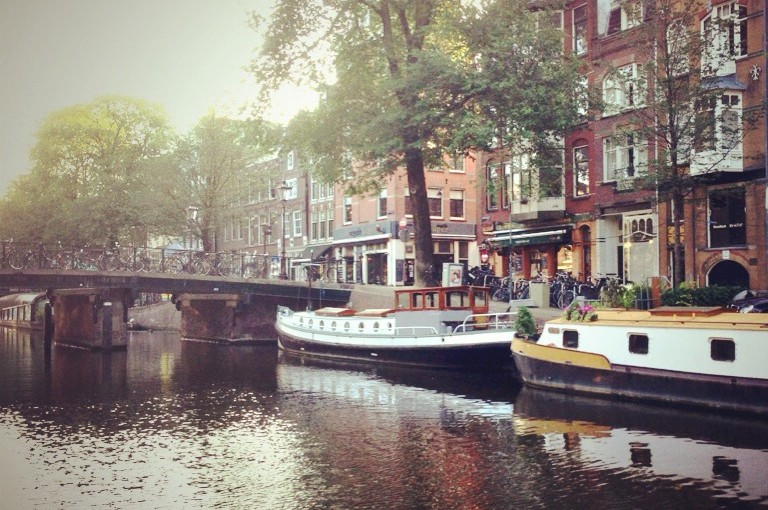
    Morning-Prince Canal, Jordaan
    Quiet Sunday Morning Before the Tour Boats Invade the Prinsengracht

    Back in front of the mic after summer vacation, I’ve continued the heavy travel schedule — New Orleans mostly with a week in Amsterdam for a family vacation. I talk about the exposure of staying in a houseboat on an Amsterdam canal and run through my personal “Best of” list. Flying out of the Gulf Coast in the summer with its afternoon thunderstorms has forced me to become a weather geek. I run through the weather apps I religiously use. Bad weather also caught up with me in Europe, but Lufthansa did a great job of taking care of us. I’m still in love with TSA’s PreCheck. I may make Southwest’s A-List once PreCheck comes to Chicago-Midway airport. And we wrap with restaurant trends seen at this year’s National Restaurant Association show. All this and more  at the direct link to the podcast file or listening to it right here by clicking on the arrow below.


    Here are the transcript of TravelCommons podcast #106:

    • Intro music — Warmth by Makkina
    • Back in the TravelCommons studios outside of Chicago. I sorta took the summer off — working, biking, reading, drinking beer. Nothing really exciting, which meant, I guess, that I didn’t have anything new to podcast about.
    • Which doesn’t mean I haven’t been traveling. I’ve been in the air almost every week since the last episode — New Orleans mostly, with a few trips to Houston, and a week in Amsterdam for a family vacation.
    • The New Orleans trips have taught me a key life lesson — don’t try to fly out of the Gulf Coast after 4:30pm in the summer. New Orleans in the summer is 91 degrees and 91% humidity. And so you sit in the airport terminal and watch the line of thunderstorms cross the runway at about 4pm — just bucketing down rain with lightning strikes that keep the ground crews inside. That’s about the time you walk over and get another beer ‘cause you’re going to be there for a while.
    • Of course, it could be worse. You could be on one of the planes that managed to land right before the squall line hit. You’re sitting on a plane that’s pulled up to the gate, but you can get off because there’s no one to pull the jet bridge up because of the lighting. You get the same wait, but no beer.
    • So if you don’t want to torture yourself, you don’t fly out late afternoon, but the other problem is that, after 7pm, MSY is a ghost town. The last flight that will get me to Chicago — even with a connection, leaves at 6:30. Save for the odd SW hop to Houston, there’s nothing going.
    • So, if I have a late afternoon meeting, I have to stay overnight. And then head over to the French Quarter, or the Garden District, or the Bywater district for a cocktail and some fresh oysters, maybe a bit of gumbo or cochon… OK, so maybe the lack of late night flights home isn’t so bad after all.
    • Bridge Music — Drops of H2O (The Filtered Water Treatment) by J Lang

    Following Up

    • So all this dodging summer Gulf storms has made weather apps join airline and trip mgmt apps in the critical travel apps folder on my iPhone and Nexus 7. Actually, it starts on my laptop where I have WeatherSpark on an open tab at all times. In one browser window, I get radar, temperature and precipitation forecasts. On my iPhone, it’s Forecast and the rebuilt Yahoo Weather apps which really represent two ends of the design spectrum. Forecast has very minimal aesthetic — lot of white space; focused quickly giving you what it thinks most people want to know — what’s the forecast for the next hour; and the next 24 hours. Tapping and reveals current weather conditions — humidity, pressure, wind; another tap the 7 day forecast; tap one of those days drills down to its hourly temperature and precip forecast. Yahoo Weather is less tappy — you start with current conditions and a big picture from Flickr and then scroll down for forecasts and a radar map. On my Nexus 7, SkyMotion is focused on short-term forecasting — it gives me current conditions and a forecast as far ahead as it can see (No Rain for the next 115 min) and then counts down the next forecast — I have mine set to update every 5 minutes. I tend to triangulate across all of them for sort of a consensus forecast, but that’s because, in trying to get home at a reasonable time every week, I’ve become a bit obsessive about the weather.
    • Maps, of course, are the critical travel app. And I don’t know about you guys, but for me Apple Maps is still lousy. I hadn’t used Apple Maps ever since Google launched their IOS Maps app, but a few weeks back, landing at ORD, I was in a rush to get directions and travel time to a meeting. The address was in the appt so I just clicked on it and it popped up Apple Maps. A couple of clicks and I had directions, or so I thought. As I skimmed the turns, I thought “This can’t be right”. I looked at the address in the pin — it was Michigan Ave in Evanston, IL not Chicago — even though the address on the appointment included Chicago. So I manually edited the address, specifically typing in Chicago and hit Return. But Apple still wanted to send me to Evanston. I re-opened the appointment, copied the address, pasted it into Google Maps and I headed to Chicago.
    • Playing around later that day, I found that Apple Maps just isn’t as smart as Google Maps about my location. Standing in the Loop, I put a street address into Google Maps — 525 Monroe — and Google assumes that, since I’m in standing in downtown Chicago, I want to find 525 W Monroe in Chicago. Apple Maps will tell me “Address not found” if I don’t specify Chicago. Remember when this whole debacle started — Tim Cook said Maps would get better the more people used it. I haven’t seen it, but thanks to Google, I’m not too worried.
    • In the last two episodes, I talked about, when traveling internationally, buying a SIM card in country to save on voice and data roaming charges. In Amsterdam, the story was no different. After landing in Schiphol, I searched out the Lebara Mobile booth in the shadow of the Burger King. It wasn’t the biggest booth, so it took me a bit. But once I found it, it took the guy all of 5 minutes to get my unlocked AT&T iPhone 4 registered on the KPN network. For €20 (about $26) I got 1 GB of data, unlimited texts, and enough voice minutes to make a half-dozen restaurant reservations. Compare that to $30 for 120 MB of international data.  The web site http://prepaidwithdata.wikia.com is a great site to prepaid plan comparisons. Should be a top bookmark for any international traveler.
    • The Saturday we flew back from Amsterdam was the one day of bad weather — rain and low clouds. I’d booked our flights using United miles, so while the flight over from Chicago was a non-stop United flight, the flight back was on Lufthansa with a connection through Frankfurt. We got to Schiphol a bit early, and seeing delays, we tried to get on an earlier flight to Frankfurt. We weren’t the only ones with idea; the flight was full. “No worries,” said the counter agent, “your flight is only delayed 20 minutes. You’ll still have an hour to make your connection.” 45 minutes later, the delay is now an hour. “No worries,” the gate agent said, “you’ll still have 20 minutes to make your connection.” I study her face for signs of irony or sarcasm, but I don’t detect any. Boarding time comes and goes and we’re still in the gate area. The fuel truck is MIA and we can’t board while the plane is being fueled. I’d already talked to United. The connection we will now miss is the last flight to the US from Frankfurt and there’s no room on any nearby United flights to the US until Monday. I figure there’s a better chance of us getting to the US from Frankfurt, Lufthansa’s main hub, than Schiphol. We board the flight knowing we’ll be overnighting in Frankfurt.
    • On approach to Frankfurt, the flight attendant reads off all the connecting flights — the gates for the connections that are still make-able, and the rebookings for those that weren’t — more information than I typically hear on a delayed flight into ORD. According to this, we were rebooked on the next morning’s flight to ORD, which was great news because United said it was booked up. We head over to Lufthansa’s customer service desk. Not much of a line. The agent quickly finds us in the system, looks at me, my wife and my two kids and says, “So you’ll need two or four rooms this evening?” “Two will be fine,” I tell him. He gives us vouchers for two rooms at an airport hotel, which includes €20 a piece for dinner, and also includes breakfast. All on Lufthansa. And remember, we were flying on award miles. Now think about this for a minute. If this was the US, we would’ve been told “It’s weather. Not our fault. You’re on your own.” And re-booking on award miles? I think we would’ve ranked lower than non-revenue employees. All of this, plus the really nice service in coach on the way back to Chicago has my wife telling me — the next time we book flights with United miles, avoid them; book all the legs on Lufthansa.
    • One thing United does do right, though, is TSA PreCheck. As I’ve said in previous podcasts, PreCheck is wonderful thing — keep your shoes and belt on, keep your liquids and PC in your bag, stroll through the metal detector; no full body irradiation, everybody — the passengers and the TSA agents — are happy and smiling, there’s a rainbow over the exit of the X-ray machine, and a sparkly unicorn happily gives you your bags at the end. OK, I exaggerate — but just a bit. Anyhow, TSA PreCheck is a wonderful thing and United does a good job of it in ORD and IAH. American, though, seems to have its challenges. Their PreCheck line at ORD can get very long — not quite sure why — and now somehow, they’ve screwed up my PreCheck status because on my last 3 flights to New Orleans, I’ve been shunted over to the regular status line. Missing the unicorns and rainbows, I called up American. Yes, I know that PreCheck is not guaranteed and that randomly I’ll have to go through the regular line — it’s happened before, but not three trips in a row. I got shunted between Customer Service and the Platinum Desk — don’t understand it; everything looks fine. A Twitter conversation with American earlier this week asked that I compare the name on my AAdvantage account with my Global Entry account. I also looked at my United account. Both Global Entry and United have my middle name spelled out; my American account just has my middle initial. I updated my American account — we’ll see if this solves the problem.
    • On a recent flight down to New Orleans, I took Southwest out of MDW. No PreCheck there. And with all the families and leisure travelers who use MDW, and the way security is configured — everyone funnels into a single massive multi-lane security checkpoint — I avoid MDW at all costs. So during this rare flight through, I asked a TSA guy when they’d be getting PreCheck. “End of the year,” he said. “They’ve been reconfiguring a bunch of lanes on the right hand side to handle it.” Well, now. I had just spent 20 minutes getting through security vs. what is usually 5 minutes in United’s ORD PreCheck line. I might be a lot more accepting of a Southwest flight with PreCheck.  Provided that Southwest doesn’t do PreCheck just for its A List members.
    • And finally, I had a nice social media serendipity moment last month. I was at the Oak Park Microbrew and Food Review. I think this was the 6th year was on, but the first time I’d gone. It was a spur of the moment thing, so I was by myself. I was checking in my first couple of beers on Untappd, which is something like beer geek Foursquare. And up pops a comment on one of my check-ins — “Come find me, I’m in a Red Hat Linux hat”. Another Untappd friend, and long time podcast listener Rob Auch was there too. It wasn’t too crowded yet, so we managed to find each other fairly quickly, and then hung out for an hour or so tasting beer together. It’s kinda fun when the virtual world intersects the real world.
    • And if you have any travel observations, questions, a story, a comment, a travel tip – the voice of the traveler, send it along.  The e-mail address is comments@travelcommons.com — you can use your smartphone to record and send in an audio comment; send a Twitter message to mpeacock, or you can post your thoughts on the TravelCommons’ Facebook page — or you can always go old-school and post your thoughts on the web site at TravelCommons.com.
    • Bridge Music — Test Drive by Zapac

    Summer Vacation in Amsterdam

    • I’ve been burning through the award miles recently — I drained the American bank for a spring break trip to Spain, so it was United’s turn for summer vacation. Since my daughter got to choose the spring break location, my son got the choice for summer. We could only carve out a week, so Asia was out which nixed his usual choice of Japan. Let’s look at Europe “but”, I said as he was opening his mouth, “not Russia. I might be interested in St Petersburg as part of a Baltic thing, but for the rest of Russia, no thanks. You can do that on your own dime.” “Fine,” he said, “then Amsterdam”.
    • Really? Why? “I dunno; just a place I want to go.” OK. Actually, as I thought about it, I got more interested in it. I’ve done a good bit of work around Amsterdam — in Haarlem, Utrecht. I’ve flown in and out of Schiphol a bunch of times, but save for one windy afternoon, never really spent any time in the city itself. This could be fun.
    • As I mentioned in the last episode, we’ve pretty much converted from hotel rooms to vacation rentals for our family vacations. For about the same price as two hotel rooms, we get that and more — a kitchen, living room — places to sit and hang out other than beds and concierge lounges. We also like to shop in local markets. And with a kitchen, this is a lot more fun. We get to buy and try things rather than just doing grocery tourism.
    • Normally, this works out very well. But the end of July was warmer than normal in Europe. We had expected weather in the mid-70’s — we got high 80’s during the day and maybe dipping into the mid-70’s at night. Wouldn’t be bad if we were staying at a hotel with air conditioning, but we had decided to do something a bit more local — we rented a houseboat on the Prince’s Canal. Which didn’t come with air conditioning — nor great cross-ventilation since you’re kinda down below street — and breeze level in the canals.
    • The first morning in the houseboat, I woke up and headed to the kitchen to figure out the Nespresso coffee machine. I opened the canal side door and windows to let in the morning breeze and started rummaging around for the coffee capsules. I heard a noise behind me; I turned and saw one of those big canal tour boats passing within a couple feet of our houseboat; full of tourists, wielding cameras, many pointed through our open door, looking straight at me in my boxers. I waved — really, what else could I do? — pressed the Brew button on the Nespresso, and headed back to the bedroom for a t-shirt and a pair of shorts. A bit of a shock at first, it became a game for us the rest of the trip. Now purposely walking around in the most colorful boxers my son and I could find; pointing our cameras back at the tour boats. The tour boat traffic on the Canal was heavy — I posted a Vine video on my Twitter feed of passing tour boats  — but that was part of the fun. We would hang out on the little porch at the end of the day, eating some cheese, drinking a beer. It felt like we were part of the Amsterdam vibe, not just observing it.
    • One of the best days of the week, though, was spent turning the tables — piloting ourselves through the canals and peeping into the other houseboats. Social media serendipity hit again, this time through Twitter — by way of Untappd, again. Arnoud Heijnis, a long-time TravelCommons listener, follows me on Twitter. Untappd pushes beer drinking badges to Twitter. Arnoud sees the Weiss beer badge I earned from a check-in at some canal-side bar and shoots me a great e-mail with a fantastic list of suggestions. The one that immediately catches my eye is renting a boat for your own canal tour. I get on line, book a boat, hit the grocery store from some snacks and walk to the rental place in Westerpark. We hop in an aluminum boat with an electric outboard motor, lay on the bottom of the boat to clear what we’re told is the lowest canal bridge in Amsterdam, and then go out for a 3-hr cruise. Bopping around the canals, dodging the big tour boats — it was a great time.
    • We also spent a couple of days being part of the bicycling culture in Amsterdam. I think it’s impossible to say you’ve truly visited Amsterdam without renting a bike and spending the day cycling around. I’ve spent time in Portland, OR, Seattle, and Boulder, CO — three of the top US biking cities in US — and they pale compared to Amsterdam. Until you get in the midst of it, you can’t really appreciate that bicycles are on the top of the Amsterdam transit pyramid — cyclists, then motorists, then pedestrians.The bicycle lanes near the Central Station are the craziest — a mosh pit of cyclists and foreign pedestrians coming out of the train station sprinting for their lives across car and bike lines, chased by honking horns and ringing bells. But get outside town a bit, as we did biking up to Marken Island, and it settles down a lot. And it’s pretty easy cycling — except for bridges, the country is pancake flat.
    • Other tips?
      • I already mentioned hitting the Lebara stand in Schiphol for the “€20 for a gig of mobile data” plan
      • The train into Amsterdam from Schiphol is dead simple — take it if you’re staying in the city, but be ready — it’s so dead simple that it gets crowded.
      • The family and I loved the Van Gogh Museum — it’s rare to be able to trace an artist’s development in such detail. But understand that a lot of other people love it too. Go on-line and book a specific date and time for your visit. It’s a lot shorter wait.
      • Skip the new “Heineken Experience”. It’s just not worth the money. Hit Brouwerij ‘t IJ on one of your bike rides. Drink better beer outside under a windmill. Or hit Proeflokaal Arendsnest in the Jordaan district for their selection of Dutch microbrews
      • We stayed in the Jordaan district and definitely recommend it. We hit the Noordermarkt farmers’ market on Saturday to stock the houseboat kitchen, shopped down Haarlemmerstraat , stopped in at the neighborhood restaurants and bars. We found it the right mix of happening but not too raucous — which, from walking down the Damrak or around the Red Light district, seem to put us in the minority.
    • Bridge Music — Black Rainbow by Pitx

    Restaurant Trends

    • This week’s trip to Atlanta will make it 9 straight weeks that I’ve been on travel. So not only do I get to know airports, and airplanes, and hotels, but also restaurants. And for the past couple of years, I’ve attended the National Restaurant Association‘s’ annual show in Chicago to walk the floor and see what trends we can expect to see when we’re eating on the road.
    • In episode #98, I talked about last year’s show, where technology seemed to be the trend — mobile apps to let you pay your tab, iPad digital menus, smartphones replacing pagers for queued-up guests,…. This year there was still a technology bent — yet more permutations on digital menus (though this time featuring cheaper Android tablets as well as iPads) and a whole lot of social apps — seems everyone wants me to check-in, upload pictures, and leave comments (good ones, I assume) on their site. I gotta tell you, though, I sorta full up with social networks. Personally, I have zero interest in donating free content to yet another social network.  Twitter, Facebook, Untappd, Foodspotting, TripAdvisor, and now a friend just talked me into Yelp. That’s it — I’m over-socialed.
    • Luckily this year’s NRA floor — remember, I said Restaurant, not Rifle Association — had, well maybe not new food trends, but some clearer, perhaps more consensus trends. Two that jumped out at me were Mediterranean and Japanese foods. Now, I know, how new is Mediterranean? But if in years past, Mediterranean was a label used to push more expensive Italian food, I felt like I saw more of the Mediterranean this year — specifically, more of the Eastern Mediterranean — Greek, Turkish, Lebanese. Different, interesting flavors — sumac, pomegranate, tahini; less basil, more oregano; less pork, more lamb. Nothing against Italian — I love it — but anything that brings more flavor choices, I’m all for.
    • Japanese flavors also had a big presence this year. But not sushi — although someone was demoing a very cool automatic sushi maker. Instead, it was about the broader spectrum of Japanese flavors — noodles, green teas, and umami — the newest basic taste — sweet, sour, salty, bitter, and now umami — sort of a meaty, savory taste that is at the core of many Japanese flavors. Japanese noodles seem to be all the rage now — ramen, udon, soba, …. On the floor of the show, a Japanese company had an entire automated noodle making assembly line running. Watching those big fat udon noodle roll off made me hungry.
    • Anything that adds variety is a great thing. I remember some years back traveling every week to St John, NB. I won’t bore you with the hassles of getting there from Chicago — suffice it to say that, with no customs in St John airport, it wasn’t a simple trip. St John is a nice town, but the choices were a bit limited. Monday night, we’d have salmon — very fresh, very good. Tuesday, we’d have mussels — over from nearby Prince Edward’s Island, again very fresh, very good. Wednesday, we’d have a hamburger — less fresh, but washed down with fresh Moosehead beer from next door Nova Scotia. Thursday — well, it was back to the salmon — still fresh, perhaps a little less good.
    • I’m certainly not having that problem on my weekly commutes to New Orleans, but for those travelers heading to less culinarily interesting destinations, I hope the variety I saw on the floor of the Restaurant show reaches you real soon.

    Closing

    • Closing music — iTunes link to Pictures of You by Evangeline
    • OK, that’s it, that’s the end of TravelCommons podcast #106
    • I hope you all enjoyed this podcast and I hope you decide to stay subscribed.
    • Bridge music from ccMixter
    • If you have a story, thought, comment, gripe – the voice of the traveler — send ‘em along, text or audio file, to comments@travelcommons.com or to @mpeacock on Twitter, or post them on our website at travelcommons.com. Thanks to everyone who has taken the time to send in e-mails, Tweets and post comments on the website
    • Follow me on Twitter
    • “Like” the TravelCommons fan page on Facebook
    • Direct link to the show
  • Podcast #103 — Hospitality is Personal; Tablets Everywhere

    Podcast #103 — Hospitality is Personal; Tablets Everywhere

    Twin or King-Size Lily Pad?
    Twin or King-Size Lily Pad?

    Doing a bit more travel since the last episode, so have more to talk about. First business trip of the year started out great, but quickly deteriorated as weather delays forced me to make quick changes. I update my trip management app recommendations after TripCase released the latest rev of their app, and talk about good mass transit experiences in Portland, OR and Park City, UT. A new behind-the-scenes book on the hotel industry shows how important people are to the travel experience. And the explosion of tablet form factors makes me re-think why I carry a tablet — comparing Apple’s iPad Mini to Google’s Nexus 7.  Here’s a direct link to the podcast file or you can listen to it right here by clicking on the arrow below.


    Here are the transcript of TravelCommons podcast #103:

    • Intro music — Warmth by Makkina
    • Great Welcome Basket at Hotel Monaco

      Coming to you from the Hotel Monaco in downtown Portland, OR. It’s been a long time since I’ve broken out the mobile recording kit. And for Jeremy Philips, who back in October, tweeted “I kind of miss the bathroom acoustics…”…

    • I am back on the road again with a mix of business and leisure. Flew into SLC on Southwest for a week-and-a-half Christmas ski vacation in Park City. First time I’ve skied Utah. It was nice, but cold. I’d say the last 5 years of skiing has been over Spring Break in Colorado. I’d forgotten how cold Christmas skiing is. It’d be 8 or 9 degrees when we hit the slopes, rising to maybe 15 in the afternoon.
    • My first business trip of the year was last week to Hartford, CT. I used to fly through there a lot 10-12 years ago. The airport was a dump back then. I was hoping that they’d freshened it up a bit — at least replaced the carpet. The day started great — United upgraded me to first class (milking the last month of 1K status for all it’s worth) and I got waved into the TSA PreCheck line. I felt so lucky, as the old Mary Chapin Carpenter tune goes, I bought a couple of lottery tickets at the first kiosk I saw.
    •  An hour later though, it all started to break up — go pear-shaped as my friends in the UK would say. As airlines have taken seats/capacity out of the system, secondary airports like Hartford have been the ones to lose service. For me, booking this flight at the last minute, there were no direct flights available, so I had to connect. Big risk; breaking my cardinal rule of flying. But I didn’t have another choice. So what do you do? I picked a smaller airport — CLE — to connect thru in hopes of avoiding air traffic control delays. My connection time was over an hour, just in case my first flight was delayed. And I scheduled myself to arrive almost 3 hours before my meeting, building in buffer for delays coming out of CLE.
    • My first two strategies worked — CLE was clear, no delays; and my inbound flight from ORD arrived 15 minutes early. When I turned my phone on after touching down in CLE, TripIt and WorldMate both told me my BDL flight was 40 minutes delayed. Annoying but not fatal because of all the backend buffer I’d allowed.
    • I went straight to the gate to get the story — why the delay? The plane was 2 hrs late leaving CLE because of fog in PHL, and is so now is late getting back to CLE for the BDL flight. Hmmm, this is starting to feel uncomfortable. I lived in PHL for 4 years and I know what a nightmare that airport is. Is the plane on its way back yet? No, it hasn’t landed at PHL yet.  Double hmmm… The departure time has slipped 10 minutes since I touched down. Not a good sign, but still not fatal. I sit down and run some e-mail.
    • Departure time slips another 15 minutes. I talk to the gate agent again. Has the flight left PHL? No, but it looks like it has pushed back. I start checking other options. Nothing else to BDL. I reach back for those 8th grade map skills — what about Providence, Boston, Albany, White Plains?
    • There’s a flight out to PVD. I pull up Google Maps — 90 mile drive from there to my meeting. I look at the arrival time, 45 minutes for taxi, getting off the plane, walking down the terminal, and getting to the car rental place. Would get me to my meeting with 30 minutes to spare. I draw a line in the sand — if the plane for the BDL flight isn’t in the air 5 minutes before the PVD flight starts boarding, I’m switching. The United gate agents were very helpful. They called ahead to the PVD gate, they gave me updates what was going on in PHL… But when I hit my decision time, the plane was still on the ground in PHL and speed-walked to the PVD flight.
    • And as you might have guessed, I didn’t match a single number on my lottery tickets…
    • Bridge Music — Beneath the Skin by Jerry Berlongieri

    Following Up

    • OK, we’ll leave the tile reverb behind for the rest of the podcast. Listening back to some of the old episodes, a little of that goes a long way…
    • At the beginning of December, I expanded last episode’s trip management app bake-off into an article for Tnooz, a travel industry website focused on travel technology. In episode #102, I compared the free versions of TripIt, TripCase, WorldMate, and Kayak. The Tnooz article has the same use cases, but drops Kayak for the paid versions of TripIt and WorldMate. The recommendations didn’t change that much — use the free version of TripCase, but for $10, the WorldMate app is not a bad deal either.
    • Trip Management App Logos
      The Usual Suspects

      And then, just to show that no good deed goes unpunished, TripCase launched a completely revised version of their app and website a week after my Tnooz review. Using it during my SLC and BDL (or should I say PVD) trip, I’m revising my opinion southward. The new interface is fine. I’m not sure that it’s better as much as it’s just different — I picked up the new navigation pretty quickly. But I noticed that I wasn’t getting the normal iPhone notifications — I was getting e-mails instead, which you’ll remember from my evaluation in the last episode is definitely inferior to native iOS or Android notifications. And I can’t find in the app or the website how to re-enable them. The paid version of WorldMate does a good job of native notifications. TripCase also seems to have hidden where to manage social media notifications — where to turn on/off trip postings to Facebook and LinkedIn. I have to say that, after this redesign, my recommended solution is a bit muddier. I’d say it’s a combination of the free version of TripIt to push Facebook and LinkedIn notifications, and the $10 WorldMate Gold for managing the day of travel.

    • I had a chuckle a couple of weeks back. I was doing my weekly check-up on the TravelCommons site — going thru the comments caught up in the Spam filter (you wouldn’t believe some of that stuff) and looking at some of the traffic stats like inbound links. I saw a new link, or at least one I didn’t recognize, from FlyerTalk, the frequent flyer forum. Following it back, it was a topic that was started in April 2006 asking for travel podcast suggestions. I was very pleasantly surprised to see TravelCommons listed in the first response. We get bumped in 2007 and again in 2009 with listeners recommending the podcast. Then, what I would guess to be a former listener commented “The content of the Travel Commons podcast is interesting, but the guy’s voice is monotone and metronomically slow.” OK, I’ll take that as a half vote. But then Bob Fenerty jumped in with “I can see that perspective, but I find Mark’s voice soothing and reassuring”. Thanks for the help, Bob. I think the stint in the ‘70’s I did in contemporary Christian radio in Memphis — “You’re listening to the Voice of 1590” — has permanently crippled my ability to be vocally exciting…
    • As longtime listeners like Bob will recall, one of my more nerdy travel hobbies is taking mass transit to the airport. I don’t know why — maybe it’s some weird twist on trainspotting. But even after getting my passport stolen on the train back to Brussels airport last year, I still like to try these things out. I have three criteria for good mass transit to the airport — it’s gotta be clean, frequent, and cheap. Washington’s Metro hits all three while SF’s BART misses on all of them
    • Portland’s MAX Red Line from the airport also hits all three. Clean, reasonably modern trains, though they’re more like light rail trams, so not the fastest things. They run every 15 minutes, so good frequency. And at $2.50 for a ride downtown, they’re an order of magnitude cheaper than a cab. Unless you don’t buy a ticket. Halfway into my ride Monday night, three fare checkers step into my car checking tickets. I had mine, but the woman next to me didn’t. She said that she skipped the fare machine to run to make the train. The fare checker didn’t have much sympathy. She ended up with a ticket and a court date. He told her that if she had a clean record, she’d probably get away with a $60 fine and a day of community service. Wow! All that to save 15 minutes…
    • I also had a good experience with the free bus system in Park City UT during our ski holiday there. We took a cab to and from SLC, but once in Park City, we relied on the bus system to get everywhere — to/from the ski areas (Park City and The Canyons), town center for dinners on the very cold nights…. Clean buses, extensive routes, good frequency, and free. I’m told it’s funded by a piece of the local sales tax. It was certainly a money saver — no rental car, gas or parking costs — and very convenient.
    • If you have a question, a story, a comment, a travel tip – the voice of the traveler, send it along.  The e-mail address is comments@travelcommons.com — use the Voice Memo app on your iPhone or something like Easy Voice Recorder on your Android phone to record and send in an audio comment; send a Twitter message to mpeacock, or you can post your thoughts on the TravelCommons’ Facebook page — or you can always go old-school and post your thoughts on the web site at TravelCommons.com.
    • Bridge music — Bulletproof by Music Inside

    Hospitality Is Personal

    • I read Jacob Tomsky’s Heads in Beds: A Reckless Memoir of Hotels, Hustles, and So-Called Hospitality while in Park City. It’s a fun, easy read. Just looking at the cover, you can tell that Tomsky wants to give us the hotel version of Anthony Bourdain‘s Kitchen Confidential— the flawed insider with a heart of gold giving us a snarky behind-the-scenes tour.

      Heads in Beds by Jacob Tomsky
    • This tour has two very distinct parts. The first third of the book tells us how Tomsky fell into the hospitality industry and began to make it a career. He finds that having a philosophy degree in New Orleans isn’t an easy way to get a job, and so he takes a job as a parking valet at a new luxury hotel. Working hard and being earnest (which in his case means that he cleans up well and doesn’t try to kill his co-workers), he gets promoted to front desk agent and then into management. The second part of the book is set in a gone-to-seed Manhattan hotel where Tomsky lands, very reluctantly, broke after 9 months touring through Europe and 3 months searching for a publishing job in New York.
    • The New Orleans story is certainly the sunnier of the two; a young man finding his niche in the world and working his way up. Tomsky does a great job of describing the amount of planning and effort it takes for a Ritz Carlton or Four Seasons to provide their levels of hospitality. And the biggest target for that effort doesn’t seem to be the guests, but instead the front line employees. Tomsky talks again and again about how amazed the valets and maids are when they’re treated to a pre-opening reception with an open bar, that  the general manager knows each of their names…. Little things, but things that translate into self-respect, pride in their jobs, pride in their hotel, which then translates into a drive to give the best service possible to each guest.
    • If the New Orleans story is about a man on his way up, the Manhattan story is about Tomsky abandoning, bit by bit, the Ritz level of service he was so proud of, becoming more focused on hustling tips than helping guests. As he slides down that slippery slope, the snark level increases… as does a sense of self-loathing. Everyone in the hotel is out for themselves — the managers, the bellmen, the front desk clerks — running their hustles not to serve their guests, but to maximize their tips. Which certainly leads to great service for some guests — but only those liberally spreading $20 bills around the lobby. And again, the tone is set at the top, but in this case, the general manager isn’t trying to deliver the best service; he’s trying to deliver the most money into his and the owner’s till as quickly and easily as possible.  An example that prompts each worker to do the same.
    • I’m not sure if Tomsky meant to show this, but his tale clearly illustrates something we talk about often on TravelCommons — that, in spite of all the technology being injected into the travel experience, the most important bit of the experience is still delivered by people — hospitality is personal. And the two parts of Tomsky’s story show how hard it is to build a team that prides itself on delivering great hospitality, and how easy it is to build a cynical team that’s doesn’t care.
    • Bridge music —Hurt Me So I Can Walk Away by Michael Joy

    Tablets, Phablets, and Other Devices

    • One of the most popular pieces of technology being carried by travelers nowadays is a tablet. Walk down the aisle of a plane or a train and you’ll half to two-thirds of the passengers looking intently into one of these flat pieces of glass.
    • It started with people carrying Kindles, and then you saw iPads propped up against seat backs, but now it’s all kinds. I saw my first Microsoft Surface table in the wild (i.e., not in a Microsoft store) a few weeks ago walking through a food court in LGA. It was sorta royalish baby blue, complete with the snapon keyboard. An older guy sitting next to me on the plane on Monday was working on a Samsung Galaxy Note. The 5-1/4 inch screen looked huge compared to my iPhone 5. He had it a couple of weeks and really likes it. The key for him is having enough screen size to run e-mail in a large font so he doesn’t have to pull out his reading glasses, but it’s small enough to fit in his suit coat pocket. The only thing that feels a bit funny, he said, is using it to make a phone call. That big slab of glass feels like it’s covering half his face.
    • I’ve been running a Google Nexus 7 for 3-4 months now. The 7-in screen size puts it between the pocket-sized Galaxy Note and a full-sized iPad. I had run iPads since they first came out — the 1, the 2, the next one after that (the iPad without a number). Like everyone, I thought they were phenomenal devices. But as I traveled with it, I had more trouble trying to figure out how the iPad uniquely justified it weight in my travel kit. I had colleagues who tried using them in place of laptops and as electronic notebooks. It worked just OK for them — the iPad’s e-mail client and calendar app just don’t have the same power as Outlook, and the notes they took with a stylus looked like a kindergartener’s scrawl with a black crayon. Some guys carried bluetooth keyboards, but that seemed like more hassle than it was worth. And then, I found myself getting frustrated with the iPad’s “sandboxing” — certain files are opened with certain apps; you can’t get to the file system like you can on a PC if you need to do something more than an app will let you. It’s a great model that works for 80% of population, but was way too constraining for me. For what I do, an iPad isn’t going to replace a laptop.
    • As a “media consumption device”? iPads are great for watching movies but most of my “media consumption” is reading and I found the full-sized iPad too heavy — both in my hand and in my bag — to be a good e-reader.
    • The laptop/iPad combo had too much overlap, so I started looking at 7-in tablets. I skipped the Kindle — I wanted to do more than just e-read; I don’t have a big investment in the Amazon eco-system, and didn’t want to get locked in further. So I looked at the iPad Mini and the Google Nexus 7. I gravitated toward the Mini — I have a bunch of iPad apps, am deeply invested in the iTunes eco-system… But pricing out equivalent Minis and Nexus 7s, the Mini was almost twice as expensive and, try as I might, I couldn’t justify that delta.
    • The Nexus 7 works fine for what I want — a lot of reading — with the WSJ and USA Today apps, work documents that I cloud-sync from my laptop with DropBox, — watch the occasional movie or video podcast, run Android photo editing apps like Instagram and Snapseed,…. I’ve even done some Google Hangouts on it.
    • One thing I haven’t done is try to make a phone call on it. that’s a lot of glass to lay across my cheek.

    Closing

    • Closing music — iTunes link to Pictures of You by Evangeline
    • OK, that’s it, that’s the end of TravelCommons podcast #103
    • I hope you all enjoyed this podcast and I hope you decide to stay subscribed.
    • Bridge music from Magnatune
    • If you have a story, thought, comment, gripe – the voice of the traveler — send ‘em along, text or audio file, to comments@travelcommons.com or to @mpeacock on Twitter, or post them on our website at travelcommons.com. Thanks to everyone who has taken the time to send in e-mails, Tweets and post comments on the website
    • Follow me on Twitter
    • “Like” the TravelCommons fan page on Facebook
    • Direct link to the show
  • Podcast #92 — Not-So-Upbeat Traveler; iPad 2 vs. Samsung Galaxy Tab 10.1

    Podcast #92 — Not-So-Upbeat Traveler; iPad 2 vs. Samsung Galaxy Tab 10.1

    Train Crash at Montparnasse 1895
    Train Crash at Montparnasse 1895

    Into the summer travel rhythm with a mix of vacation and business travel. Using an Apple iPad 2 and Samsung’s new Galaxy Tab 10.1 Android tablet during this mix gave me enough real world experience to make some recommendations. A couple of recent web links describe this podcast as “not as upbeat as others” which is true, but because it focuses on traveling, not destinations. Perhaps this non-chipper attitude is partially explained by a recent study placing 4 US airline companies in the top 8 most hated companies in America. And a listener suggests ways to reduce roaming voice and data costs. Here’s a direct link to the podcast file or you can listen to it right here by clicking on the arrow below.


    Here are the transcript from TravelCommons podcast #92:

    • Intro music — Warmth by Makkina
    • Travel since the last podcast has been pretty evenly split between personal and business travel.  First couple of weeks was summer vacation in the UK — the Lake District, Scotland, and a couple of days in London.  Had phenomenal weather the whole time we were there — one afternoon of rain, and the rest of the time was warm and sunny.  Almost too warm for the clothes we packed. And everyone was amazed.  All the bed & breakfast owners were marveling at the weather. “It’s luvly,” said our landlady in Edinburgh, “Last week it was hailing”. Lucky us because we certainly didn’t pack for that.
    • Just to make sure I didn’t forget we were on vacation, we stayed at bed & breakfasts the whole time — until we hit London, when I made the reservations. Actually, when I think about it, it’s not all that different from the service I get in the concierge lounges at big hotels. Breakfast comes with the room — though the full cooked breakfast, complete with black puddling in England and haggis in Scotland, was a bit heartier than the continental breakfasts I normally get in concierge lounges.  And there’s a bit of nice chit-chat when we walk in, though the B&B owners are typically a bit older/more seasoned that the typical lounge staff.  The main differences — most hotels I stay in don’t have dogs living there, and they prefer credit cards over cash.
    • Of course, back in the US, the weather’s been sweltering.  I was in South Florida a couple weeks ago and it was cooler there than Chicago.  But that wasn’t good enough, so last week, I was down in Phoenix, where it was hitting 105-107 degrees during the day and wasn’t getting below 100 any time while I was awake.
    • Tough weather to take advantage of the convertible red Mustang that Avis was nice enough to upgrade me to.
    • Wednesday night after dinner, though, I decided I just had to drop the top.  The dashboard said the external temperature was 102 — and it felt it when I dropped that top.  Soon, though, I found that the key to driving top-down in 102 degrees is the pretty much the same as driving top-down in 55 degree weather. Set the fan to High and remember to have the knob set to A/C.
    • Bridge music — Crazy Love-The Alex & Lang mix by J.Lang

    Following Up

    • Let’s take a run through the comment bag.
    • Sarah, who’s been a listener since 2006, posted a comment on the website on episode #85 (!) — she says “I was playing catch up after all my driving trips this past two months.” In that episode, I talked about how the hotel industry seems to be focused on spiffing up their lobbies and putting whizzy new technology in the rooms, and that they were making a mistake ignoring what I think is critical to the hotel experience — the bathroom.  Sarah says “I say ‘heck yeah’ to the bathroom being one of the most important parts of a stay.  I ended in a bed and breakfast in the middle of nowhere, with no wifi.  And the bathroom made me want to tell everyone about it. It had a hot tub and a beautifully large bathroom. But even though I knew no one who was going to the area, I wanted to tell everyone about it. It’s the Inn in New Berlin, PA (in case you care).”
    • Sarah, thanks for the note — and thanks for the pointer to the Inn in New Berlin.  I do think we look for luxurious touches in hotels. And it doesn’t have to be anything big.  The first thing my wife looks for in a hotel room is to see if there are robes in the bathroom.  It’s a helluva lot cheaper than a tricked-out media panel, and it makes a much bigger impression.
    • Sarah’s comment about wanting to tell everyone about her find reminded me of some stats I saw a few days ago.  It said on average 24% of a hotel guests first heard about it from a friend or family member; 16% from a review site like TripAdvisor. I would guess that if anyone could calculate the cost of creating an enthusiastic recommender like Sarah — it would turn out to be a lot cheaper to do it with a great bathroom than a posh new lobby.
    • Fast forwarding to episode #90, Andrew Gill left a comment on the TravelCommons Facebook wall
      • Thanks for podcast #90, it’s great to hear how 170 degrees isn’t as comfortable as fully flat when my company has a different approach to travel. UK to Australia in Economy has to be tried
      • You talked about using large chunks of roaming data in a recent trip and I’ve a couple of hints to share.
      • Google Maps is great but try City Maps 2Go. I’ve been using it for over a year having tried other off-line mapping products. It uses the built in compass so I don’t have to walk a block either way to figure out if I’m going in the right direction.
      • I’ve also become a real convert to local SIM cards. Now this may not be perfect for a business trip, but I had two weeks in Chile in January and my iPhone bill was $500, compare this to two weeks in Australia using the AU$2 a day plan from Optus and my bill was $22. In Australia I didn’t worry about when I used my phone or finding the next hotspot, because I had unlimited calls, SMS and internet usage all for AU$2 a day.
    • Thanks Andrew.  Sorry about the whinging on 10 degrees of seat recline. I paid for it on my flight over to Manchester last month — 8 hrs of suffering in coach in a packed American Airlines 757. Even United gives you free beer in coach, but not American.
    • Thanks for the tip on City Maps 2 Go.  I looked at it for our UK vacation and since we were spending most of our time in the hinterlands — the Lake District, the Isle of Arran, around Loch Lomond, it wasn’t going to give us enough coverage.  I found, though, a great app from Phil Endecott called “UK Map”.  For $11 you get all the Ordnance Survey maps, 2D and 3D views, combined with OpenStreetMap.org info downloaded so you can use it off line.  It’s a universal app so I have it on my iPhone and iPad.  If you’re touring the UK, I highly recommend it.  I may end up back in Madrid in a couple of months.  If I do, I’ll be downloading its map from City Maps 2 Go.
    • I did find an unexpected but valuable benefit from my Starbucks obsession. I have a couple of Starbucks gift cards that I’ve registered.  I kinda did it on a whim.  They send me a card for a free drink after every 15 coffees I buy.  I don’t use them — it would be wasted on a tall coffee or cappuccino.  I give ‘em to my kids who use them for venti frappuccinos.  But anyways, while in London, I found that my US Starbucks Rewards credentials gave me free WiFi in UK Starbucks. Since I was limiting my mobile data usage and there’s a Starbucks about every 200 ft in London, it was very handy.
    • How big, exactly, is Starbucks’ new ‘Trenta’ size?
      How big, exactly, is Starbucks’ new ‘Trenta’ size?

      Speaking of Starbucks, when I was flying out of ORD last week, one of the Starbucks in Terminal 3 advertised “trenta is here” — Starbucks’ new “BigGulp” serving size. I thought about this while waiting in line to order my tall bold coffee.  Should they really be selling the trenta in airports?  I mean, does it make sense to sell someone 31 fluid ounces of a beverage right before they will be strapped into a seat for the next 2-4 hours?  And odds are that the person ordering a trenta will be in the window seat.  Meaning that he/she’s rousting two people at least twice during the flight to drain that trenta.

    • And then, reacting to my comments about Ryanair in the last episode, Leo Vegoda wrote
      • What you say about Ryanair reminds me of how Irish comedian Andrew Maxwell described them: ‘Ryanair is what flying would be like if it was illegal’. I think that says it all.”
    • That is perfect — and I think perfectly describes Ryanair and Spirit and all that ilk.
    • And it shouldn’t be too surprising then that 4 of the top 8 most hated companies in America are airlines.  The latest American Customer Satisfaction Index has American Airlines at #8, United at #7, US Airways at #6, Delta Airlines at #2(!), beat out by just 2 points for #1 by Potomac Electric utility.  Impressive results all around.
    • If you have a question, a story, a comment, a travel tip – the voice of the traveler, send it along.  The e-mail address is comments@travelcommons.com — use the Voice Memo app on your iPhone or something like Virtual Recorder on your Android phone to record and send in an audio comment – or iMovie if you want to send in some video; send a Twitter message to mpeacock, or you can post your thoughts on the TravelCommons’ Facebook page — or you can always go old-school and post your thoughts on the web site at travelcommons.com.
    • Bridge music — August (Reggae Rework) by el-B

    The Not-So-Upbeat Traveler

    • This podcast is a hobby, not a business, for me — as if you couldn’t tell that from my haphazard posting schedule. So, I don’t obsess over podcast or website statistics, how many downloads, how many page views, all the stuff that real web business live and breathe and monitor on a real-time basis. I do, though, check in every couple of days to make sure everything’s running, clean the spam bin, and to look at site stats to see if anyone is coming by.
    • I didn’t do any of this while on vacation, but when I got back and checked in, I saw that I’d gotten flooded with visits the first week in July.  Following the source links, I found most of the traffic came in from StumbleUpon, while another bit came from a recent post by Chris Christensen on his Amateur Traveler blog.
    • The StumbleUpon pointer was from “sher1lock,” a “woman from Ontario”.  She recommended episode #88, where I reported from the floor of the Travel Goods show and talked about losing elite status. Her comment — “A neat travel site. Not as upbeat as some.”
    • Which actually lined up very nicely with Chris’ post.  Titled “Where is the Darker Side of Travel?”, Chris was responding to a listener’s letter that suggested his Amateur Traveler Podcast sugar-coats the travel experience a bit; the listener challenged Chris to “bring attention to the darker side of travel”. Chris gave a good, straight up response that boiled down to — “Guilty as charged; I’m an optimistic guy” and “If you want a podcast about travel from the point of view of how bad can be, listen to Mark Peacock’s Travel Commons. Mark is a friend and fellow podcaster but I describe his show as the anti-Amateur Traveler.”
    • OK, so I’m not always the cheeriest guy about travel, but I didn’t think I was a complete “Debbie Downer”.  But, because I talk about more about the journey — the act of transiting, travel as a verb — rather than being a tourist — what you are when you get to your destination, my travel stories are going to naturally follow what we all think is the dramatic decline in the travel experience — airplanes as flying cattle cars, beat-up high-mileage rental cars, ….  Any podcast whose major characters are 4 of the top 8 most hated companies in America just isn’t going to be “as upbeat as some.”
    • I have varying degrees of success in being cheery about my travels.  It’s always easier to be chipper when there’s something new in the mix — new destination, new air carrier, new plane,…  A couple podcasts ago, when I talked about flying to Madrid on USAir — the USAir service was definitely a 9-hour drag, but it couldn’t dull the excitement of a new destination. But this last trip to Phoenix? Going to the same place for the umpteenth time, on American, on old MD-80’s (one of which — with a 1983 birth date — treated me to yet another 2 hour delay), to temperatures in the 100’s every day.  I had to drag myself to the airport. The best thing about the trip — a toss-up between  the convertible Mustang from Avis and the Tempe In-n-Out Burger where I killed some of that 2-hour delay.
    • But then again, who really enjoys their commute to work?  Most of the times, that’s what my travel is — a commute to work.  Some people drive 45 minutes to work; I fly 3 hours.  And just like you should avoid road rage, I try to avoid travel rage. Specifically, when my commute goes wrong, I try to limit the collateral damage.
    • First off, I try not to call anybody. There’s just nothing to be gained from talking to family or colleagues live.
      • “I’m going to be late coming home/getting to the office.  American/United/Southwest/Joe’s Cattle Car decided to skip preventative maintenance this month in order to make payroll and so I’m waiting out a maintenance decision.  The delay’s going to be either 30 minutes or 3 hours — depends on whether duct tape can fix the problem.”
      • “Oh, that’s too bad.  I’m sorry to hear that”
      • “Not half as sorry as I am to be living it”
    • See?  That’s just not a good exchange for anyone. I’m not feeling any better, and worse yet, I’ve passed along my frustration, my lousy day to a completely innocent bystander.  Best to rely on e-mail or text messages. Just make sure you immediately delete the inevitable frowny face emoticon from your significant other. Leaving it fester in your inbox will just lead to bad things.
    • Same goes with airline gate agents and hotel clerks. They didn’t overbook the hotel or break the plane.  On a good day, these folks are just barely breaking minimum wage.  They’re just trying to get on the other side of 8 hours.  Unless they’re pre-emptively snotty to me — they take an attitude before I even open my mouth — I give them a pass.
    • So we’ve identified a lot of people who aren’t responsible for botching up my commute.  Who is, then? Who can I dump this rage on? Well, that’s the challenge.  When you’re driving down the freeway and a guy cuts you off, you see the culprit. You can yell, you glare, you can flip him off.  You vent and, if you’re a normal person, you move on.
    • Airlines, hotels, car rentals — you’ll never see the person that made your morning miserable. You can’t find them to flip them off; they don’t even know you exist. They’re sitting inside some operations center combining the output of some linear revenue optimization programs with the weather forecast and sending out e-mails that will complete jack up my day.  Nothing personal — I’m just collateral damage.
    • Without that outlet, though; that ability to vent directly to the culprit, the frustration festers. The undisciplined take it out on innocent workers. The introverts mutter to themselves under their breaths.  The majority of us, though, inhale, exhale and then make for closest repository of the three cure-alls for travel frustration — fat, salt, and beer.
    • Bridge music — I Will Writhe by SackJo22

    Tablet Wars: Apple iPad 2 vs. Samsung Galaxy Tab 10.1

    • Regular listeners know that, over the past couple of years, I’ve migrated to an all Apple technology kit — the 11-in MacBook Air, an iPhone 4, and an iPad 2. This isn’t a religious sort of fanboy thing — the desktop unit that I create this podcast on is a custom-built dual monitor Windows 7 64-bit rig with 3 hard drives and a Blu-Ray DVD burner.
    • Attending Google I/O earlier this summer, I received a Samsung Galaxy Tab 10.1 with the Honeycomb tablet version of Android — I think Honeycomb translates to version number 3.1 for non-Google-ites — and a Samsung Chromebook. During the summer I’ve been traveling with both the Google and Apple kit — a significant increase in carry-on weight, but the only way I know to truly compare equipment is live in the field.  I’ll compare the tablets this episode and talk about my Chromebook experiences next time.
    • Not only did I carry both tablets for business over the past couple of months, I also took them both with me on vacation to the UK, leaving my laptop at home — a real pressure test.
    • To cut to the chase — which do I like better? — it’s a real toss-up.  Both tablets are nice pieces of hardware — the screen sizes are a bit different (the Galaxy has a bit more of an HD aspect ratio while the iPad’s dimensions are more like a sheet of paper) and the Samsung is a few ounces lighter than the iPad, but in the real world — it’s a push.  They feels the same, both screens are beautiful, and their response times are great.
    • As you would expect, the iPad has a better selection of apps — the Android tablet just launched this summer while the iPad has been out for over a year.  However, for apps that I use, the delta isn’t as huge as the raw number of apps — iPad vs. Honeycomb — would suggest.  Apps that I use regularly — Evernote, Kindle, Pandora, Dropbox, Skype, Concur expense reporting, Angry Birds — are all available for Android.  The Evernote app is the only tablet-specific one — and it’s really nice — but the others work fine.  The only MIA apps that have any real impact on me are WebEx and GoTo Meeting. I think the tablet form is the best way to watch an on-line presentation and so I do miss those apps.
    • The operating system — Apple’s iOS vs. Google’s Android and the accompanying apps — the comparison seems to be less of a “better-worse” and more a difference in philosophies.  The Apple experience is pretty much locked down — there’s only one place to get apps, the screen layout not very customizable, there’s no independent access to the file system. Now that’s not necessarily bad — most people never change the default settings on their technology and there’s a lot to be said for not letting users screw things up beyond recovery. It’s Apple’s point of view. It’s a valid one, but it does have some impact.
    • When we were in the UK with only the two tablets, I wanted to replace my Facebook profile picture with one taken that afternoon in the Glengoyne Distillery near Loch Lomond.  My daughter had taken the picture with my iPhone. Plunking around the Facebook app, I couldn’t find a way to change my profile. So I e-mailed the photo from my iPhone to my Gmail account.  Logging onto the Facebook site on the iPad Safari browser, I couldn’t save the picture from the Mail app to a place where the browser could access it — for security reasons, all the apps seem to exist within their own sandboxes.  Opening up Gmail on the Samsung tablet, I could save the picture to the folder of my choice, and then upload the picture from that folder to the Facebook site through the Android browser.
    • It’s a little thing, but it illustrates why I found working solely with the Android system — being without my PC — easier than the iPad. The Android design philosophy is to give the users much greater control over their experience.  Which means I can spelunk around the file system, tweak the technical operations, create truly horrid screen designs, and view Flash-based web sites to my heart’s content
    • I also found it interesting that my daughter who’s starting high school this year, tends to pick up the Samsung tablet over the iPad. A lot of it probably has to do with the fact that she has an Android phone, but she seemed to prefer the Google experience.
    • So as I said at the top, it’s a toss-up.  I think the iPad is a more polished experience.  It feels 1-2 releases ahead of the Android tablet — which it is.  The Samsung tablet, though, keeps right up with Apple in hardware and fit-and-finish, and Android lets the advanced user customize it better to his/her specific needs.  Final recommendation — at the same price, I’d recommend the casual/non-technical user go with the iPad, but if you like to pop the hood on your technology, you won’t go wrong with the Samsung.

    Closing

    • Closing music — iTunes link to Pictures of You by Evangeline
    • OK, that’s it, that’s the end of TravelCommons podcast #92
    • I hope you all enjoyed this podcast and I hope you decide to stay subscribed.
    • Bridge music from the ccMixter site
    • If you have a story, thought, comment, gripe – the voice of the traveler — send ‘em along, text or audio file, to comments@travelcommons.com or to @mpeacock on Twitter, or post them on our website at travelcommons.com. Thanks to everyone who has taken the time to send in e-mails, Tweets and post comments on the website
    • Follow me on Twitter
    • “Like” the TravelCommons fan page on Facebook
    • Direct link to the show
  • Podcast #91 — Can’t Patch Planes Forever; Saving Customers With A Personal Touch

    Podcast #91 — Can’t Patch Planes Forever; Saving Customers With A Personal Touch

    Let's seeeeeeeeeeeeeee ....
    Let’s seeeeeeeeeeeeeee …. © Stefan Sonntag / Flickr

    Was off the road for two weeks for my kids’ graduations, but now back in the security lines with a mix of domestic and international travel. Listener suggestions include dining at local music clubs to avoid the “eating alone” stigma, and using mini-USB hubs to power your gadgets without carrying a basketful of international plug adapters. I’m impressed by how a couple of TSA screeners deal with a silly carry-on. I’m not impressed though by how American Airline’s old MD-80’s keep delaying my travels. And, after a lousy Avis rental return experience, an employee reaches out and wins me back. Here’s a direct link to the podcast file or you can listen to it right here by clicking on the arrow below.

    [sc_embed_player_template1 fileurl=”https://migrate.travelcommons.com/podcast/travelcommons_91.mp3″]
    (more…)