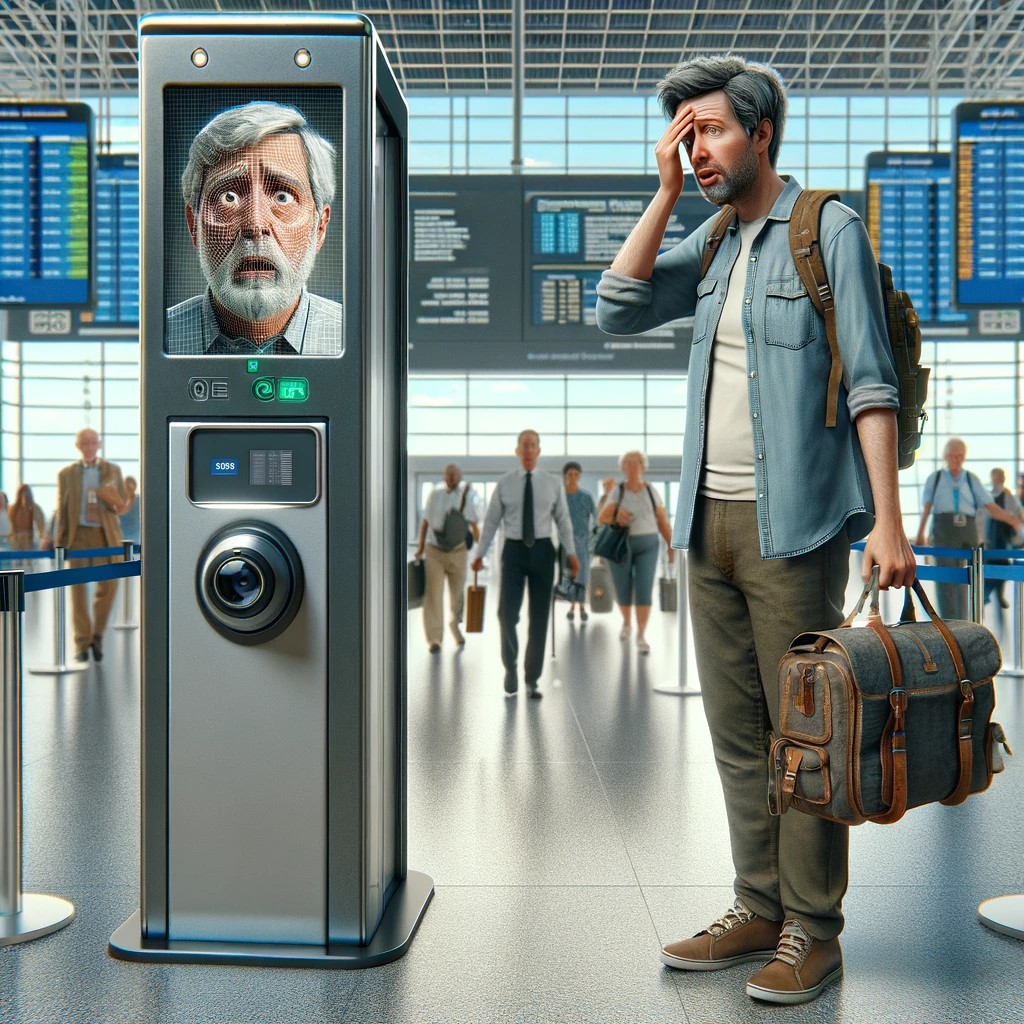

Using my face as my boarding pass to get on a flight to Oaxaca, Mexico and then as my passport to get back in the US got me thinking about how facial recognition has permeated the travel experience. To help us understand where this is going, we talk with two travel industry experts, Dr. Sheldon Jacobson and Henry Harteveldt.
But before that, we talk about eating grasshoppers, an EV experience with Avis, and a couple of my travel tips that need to be revised. All this and more – click here to download the podcast file, go up to the Subscribe section in the top menu bar to subscribe on your favorite site, or listen right here by clicking on the arrow on the player.
Here is the transcript of TravelCommons podcast #199:
Since The Last Episode
- Intro music — Warmth by Makkina
- Coming to you from the TravelCommons studios in Nashville, TN a couple of days after a last-minute 200-mile trip up to Carbondale, Illinois, home of the Southern Illinois University Salukis… but that didn’t matter. What did matter is that Carbondale was right in the center of the solar eclipse’s path across North America, which meant we had 4 minutes of total eclipse.
- Looking up, straight into the sun with its corona glowing, wavering around the black disk of the moon — I’ve seen… we’ve all seen pictures of total eclipses, and of this one all across social and regular media Monday afternoon. But the pictures couldn’t do justice to being there, even if there was the far end of the Salukis stadium parking lot, backing up to a scraggly bit of woods. The experience more than made up for the 3-hr drive there and the 5½-hour bumper-to-bumper traffic back. I add it to my list of things that, even though we’ve seen seemingly an infinite number of pictures of them, experiencing them in real life was worth the hassle to physically travel to see them. The Taj Mahal, the Great Wall of China, Niagara Falls — all on the list. As opposed to, say, The Mona Lisa in the Louvre. The crowd of people with their phones in the air trying to get a picture was much better than the Mona Lisa itself.
- Before that, the start of March, we were in Oaxaca, Mexico for a week. I’ve had Oaxaca on my “To Visit” list for 4-5 years now. For me, it was a good match — the combination of interesting food, lots of culture, and no beach. I’ve done “resort-y” Mexico — Cabo, Cancún, Puerto Vallarta — not a big fan. While there were a lot of tourists in Oaxaca, it didn’t seem to be overrun with them like, say, the center of Cabo is. Maybe because the city center is bigger, so there’s more space to absorb them, or maybe the absolute number of tourists are lower; it wasn’t an easy nor a cheap flight to get there.
- We hit the food scene pretty hard, high- and low-brow; food stands in the market; high-end places serving up phenomenal moles. But the food that made the biggest impression is the insects. It wasn’t some tourist-baiting shtick. Walking past a group of street vendors, I saw one of the women making a snack of a couple of grasshoppers wrapped in a small tortilla. At a mezcal bar on the eastern edge of the Centro, the bartender put down a small bowl of grasshoppers as a bar snack. (If you follow TravelCommons on Instagram, you can see a picture in my Oaxaca story) “Those are good grasshoppers,” he told us. “I drive an hour up towards Pueblo to get them. They’re not farmed like the ones you get in the markets.” I have to admit that I’m not enough of an insect connoisseur to be able to pick out the finer nuances of free-range vs. farmed grasshoppers, but they were as good as Beer Nuts as a bar snack. Or maybe that was just the 3rd, or 4th, or 5th shot of mezcal talking.
- Bridge Music — Another Girl (instrumental) by duckett (c) copyright 2009 Licensed under a Creative Commons Attribution Noncommercial (3.0) license. http://dig.ccmixter.org/files/duckett/23334 Ft: fourstones, miafas
Following Up
- Friend of the podcast Allan Marko swung by the website to leave this comment about the last episode:
- “I was assigned an EV by Avis at Fort Lauderdale [at the end of February]. Curious enough to try it out for the relatively short distances I would be traveling, I got in. After starting, I noticed it only had a 10% charge, so, “check please.” I fired up the Avis app and selected a Chevy Malibu with 1,200 miles on it. As for booking.com, we had tremendous luck using that website for most of our accommodations over a two month period in SE Asia five years ago – exclusively for hotels though.”
- Allan, thanks for that. Expecting you to drive off with a 10% charge? Avis would never think to give you a car with just an ⅛-th of a tank. And if they did, it would take them 10 minutes to fill the tank and get it back to you. But for that EV? Even at a Tesla Supercharger, at least an hour, maybe more. No wonder they tried to get you to do it. And regards to booking.com, my experience with their hotel product is the same as yours — never had a problem. But their property rentals, never again!
- One of my regular travel pro tips from years ago was “Don’t take the last flight out” because, if you missed your connection or your flight was canceled, you had a backup. And, as an IRROP passenger — industry lingo for “irregular operations” — you have priority on open seats on that later flight; even more so if you have frequent flier status. But nowadays, with US airlines sporting load factors over 80%, this strategy is a lot tougher to make work. Last June, back in episode #194, I talked about how United’s delay leaving Amsterdam meant we missed our connection home, and how I spent about an hour between the service agents at ORD and on the phone, saying “This is unacceptable” 2, 3, 4 times before they found two seats on the later flight to BNA that they’d been saying was completely full. And now this trip flying home from Oaxaca through DFW on American, I had gotten an email saying there could be bad weather, but I thought, “Well, there’s always that later flight.” En route from Oaxaca to DFW, I’m connected to the plane WiFi and an hour before we land, I get a notice from American — our flight to Nashville had been canceled. OK, that sucks, but no panic, they’d rebook me on the later flight. But I keep reading — no rebooking; it just tells me to go to the American app. The WiFi over northern Mexico is not the greatest, but when I do get the app to respond, it’s not showing the later flight as an option. Indeed, the options keep changing with each refresh, but nothing earlier than the next day, Friday, or sometimes, not until Saturday, two days later. It wasn’t until after we landed, passed through Immigration, and were waiting at baggage claim to pick up our luggage to go through Customs that we finally got a message through the app that they’d found us seats on the later flight. Still got home that night, but in both these instances, the customer service experience has degraded just so far. I’ve had to push very hard, and, honestly, be a bit of a jerk to get what used to come seamlessly.
- And another travel tip that seems to need retiring — “Use Twitter as a Concierge Service”. While struggling to rebook while still in the air from Oaxaca, I pinged American on Twitter hoping for a little more help. What I got was an amazing (and depressing) amount of spam messaging masquerading as AA customer service managers. It’s easy to get fooled in the panic of trying to find a way home, but a few rules to keep in mind — only communicate with the airline’s gold-checked verified accounts; ignore messages from everyone else — like “AMERICAN AIR HELP DESK” (all in caps) or “Jason frank (uppercase Jason, lowercase case frank) American Air manger” (as opposed to “manager”); and never give anyone your phone number.
- And there’s a quick programming note at the end of this episode, so for those interested, hold off on hitting the Skip button when you hear the music.
- If you have any travel stories, questions, comments, tips, rants – the voice of the traveler, send ’em along to comments@travelcommons.com — you can send a Twitter (X?) message to mpeacock, post your thoughts on the TravelCommons’ Facebook page, or on the Instagram account at travelcommons — or you can skip all that social media stuff and post your comments on the web site at TravelCommons.com.
- Bridge Music — Nube – Djiz Rmx by Kwame (c) copyright 2007 Licensed under a Creative Commons Attribution Noncommercial (3.0) license. Ft: SylviaO
Smile for Security: The Future of Facial Recognition in Travel
- Over the years on the podcast, we’ve talked about how travelers are seeing more and more use of biometrics in their travel days. I’ve told the story of my first fingerprint scan back in the late ‘90’s so I could skip the US immigration line on my weekly commute home from Toronto-Pearson Airport. My colleague’s reaction — “I’m not giving the US government my biometrics!” Me — “I can skip a 3-minute line? Where do I sign up?” Which I think shows that the privacy-vs.-convenience choices haven’t fundamentally changed all that much in the subsequent 25 years.
- But (surprise!), technology has, and it seems to be accelerating the use of biometrics, specifically facial recognition. Boarding our flight to Oaxaca, our face was our boarding pass — just look at the camera, wait for the “bing”, and move on. And coming back, the Global Entry kiosks no longer need passports, no longer have you twisting your hand just so to get the fingerprint pad to read all five fingers; just walk up, it takes your picture, and tells you to move on.
- Which got me wondering — where is this going? To help answer this, I invited on two guys who have been digging deep into this for a number of years. First up, Dr. Sheldon Jacobson, Professor in Computer Science at the University of Illinois. Sheldon was last on the podcast in episode #189 in September 2022 talking about why another of my travel tips, “catch the earliest flight you can”, is not always right. Over the years, Sheldon has developed operations research models to optimize aviation security. So I asked him to come back on the podcast to talk about the growth of biometrics…
- Mark: Sheldon, thanks for coming back on to the Travel Commons podcast. Wanted to talk with you about biometrics, facial recognition, all the things that seem to be increasing with regards to air travel.
- Sheldon: The airlines, as well as the Transportation Security Administration need to know who you are when you are traveling and they relied on identification cards, driver’s license, real IDs and are continuing to be part of the future. But ultimately, the best way to determine who you are is through your face and biometrics and artificial intelligence imbued with it. In fact, it is a solution that people are recognizing; the airlines are starting to use it. And of course, the Transportation Security Administration is investing billions of dollars to advance this idea. And there’s a reason why they’re doing this. They’re doing this simply because the traditional model of airport security screening has been to detect stuff — prohibited items, knives, explosives, firearms, even, you know, full size tubes of toothpaste could be a threat based on explosives that can be embedded in them. However, the real threat are the people and facial recognition is a means to transform the platform for airport security from the detection of items to knowing your traveler. And that’s where we’re heading right now. And this is the future of airport security.
- Mark: And how does that work? How do you think that works?
- Sheldon: TSA has not broadcast this and I don’t even know if they’re thinking about it, but I have thought about it and I have proposed to them because I visited them in October 2023. And I told them that if they can bring facial recognition biometrics and the use of AI to truly validate and authenticate the travelers, the need for physical screening will be reduced tremendously to the point that they can create a new class of traveler, which I would call a “Super PreCheck” traveler who subjects themselves to greater background vetting. But then they would be treated like a known crew member at an airport and require no further physical screening. That is the future of airport security.
- Mark: It’s almost like “Back to the Future”, right? It’s almost like back to pre 9/11 days.
- Sheldon: Now, some will argue, “Oh, someone will gain the system and we will have a terrorist threat because of that.” And I would argue the exact opposite, that the only people who would be willing to subject themselves to the background check would be people who know that they’re going to get through it fine. And the ones who are truly threats cannot risk it because rarely are people acting by themselves. They’re often acting in a network. And as a result of that, for them to be exposed, they would be exposing their whole network. And the risk of doing that is far too great. What it would also do is it would parse the whole spectrum of travelers into a group of people who are willing to be known and a group of travelers that are not willing to be known. But over time, the ones who are willing to be known will be much larger, which means you can target your resources and your attention on this so-called unknown group and actually make it more secure for the air system by targeting your resources in that way. After September 11th, everybody was treated the same — one size fits all. TSA PreCheck moved away from that. Now, I’m proposing we move even further. And our original research we presented to the TSA in 2003 when we proposed this idea of differential screening to them and how it would work and why it would be beneficial. We said that you really need three classes, two would be fine, but three would be better. And it turns out that third class is what we would now call a “Super PreCheck” class of passengers. And those are the people who would be treated like crew members, the known crew members. And a lot of people would be willing to pay for that privilege and we’ve put boundaries on what that means. It wouldn’t be renewed every five years; it would be renewed potentially every year. It would be more expensive. But there’s a lot of business travelers who are willing to pay that price to basically pass through security untethered, but they aren’t a risk to the system anyway. So why waste resources and time on them? It would transform the footprint and create what I would call “security tunnels” rather than security checkpoints for many of these people.
- Mark: That seems to make sense. What was the reaction to that at TSA?
- Sheldon: That’s a good question. I don’t know. I don’t know if I can say that.
- Mark: Ok, I got it.. Understood. I just had to ask. Well, that’s a great concept and I appreciate that insight around you guys’ research. You’re right. I mean, there’s something that says you just look at what people are willing to sign up with — with Clear. with Global Entry, with PreCheck. Again, frequent travelers will always look to streamline that experience. And so I would agree, I would say there would be people in a heartbeat who would raise their hand for that.
- Sheldon: Exactly. Right now, people who sign up for Clear pay $189 on the top end for one year, being able to be identified as who they are and go to the front of the precheck line. That’s all they’re paying for and they’re not paying for anything more. If the TSA implements a new class of passengers then Clear would become superfluous and literally would go away.
- Mark: Yes, that was what I was thinking also.
- Sheldon: It’s just, it will not be needed anymore. And in some sense, the pathway of using what the TSA calls the “credential authentication technology” which basically validates who you are using biometrics as well as that you’re entitled to, imply that you don’t even need a boarding pass right now when they implement this, and in some airports they have it, Clear will have to find a new business model because the TSA is going to assert that model into their own operations.
- Mark: You can kind of feel that. And indeed, I still think this most recent version of Clear — and I had originally signed up for the initial version way back 10-15 years ago (whenever it first started), Rev 1.0, and then they went bankrupt and now we’ve got Rev 2.0. But even today, I still have a challenge to see a compelling business model for the service that they offer. Oftentimes at a lot of the airports I’ll go to, the difference between a Clear line and just the basic PreCheck line is pretty much nothing.
- Sheldon: Exactly. I’ve never been impressed with their business model. They’ve tried to sell it for stadiums and large entertainment venues. The challenges, it’s just been difficult and most of their money, most of their resources, most of the revenue still comes through airports and they need that. I just don’t see the future of it being very bright.
- Mark: Is there more facial recognition coming or different facial recognition coming? Where do you see that path going?
- Sheldon: Well, we are nowhere near the end game on this facial recognition as effective as it is. I mean, the concept is ideal and wonderful. It’s still not perfect. It misses certain people of color. It struggles at certain times, and research is continuing to bring the error rates down, lower and lower and lower, especially if you’re going to create security tunnels where people just walk through it. And your picture is being taken literally in real time matched up using recognition. And then the next thing you know, you’re at your boarding gate because everything worked out fine for you. And now it will be the majority, the vast majority of travelers. So we are nowhere near the end of this and we are at the beginning. I think the challenge right now is the perception that people do think there is a privacy concern. And like I said, I think it’s exactly the opposite. I think this is opening up opportunities where we are going to spike in one dimension of AI which is facial recognition. And then the rest of the screening aspect at airports and validation literally gets dampened and in some cases, completely eliminated. I’m a firm believer and supporter of facial recognition for airport security and air travel. I know that if they do it right, and they seem to be on that pathway, that we are going to have a very different experience at airport screening for security and even air travel in the next 5 to 10 years. It’s just going to be radically and dramatically different. And I think when people realize that and begin to experience that they’re going to be happy for it. But at this point, a lot of the rhetoric is around privacy, but our privacy is being violated so often, so frequently and in so many venues that argument is no longer holding any water. I am convinced that this is a positive future for air travel in all aspects.
- Mark: Sheldon, thanks very much again for joining us on the TravelCommons podcast and sharing that. That’s great stuff.
- Our second guest is Henry Harteveldt, a travel industry analyst for many years. He had the depth of experience and industry contacts to give us a grounded sense on what’s coming with regarding biometrics…
- Mark: Henry, thanks for joining us today on the Travel Commons podcast. Wanted to talk about biometrics in and around air travel and specifically, I don’t know if this is recency bias or what, but it just seems like I’ve seen a whole lot more of, especially facial recognition over the past couple of years. What’s your cut at it from a travel industry standpoint?
- Henry: In the Crawl/Walk/Run continuum, I would say that with biometrics, we are somewhere between crawl and walk. Think of biometrics as the baby who is crawling really fast and it’s going to start walking any day now. But in the meantime, it’s scooting all over the place. So let’s break it down… Using facial recognition cameras for boarding flights has actually been around since before COVID began. I think the trial started somewhere in the 2016-17 time frame for international flights. That’s the only time it’s used right now, and it started to roll out in 2018- 2019. Delta was one of the first to embrace the technology and JetBlue as well. And what it does when it works well, and this is something we should come back to to discuss, but when biometrics, facial recognition works as everybody wants it to, it speeds up the boarding process. It reduces the need for us to show not just a physical boarding pass but also a physical passport. And, as a result, on a wide-body jet, it can shave perhaps 10 or more minutes off the boarding time; on a single-aisle plane, a 737 or an A320-type of plane, that could shave 5 to 7 minutes off. So it speeds up the boarding process and makes everything a little bit more efficient. It’s not perfect. There are people who are uncomfortable using it. There are people who are not familiar with it. So airlines have to have a belt and suspender type of approach. They’ll have to have gate staff there for the time being. But I don’t think we are that far away from where international travel is primarily biometrics based boarding, at least in major airports. And I think we will start soon to see it being tested for domestic travel, but there’s going to be a wrinkle with that when we use the biometric readers at the gate to get on the plane. The database links back to US Customs and Border Patrol which has photographs of US citizens, resident aliens, and international visitors, and it can call up that data to validate that you are you and I am me. With domestic flights. I think only the TSA has the biometric data right now for PreCheck. So it may take a little bit of work to get to a point for that. So that’s boarding. But let’s talk about airport security. Yes, TSA is indeed testing and in some cases, I think it’s actually beyond testing, they are rolling it out facial recognition that again eliminates the need for us to take out a driver’s license or passport or any other physical ID and, importantly, eliminates the need for us to show any type of boarding pass, whether it’s a paper boarding pass or digital boarding pass. And again, in theory, it speeds up the number of people who can get into and through the security screening process and reduces the need for human agents at those checkpoints. Now again, we’re still very much at the beginning of this. And TSA is saying we are going to have a security screening officer at that checkpoint in case something goes wrong or in case someone isn’t comfortable using biometrics.
- Mark: Yeah, that was my experience in Nashville. There was a guy standing right there.
- Henry: And as we record this, the TSA is testing at Las Vegas, basically this walkthrough type of environment, a new type of screening which is biometrics-based to validate who you are. You put your bags on the belt, you go through, it’s a lot less invasive, a lot less intrusive and supposed to be a lot faster. I actually want to go over to Las Vegas just to check it out and see what it’s like. They have this in Dubai and they are testing it elsewhere in England and in France, they are testing it on Eurostar. Now, there are a lot of other things coming along with biometrics at a lot of European airports and in Asia as well. I was just in Singapore. There are biometrics-based scanners so that you don’t have to queue up and have a border patrol officer review your passport, stamp your passport.
- Mark: I had it at Heathrow last November. I went through the e-gates. So I was just surprised; I walked through to the other end and I was like, “Wait, this is it? Nobody to stamp my passport?” No, nothing. Just like, “No. Get out of here. Go, move on.”
- Henry: Right. Now, for those of us of a certain age, part of the love of travel is hearing that clunky thunk of the passport officer stamping your passport and, every time you get a new passport, the passport service mails back your old one. Those become mementos of our lives.
- Mark: Yes, absolutely.
- Henry: And there is a part of me that will miss the day when we get our passports stamped just as there is a part of me that misses airline branded paper, boarding passes to show “Oh, here’s where I have been” and so on.
- Mark: That obviously, then, pivots over to — how should the travelers think about biometric data and the storage of that and the risk of that as a condition of travel?
- Henry: Look, it is obviously a personal decision. Our research shows that right now in the US, far more travelers would trust sharing their personal biometric information with an airline than with any government agency. So in the US right now, it’s nearly 80% of airline passengers who, and this is first quarter 2024 data fresh off the press if you will, nearly 80% of us, airline passengers, business and leisure say they’re willing to share their personal biometric data — fingerprints, iris scans, etc. — with an airline they fly regularly if it will lead to a more efficient airport experience or journey. Only a quarter of passengers say they’re comfortable sharing their personal information right now with any government agency or entity even though, again, with the same benefits of an easier journey. Now, both of those numbers are up from 2023. The government only keeps certain information for a certain amount of time, usually 30 days or less and then it is expunged. So I am in the crowd that is comfortable sharing biometric information with governments and airlines because doing so makes my journey more efficient. It’s faster, it’s less stressful. It’s fewer people that I need to interact with. Remember we’re somewhere between Crawl and Walk. But where I see it, from the analyst perspective, the time difference, the time it will take us to go from Crawl to Walk will probably be many times longer in the time that will be needed to go from Walk to Run. Because again, as improvements emerge with the technology, the hardware, as well as the software, changes in society, changes in social acceptance of biometrics, the appreciation for benefits, we will reach that so-called tipping point where all of a sudden we see massive and welcome acceleration. It’s interesting. Younger travelers are a lot more suspicious of the government than some of their older counterparts. And travelers over 65 are less willing to share personal data with the government. The sweet spot is travelers from 30 to 64-ish, call it.
- Mark: That’s an interesting distribution.
- Henry: And I think that an important point for anyone listening here — if you work for an airline, for a technology company, for an airport, for a government agency or, for that matter, if you work at a hotel company, cruise line or other parts of the travel industry. You cannot view your customers as a homogeneous block and you have to understand their welcoming the use of technology. The irony is as we all know, Gen Z are digital natives. They’re very comfortable using technology. They will put anything and everything on social media it seems like, but they have some very legitimate concerns in their minds about how will governments use their biometric data and could it be used against them? And I’ll just add that hotels are looking at how they evolve the check in process. You know, I think one of the dumbest questions in the world is when we are standing at the front desk of a hotel suitcase in hand, giving them our credit card and ID and the agent says “Checking in?” Like “No, I thought I would just, I have nothing better to do. So I thought I would bring a suitcase to a hotel in a different city and hand over a credit card and my personal information just to say hello.”
- Mark: Right. “And by the way, I like standing in line. So that’s why I’ve been waiting for 10 minutes to get up and have this conversation with you.”
- Henry: Exactly. But you know, hotels are looking at how they improve the check in process. And granted, at the five-star true luxury properties and resorts, I think they will say, “Look, we value and our guests value the human interaction,” but they’re going to be a part of that. Guests can say “Look, there’s some things I can do for myself and then I want to talk to somebody about some other stuff.” But I think with four-star and below, be prepared for more biometric-based self-service check in checkout experiences. And I think, frankly, a lot of people would welcome it because it’s a lot more secure for 99.9% of us. Eventually. I think biometrics will be more than welcome. And again, if it makes our journeys that much more efficient and less stressful, less unpleasant, there is to me, no downside.
- Mark: Yes, I think that the cases you’ve laid out is the appropriate one, which is, it’s a combination of frictionless or making travel much more efficient than what we have today, doing away with as many lines as we can, and on the same token, being more efficient for the travel company, be it a hotel, be it an airline, be it the company running the airport so that their costs stay down and our costs stay down to travel. So the trade off on that, people are going to strike their own balance around privacy versus efficiency. Henry, thank you very much. This has been a great conversation. I’ve really enjoyed it. Thanks for coming on a TravelCommons podcast.
- Henry: Thank you for inviting me. I enjoyed it as well.
- Thanks to Dr. Sheldon Jacobson and Henry Harteveldt for taking the time to talk to us about biometrics, facial recognition and give us an idea of what we travelers should expect to see soon. Check out the show notes at TravelCommons.com for links to their work.
Closing
- Closing music — Pictures of You by Evangeline
- OK, that’s it, that’s the end of TravelCommons podcast #199
- I hope you enjoyed the show; the conversations with Sheldon and Henry. They had so much great insight; the editing decisions were tough. This is usually the point where I say “and I hope you decide to stay subscribed” but this is, as they say in the UK, the penultimate episode of the TravelCommons podcast; a fancy way to say “second-to-the-last”. The next episode will be #200, so a good round number to end it. I’ll unpack it all next month, but just wanted to give you all a heads up.
- As always, you can find us and listen to the current episodes on all the main podcast sites — Apple Podcasts, Spotify, SoundCloud, and Amazon Music. Google has shut down their Podcast app, at least in the US, but you can now get the regular TravelCommons audio episodes on the TravelCommons’ YouTube channel. Go figure — I can never keep track of what bits Google is shutting down or renaming. But you can always ask Alexa, Siri, or Google to play TravelCommons on your smart speakers.
- You can click on the link in this episode’s description in your podcast app to get to the show notes page at TravelCommons.com for a transcript of the episode and links to Sheldon and Henry’s websites. And along the side of the page, you’ll find links to all the TravelCommons’ socials.
- If you have a story, thought, comment, gripe – the voice of the traveler — send ‘em along, text or audio file, to comments@travelcommons.com or to mpeacock on Twitter, write them on the TravelCommons page on Facebook or Instagram, or post them on our website at travelcommons.com. And thanks to everyone who has taken the time to send in emails, Tweets and post comments on the website. I really appreciate it.
- And until we talk again, safe travels; and thanks for stopping by the TravelCommons.
- Follow me on Twitter
- “Like” the TravelCommons Facebook page
- Direct link to the show