It’ll take travel guide books a while to catch up with allthe restaurants and bars closures caused by the COVID lockdowns. To help fill that gap, here are the best places I’ve ate and drank at during my 2021 travels. I’ll update this after each trip, so keep it bookmarked.
Chicago
NoodleBird at Fat Rice, 2957 W Diversey Ave (at N Sacramento), Logan Square — The lower price-point, post-pandemic reincarnation of Fat Rice, a perennial recommendation of mine. Like Fat Rice, NoodleBird’s starting point is the Chinese-Portuguese fusion cuisine of Macau and then extends to other Asian regions
Galit, 2429 N Lincoln Ave (just north of Fullerton), Lincoln Park — Great Israeli/Middle Eastern restaurant with a nice 4-course menu that let’s your table try a lot of dishes
High Five Ramen, 112 N Green St, West Loop — Small, hip basement ramen joint. Expect a wait, but have a beer and a Texas BBQ appetizer upstairs at Green Street Smoked Meats while you wait
MingHin Cuisine, 2168 S Archer Ave, Chinatown — It’s our favorite dim sum place. And they take reservations!
Birrieria Zaragoza, 4852 S Pulaski Rd, Archer Heights (near Midway Airport) — Small, family-owned place with a small menu focused on birria (stewed goat) from Jalisco. Warm service and phenomenal food.
Bitter Pops, 3357 N Lincoln Ave (at Roscoe), Roscoe Village — a renovated slashie (bar + packaged goods) that has a great selection of Chicago craft beer
Maplewood Brewery & Distillery, 2717 N Maplewood Ave (South of Diversey), east of Logan Square — Small, neighborhood bar tucked up against the Kennedy Expressway
For more taproom ideas, check out this pre-pandemic TravelCommons taproom tour. Three of the four taprooms featured are still open — Marz, Whiner, and Lo-Rez. Only Lagunitas Brewing is still closed
Oxbow Blending & Bottling, 49 Washington Ave, Portland — Great selection of farmhouse ales with an outpost of Duckfat serving up fries on the patio
London
Behind Restaurant, 20 Sidworth St E8 3SD, Hackney — Focused on seafood and modern British flavors. The whole restaurant is a kitchen table experience, watching chefs prepare the dishes and then serve them to you. One of the best Michelin 1-star restaurants I’ve visited.
The Ginger Pig, Corner of Stoney St and Park St, Borough Market — Bought the best sausage rolls I’ve ever had from their walk-up display. Want to go back and try their meat pies.
NOPI, 21-22 Warwick St W1B 5NE, Soho — Fun Mediterranean/Middle Eastern fusion restaurant from star chef Yotam Ottolenghi. Sat at the bar and had a great late lunch.
Al Masar, 214, 216 Borough High St SE1 1JX — Strategically located near the Borough tube stop. Solid Lebanese wraps; exactly what I needed after a long taproom crawl down the Bermondsey Beer Mile.
Bermondsey Beer Mile, a mile of craft brewery taprooms that have set up shop in adjacent railway arches under a huge brick bridge carrying commuter trains in and out of London Bridge train station. Rob Cheshire, long-time TravelCommons listener and UK craft beer podcaster laid out a taproom crawl that started at The Kernel, the first brewery in on the Mile, and continued through The Barrel Project, Cloudwater, and Brew By Numbers.
Old Fountain, 3 Baldwin St (at City Rd) EC1V 9NU, Shoreditch — Tucked into a little side street, it’s a comfortable pub with a great UK craft beer selection.
Last month’s travel got me wondering what travel changes are going to stick after the COVID pandemic begins to recede. With all the restaurant and bar closures caused by COVID lockdowns, I’m updating my recommendations list based on recent travels. And I’m way overthinking our first post-lockdown international trip. All this and more – click here to download the podcast file, go up to the Subscribe section in the top menu bar to subscribe on your favorite site, or listen right here by clicking on the arrow on the player.
Here is the transcript of TravelCommons podcast #178:
Coming to you from the TravelCommons studio in Chicago, Illinois after a much lighter travel schedule than before the last episode. The day after posting the July episode, Irene and I got back in the car (because those 12-hour drives to and from the East Coast just weren’t enough for me), but this time heading north, as I mentioned at the end of the last episode, to Traverse City, MI to do Paddle for Pints with some friends; it’s a taproom crawl, but in kayaks instead of on streets. It’s a lot of fun. There’s something about physical exertion while drinking that seems to justify the next beer.
Now, anyone who’s driven any distance through the Midwest knows there’s only two seasons here — winter and construction season — and we didn’t get too far outside of Chicago on I-90 before a merge down to single lane traffic ground traffic to a crawl and I started refreshing Waze and Google Maps looking for alternatives. I’ve said in past episodes that, even though Google owns both, my experience is they can recommend different routes, especially in high-traffic, fast-changing situations. To me, Waze feels a little “twitchier”; it’ll twist you down a half-dozen random side streets to save 30 seconds while Google Maps guesses you’re willing to suck it up for a couple more minutes in exchange for a simpler route. And that’s exactly what happened to us in northwest Indiana which leaves me trying to figure out which route to take. I tweeted out later (actually while on a snack break in a taproom in Grand Rapids) “ I really hate it when Google Maps and Waze fight” to which the Waze social media crew replied “We like to think of it more as a disagreement”. Nicely done. And then Jim McDonough, a long-time TravelCommons listener, added “Apple Maps breaks the tie?” Good idea, but I was having enough fun swiping between two maps; adding a third would’ve put me in the ditch for sure. I mostly used Waze, but skipped the recommended routing through side streets in Gary, Indiana. The risk-reward trade-off on that just didn’t feel worth it.
I was supposed to head out to the Bay Area last week on business, going to a plant on the east side of the Bay for a big team meeting. But it got re-vectored at the last minute from California back to Chicago because that Bay Area country had reinstated indoor mask mandates. Nobody questioned the move. With everyone on the team fully vaccinated months ago, we’d all happily gotten used to meeting with each other like it’s 2019 again and really didn’t want to go back to 8 hours of masks, muffled voices, and trying to read non-verbal cues from the nose up. As it was, we just made it under the wire — our meeting was Wednesday and Thursday, and then on Friday, Chicago’s indoor mask mandate went into effect. It’s sorta peak Chicago that the city collected the revenue off of 385,000 mostly maskless Lollapalooza attendees before dropping the boom on those of us who actually live in the city.
Bridge Music — Astral Travel by Astral (c) copyright 2013 Licensed under a Creative Commons Attribution (3.0) license. http://dig.ccmixter.org/files/Astral/44282
Following Up
One of the reasons it takes me so long to do an episode is I lack the discipline to bail out when I get caught in a click spiral. This time it was about the United Airlines flight that was evacuated because a teenager decided to troll fellow passengers by AirDropping them a picture of an Airsoft gun. For the non-iPhone users out there, AirDrop lets iPhones and Macs easily share stuff — pictures, videos, web links — wirelessly with others nearby. It’s been around for about 10 years and pretty quickly people figured out they could drop random/interesting pictures onto nearby strangers who had set their phones wide-open. I’ve seen this happen and it can be pretty funny, watching someone suddenly start looking around in a bar or a train, wondering who’d AirDropped them a picture. But what’s funny or, at worst, annoying in a bar is easily interpreted as a safety threat 10 years on from 9/11. They pulled everyone off for rescreening, searched the plane, and then left three hours later, leaving the teen behind in SFO. Understandable, I thought, if maybe a slight overreaction — until I got to maybe the 5th page of Google search results where I clicked through to not-yet- another rehash of the United incident, but something different — a story about an AirDropped message on a Delta flight. It said “A plane-jacking will happen soon, 2 hours and 37 minutes it will start in the front on aisle 6.” That flight too was evacuated, but this time they didn’t find the sender. Maybe airlines’ safety demos need to show iPhone users how to set their AirDrop to “Receiving Off”.
Irene and I continue to push on with plans for our first post-lockdown international trip, to Italy for a bike tour through Puglia. The whole Delta variant thing adds to the uncertainty. I talked in episode #175 about sorting through trip insurance and figuring out what credit card to use for the tour. Now booking hotels before and after the tour, we’re choosing to pay 10-15 euros more a night for cancellable rates, kind of a DIY trip insurance. Booking our flights into Bari, where the tour starts, I’ve also felt the need to be a bit more thoughtful. Airline schedules seem to be a bit more variable than usual. Last week, American sent me a note to let me know our November LHR-ORD flight has moved up 5:15pm to 10:35am. I understand that; air traffic is not following predictable patterns and they’re trying to keep up. For that direct flight home from London, it’s not a problem. But when we’re having to make a connection to a city with not-frequent service, it’s a different matter. The first thing I did was X out anything with more than 1 stop; it’ll be hard enough keeping 2 flights aligned let alone 3. Then I focused on the big European hubs — Heathrow, Frankfurt, DeGaulle — skipping connections at smaller places like Munich, Zurich. Finally, I look for connection times around 3 hours; what I thought would be a “Goldilocks” connection — not too short that any hiccup on the inbound flight would cause a problem, but not too long that we’d be having to sit in the airport all day wearing a mask or would have to track COVID protocols in yet another country because of an overnight connection. All that being said, we’re booked on Air France with a 2 hr, 50 minute connection in DeGaulle. But I don’t have any SkyTeam status, which causes me a bit of a worry — maybe we get caught in a long non-status security line. So I did some DIY trip insurance on the flight, burning an extra bit of my pile of American Express Membership miles for a ride in business class (cancellable, of course) to make up for my non-status status. You could say I’ve gone way down a rabbit hole overthinking this one and I wouldn’t really argue with you. But then again, it’s the first international trip in 2 years that I’ve been able to plan. So it’s kinda like an only child, getting way too much their parent’s attention.
I was digging through my travel card wallet for my Global Entry card to find my Known Traveler number to put on the Air France reservation and came across a handful of Southwest drink coupons that are about to hit their expiration date. Southwest says expiring drink coupons are good through the end of this year. But Southwest suspended alcohol sales a few months back, and rightly so after a passenger assaulted a flight attendant, saying the booze won’t return until the federal mask mandate ends. But the TSA just extended that until January, past the coupons’ extended expiration date. And really, I don’t see the TSA letting up on in-flight masks anytime soon, so is Southwest going to be the first dry airline?
I mentor start-up founders at a tech incubator in Chicago. A few months ago, one of my sessions was with a bionic implant start-up. Implant the chip and the back of your hand becomes a contactless card; get into your office or pay at Starbucks with the tap of your hand. Another reminder, if a bit, say, unsettling (icky?), of the move to a cashless society. I talked about it back in episode #136 in 2017, about being maybe the last generation of cash payers, that my younger traveling colleagues rarely carried cash; they paid for everything with a card. And then, the pandemic massively accelerated it. Everything went contactless; nobody wanted to handle your cash. Last year, in episode #165, I noticed I had the same $200 of 20’s in my wallet in June that I’d taken out of an ATM right before the March lockdown. Last month in New York, the coffee joint across from our hotel was card-only and the same for the ice cream shop around the corner from our place in Chicago. Restaurants that use the Toast point-of-sale system print out a QR code at the bottom of your receipt, letting you pay and walk away. The country of Sweden thinks they’ll be completely cashless in 2 years. But I’m seeing a little reversion to the mean post-lockdown. I stopped off at a bar during a Saturday bike ride for a rehydration break. I asked the bartender if she took cash. “Yup,” she said, “Never stopped. It spends just like everything else.” It felt good to put a 20 on the bar, order beers, and see her take cash from the pile just like in 2019. It’s also that inflation is making it tougher for small places to eat the 2.5-3% card fees. The little Mexican place across the street from work where I’ll grab carne asada tacos for lunch now tacks on that fee for card users. They’re happy when I pull out cash, though last week I got 80 cents back in nickels. I guess the cashless thing has now caused a shortage of quarters.
And if you have any travel stories, questions, comments, tips, rants – the voice of the traveler, send ’em along to comments@travelcommons.com — you can send a Twitter message to mpeacock, post your thoughts on the TravelCommons’ Facebook page or the Instagram account at travelcommons — or you can post comments on the web site at TravelCommons.com.
Bridge Music — Emma by Doxent Zsigmond (c) copyright 2015 Licensed under a Creative Commons Attribution Noncommercial (3.0) license. http://dig.ccmixter.org/files/doxent/50905 Ft: Martijn de Boer
What Will Remain from These Pandemic Times?
In past episodes, I’ve been pretty skeptical about forecasts of permanent changes to the travel industry, or society in general, from the pandemic. I have enough grey hair to remember commentators using the same “everything has changed” and “this is the new normal” language 13 years ago after the 2008 Great Recession, yet somehow we ended up back to maybe within 90% of 2007, the pre-recession starting point. Reversion to the mean is a strong force.
Unless it’s countered by a stronger force — like saving money — which is why I think the odds-on favorites for pandemic changes made permanent are what we’ve seen at hotels and restaurants. Checking into the Hilton in Midtown Manhattan last month, the front desk guy told us that they weren’t doing daily housekeeping; we could either schedule housekeeping now or call them when we wanted it. Pre-pandemic, Starwood and then Marriott would offer you points for skipping housekeeping — Go Green they called it. They pitched it as eco-friendly, but it really was all about saving labor costs. But the Hilton didn’t offer me any points. The week before, Hilton announced their new policy of on-request housekeeping across all of their brands; the first major chain to cement what had been an ad hoc pandemic response into a new chain-wide policy. The press release talked about “guest comfort”, but behind the PR flacks, it’s all about cost savings. I expect to see Marriott and others follow soon. I do have to give props to the housekeeping staff at that Hilton, though. When, after 3 days, I did call for a room cleaning, they were there in 5 minutes.
A bigger loss for me is the breakfast buffet. My usual pre-pandemic routine was to work out and then take a quick pass through the concierge lounge for breakfast. Hotels must’ve found their ad hoc grab-n-go breakfast sacks cheaper because that too feels like it’s going to be the new normal. Way back in episode #113, in January 2015, I scoffed at a bartender in MSP who reached over to punch my food order into the iPad mounted in front of me. Now, we aim our own smartphones at QR codes and order our own meals — without any help — again, saving labor costs.
Airlines started reverting to the mean at the end of last year when they dropped capacity restrictions and put butts in the middle seats again — just as traffic began to recover. If you haven’t been on a flight this year, you’d think nothing happened — well, except everyone wearing masks and the missing Bloody Mary eye openers on the morning Southwest flights to Vegas. Some folks are predicting the death of cancellation fees, but I don’t buy it. In 2019, United made $625 million in change and cancellation fees; ten of the largest U.S. carriers made $2.84 billion. That’s too big of a hole to leave unfilled. And they’re already creeping back in. Most Basic Economy seats are back to non-changeable/non-refundable. Maybe not this year, but if traffic holds up, I’d expect to see some airlines quietly not extend their fee waiver deadlines.
Private company behaviors are pretty straight-forward to forecast — just follow the money. It’s the government regs that are uncertain — how long do the mask mandates and COVID testing international entry rules stay around? Government rules only seem to ratchet up — it’s been 15 years since the TSA had us take our shoes off and dump our water bottles at security checkpoints and other than letting people bring on larger bottles of hand sanitizer, no one thinks the TSA is going to change those rules anytime soon. There’s no incentive.
Bridge Music — Melt Away by Kara Square (c) copyright 2014 Licensed under a Creative Commons Attribution Noncommercial (3.0) license. http://ccmixter.org/files/mindmapthat/46605
The Best Places I’ve Ate and Drank At In 2021… So Far
I talk a lot about food and beer in this podcast — as proven by the direct links to those categories in the top menu on the TravelCommons website. Back in episode #168 last fall, I said that, for me, food is one of the last hold-outs to global e-commerce and social media. 10-20 year ago, it was fun to go shopping and bring something unique back home. But now, there’s not much that you can’t find easier (and often cheaper) on Amazon or Taobao or Rakuten. And don’t even get me started on Instagram — if people aren’t in a 100-person queue to get their own personal shot of the Delicate Arch in Moab, UT then they’re queuing for made-for-Instagram-selfie murals like the WhatLiftsYou wings in Nashville’s Gulch neighborhood. But food — you can post all the pictures you want of it, but you can’t post that sense memory of eating a dozen fresh oysters on a breakwater in Brittany, having a bowl of pho for breakfast in Saigon, or a 1am fresh-off-the-grill char polish that’s been dragged through the garden at a Chicago hot dog stand.
And so, over the years, I’ve talked about restaurants, bars, taprooms that I’ve enjoyed and posted links to them on the website in show notes or in blog posts. But reading articles about the number of places that’ve closed since March 2020 — some say 10% of all restaurants in the US, almost 20% in Chicago — I figure it’ll take travel guide books and blogs a while to catch up with all the changes. It kinda hit me when a college friend pinged our group text for Nashville recommendations. I’ve been going there a couple of times a year for the past 5 years, but when I started going through my list of places, it struck me how many of them had closed. I had to re-curate my recommendations. I figured a good start on that would be to post a list of the best places I’ve ate and drank at during my 2021 travels on the TravelCommons website.
Now, fair warning, this is a very idiosyncratic list; it’s the best places I ate and drank at in, say, New York City in May and July. The New York list is pretty Midtown/Murray Hill-centric because that’s where we were staying and that’s where Claire was looking for flats. I walked into Ted’s Corner Tavern because it’s around the corner from Claire’s new place; it made the list because it’s what I think a great neighborhood bar should be — good-sized bar with friendly bartenders who aren’t too busy to chat with you, the right volume level (lively, but not so loud that you have to shout across the table), and, of course, 30 taps and a well-curated beer list.
I’ve tried to make my list a well-curated one. I don’t mention restaurants or taprooms that I thought were fine — the 3 or 3½-star places. It’s a list of places that stuck out in my mind for one reason or another, and would make me go out of my way to recommend them to, say, a college friend. This played out in a funny way on my Portland, Maine recommendations. I recommend Bob’s Clam Hut in Kittery for fried clams and Island Creek Oyster’s place in the East End/Munjoy Hill neighborhood for local oysters, but have no specific recommendation for a lobster roll place. It’s not for lack of trying; we had a lobster roll whenever we saw it on a menu, which wasn’t a cheap exercise since they were about $25 a pop. They were all good — we didn’t have a bad lobster roll anywhere. But after all that, there’s no one place I could point to and say “Go there for a lobster roll.” I just say “Order one if you see it. It’ll probably be good no matter where you are”.
Another oddity of the list — no Chicago places. Irene and I talked about this a bit. Between favorite places closing and cooking at home a lot more during the lockdowns and the strict mask mandate (which in Chicago was worded kinda like the airplane mandate — wear your mask at all times unless you were actively eating or drinking), we haven’t been anywhere that’s really stuck out. Well, except maybe for the Nancy’s Pizza a couple of blocks from the TravelCommons studios. They do a great pepperoni, spinach, and fresh tomato pan pizza. That’ll definitely make the list.
Because the list is a work-in-progress; I posted the first edition on the website last week with sections on Tucson, San Diego, Nashville, New York, and Portland. You’ll find a link in the episode description in your podcast app — if it supports HTML descriptions. I’ll be adding places through the rest of the year. There will be at least a couple of Chicago places (in addition to Nancy’s) on the list. I’m sure we’ll find some places in Puglia to add; and I’m positive I’ll find some UK taprooms that’ll make the cut since Rob Cheshire of This Week in Craft Beer has offered me a personal tour of his favorites.
When I’ve added a new section or think there’s enough new stuff to justify people taking a fresh look, I’ll put a new date on it so it goes back to the top of the Food and the Beer sections of the website, and I’ll post it on Facebook and Twitter. And if you end up hitting one of these places, shoot me a note and let me know if I got it right.
Closing
Closing music — Pictures of You by Evangeline
OK, that’s it, that’s the end of TravelCommons podcast #178
I hope you all enjoyed the show and I hope you decide to stay subscribed.
If you’re already subscribed, how ‘bout leaving us a review on one of the sites? Or better yet, tell someone about TravelCommons. That word-of-mouth thing; it’s really the only way to grow.
If you have a story, thought, comment, gripe – the voice of the traveler — send ‘em along, text or audio file, to comments@travelcommons.com or to @mpeacock on Twitter, or post them on the TravelCommons’ Facebook page, Instagram account, or website at travelcommons.com. Thanks to everyone who has taken the time to send in e-mails, Tweets and post comments on the website
After a 2-week, 2,500-mile and $120 in tolls driving expedition through the Northeast, I didn’t have much time left to write a new episode. So, I mined the audio files of recent TravelCommons interviews for some good stories that got left on the cutting room floor. We also talk about planning for a bike trip in Italy, a couple of things that might make the 2021 traveler gift guide, and we mourn the demise of American Airlines’ in-flight magazine. All this and more – click here to download the podcast file, go up to the Subscribe section in the top menu bar to subscribe on your favorite site, or listen right here by clicking on the arrow on the player.
Here is the transcript of TravelCommons podcast #177:
Coming to you from the TravelCommons studio in Chicago, trying to get this July episode in under the wire, a bit delayed due to a 2-week, 2,500-mile and $120 in tolls driving expedition through the Northeast that started with a 12-hr drive from Chicago to Manhattan on the Friday of the 4th of July weekend with as much of our daughter and as much of her worldly belongings as would fit in a BMW X3, helping her move into a 5th-floor walkup in Midtown. I was very pleasantly surprised to hit only two backups on what was forecasted to be the first really big post-lockdown travel day; a detour around an accident in the Poconos on I-80 and then, at the end of our drive, the completely predictable back-up at the mouth of the Lincoln Tunnel. A completely and happily uneventful drive. I then spent the rest of the week finding a different spot every morning for my standard Manhattan breakfast — egg & cheese on a toasted everything bagel and making sure they don’t slip some milk into my black coffee order — before spending the day in front of my laptop on a not-very-big desk in our not-very-big hotel room while Irene helped Claire get her flat all set up.
The next Friday, we left Manhattan for a week’s vacation in Maine with an intermediate stop in New Haven, CT’s Little Italy neighborhood for the classic white clam pizza at Frank Pepe’s. It was a bit of a wait — a 20-minute queue on the sidewalk and then another 45 minutes after ordering — but it was worth it. I’ve had many tries at white clam pizza before, but this one was, by far, the best — a generous helping of clams, garlic, and oregano on a cracker-crisp crust . We walked past other pizza places on Wooster St, but only had time to hit one, and so it had to be the ur-pizza joint, the classic, Frank Pepe’s. And luckily for us, it didn’t disappoint; the line along the sidewalk is well-earned. You know, the Michelin Guide says a one-star restaurant is ‘High quality cooking, worth a stop!’, a two-star is ‘Excellent cooking, worth a detour!’, and describes a three-star as ‘Exceptional cuisine, worth a special journey!’ I’m not saying that Frank Pepe’s is a two-star place, but I will say that it was damn good pizza that was definitely worth our detour.
We then headed up to Scarborough, ME, just south of Portland, for a beach vacation with friends. The traffic on the drive north was a steady stream of RV’s and pick-up tracks and cars with “roof bags” tied down on top and bikes lashed to the back that continued to thicken from I-91 to I-84 to I-90 to I-495 until it finally ground to a halt trying to merge onto I-95, which was itself filled with the same thick sludge of vehicles trying to make it north for the weekend. And then the weather wasn’t great — rainy, foggy, misty (now I know where Steven King got all his inspiration) so our time devolved into an week-long seafood fest — a bivalve-palooza of local mussels, oysters, and clams; intensive longitudinal lobster roll research; and, ignoring the current UK debate about crustacean sentience, multiple boiled lobster dinners — and taproom tour, hitting the big names like Allagash, Maine Beer Company, and Oxbow as well as some (many) other little guys. And then, finally, on the last day, sunshine.
After a week of this, the rain started up again as we turned around and headed back home, getting on I-90 in Albany and not getting off until we hit Chicago. It too was an uneventful drive, but not in a great way. By the end of that day, we’d developed a deep, deep hatred of those miserable strips of boring asphalt and the hellhole rest stops that make up the Ohio and Indiana Tollways. I hope Claire loves her new life, ‘cause I really don’t want to have to drive that way again.
Bridge Music — One for Me by SackJo22 (c) copyright 2009 Licensed under a Creative Commons Attribution Noncommercial (3.0) license. http://dig.ccmixter.org/files/SackJo22/21492 Ft: Haskel
Following Up
I have to say that the most important piece of travel kit on this trip was my USB-C to HDMI cable that let me mirror my MacBook Air display on the hotel and beach house TVs so that I could sit back with a beer and comfortably watch YouTube highlights of the Euro 2020 soccer tournament and the Tour de France on 40-60” flat screens instead of hunching over my 13” MacBook Air. I had a version of this in my 2019 traveler gift guide, but it got bumped off the 2020 version to make room for bring-your-own dining sets. But with restaurants and bars open and so not having to eat every meal in my hotel room, I think I’ll reverse that change and put this cable back on the 2021 guide.
I don’t know if masks will stay on the 2021 guide — that depends on transportation agency rules — but I bought another batch of the evolvetogther masks that I called out in the 2020 guide because, even after in-flight mask mandates get dropped, I might still wear a mask on a crowded flight during the cold and flu season because, for the first time in forever, I didn’t get my usual killer cold last year. Without a mandate, I probably wouldn’t wear a mask in the airport and probably not in a fairly open plane, but I think so when it’s a full flight, when there’s someone next to me in the center seat. I think about it — they’re exhaling maybe 14-16 inches away from where I’m inhaling. No airplane HEPA filter is going to be able to get in between that exchange. I say that now, but I’ll have to re-visit it after in-flight mandates go away and I’m boarding an 8-hour flight to London; that’ll be the real stress test.
In episode #175 back in May, I talked about making some Q4 bets on international travel — a Backroads bike tour in southern Italy in October and the UK in November. Back in the spring, vaccine roll-outs were choppy, especially in the EU, but I thought that everything would sort itself out over the summer making booking travel in the fall not such a risk. Now this was pre-delta variant, but while in Maine, we got an e-mail from Backroads with the subject line “Your Trip Is A Go!” followed shortly thereafter by an alert from Chase of a very large charge dropped on our Sapphire Visa card. Now we need to start tracking travel requirements. Back in May, the best bet for US travelers was to take a “COVID-free” flight on Delta or American to avoid the 2-week quarantine. Then, a month later in June, Italy significantly eased those requirements. Now, you fill out a pretty extensive on-line passenger locator form with all your trip information and your COVID vaccination card and you’re good to go… into Italy. Getting home, the US is still requiring a negative COVID test no matter what your vaccination status is. But, back in May, the CDC said Abbott’s at-home test can be used. It’s not quite as easy as a home pregnancy test — the Abbott test requires you to download an app and enough bandwidth for a video chat with a doctor to visually confirm your identity and the test results — but it beats having to hunt down at a testing place in a new city.
In the last episode, I did a bit of “fun with numbers,” pulling daily air passenger numbers from the TSA’s website to look at Memorial Day weekend numbers and then a couple of weeks after that when, on June 11, passenger counts broke 2 million for the first time since the March 2020 lockdowns. Extending that analysis — from mid-June to now, the last week in July, checkpoint volume growth has plateaued — the TSA volume numbers averaging just over 2 million/day since the last episode. That’s more than 3 times the 623,000 daily average for the same time last year, but still 21% below 2019’s number. But to a lot of fliers, it doesn’t feel that way. It’s back to full planes, long lines, and tight schedules that can’t recover from inevitable summer thunderstorm delays. Airlines are minimizing schedule slack, trying to claw back some of their 2020 losses, but also because of labor shortages — from crews to ground-support staff, the people who drive the fuel trucks and cater the planes. Some of that is common to other industries — people slow to reenter the workforce or took jobs elsewhere when furloughed — but there’s also something unique to the airlines, staff in the wrong places because travel patterns have shifted. We’ve talked about this before, but with leisure travel snapping back much faster than business travel, the usual big travel destinations — LGA, ORD, DFW — are giving way to mid-sized airports. The fifth-busiest airport in the world is now in Charlotte, N.C., according to flight data. Charlotte had more flights in June than LAX. Made it tough to be able to spend any time in one of their famous white rocking chairs.
Last month, American Airlines pulled the plug on American Way, their in-flight magazine. Not surprising. Delta, Southwest, and Alaska all pulled theirs out of their seatback pockets in March 2020 and, most famously, 5 year before COVID in 2015, Skymall disappeared into a Chapter 11 puff of smoke. I, for one, will miss American Way. I’ve always read in-flight magazines and liked that American Way came out twice a month, so it didn’t get as stale as the other ones. Way back in episode #15, waay back in 2005, I called them “reading safety stock” because if I was stuck on the runway waiting out a weather ground stop or sitting in Detroit’s “penalty box” for a couple hours waiting for a landing slot, I’d quickly chew through my own stack of reading material, because, back then, all electronics had to be turned off on the ground and below 10,000 ft to keep a “sterile cabin” for takeoff and landings, and most flight attendants were pretty particular about enforcing it. But all is not lost. United Airlines restarted the physical Hemispheres magazine in June after going all-digital in March 2020.
And if you have any travel stories, questions, comments, tips, rants – the voice of the traveler, send ’em along to comments@travelcommons.com — you can send a Twitter message to mpeacock, post your thoughts on the TravelCommons’ Facebook page or the Instagram account at travelcommons — or you can post comments on the web site at TravelCommons.com.
Bridge Music — Fall to pieces – Silence by mika (c) copyright 2010 Licensed under a Creative Commons Attribution Noncommercial (3.0) license. http://dig.ccmixter.org/files/mika/24945 Ft: Colab
B-Sides and Rarities – Interview Outtakes
After the travel world was shut down in March 2020, I began wondering if TravelCommons would join the furlough ranks for lack of content. It’s tough to do a podcast that’s “more about the journey than the destination” if you’re not journeying. Grounded, locked down, I needed a different way to generate content, so I’ve been doing more interviews. Interviews aren’t less work; it’s just different. Instead of spending time writing, I spend it editing. The typical interview session is 20-30 minutes over Zoom (of course) which I edit down to a 6-8 minute segment which you hopefully find tight, focused and insightful.
But doing some quick math, that leaves two-thirds of the interview on the cutting floor. Not all of that is insightful — there’s, say, pronunciation guidance… that I still manage to screw up. But there’s still good stuff that, for whatever reason, doesn’t make it into the edited segment. So for this episode, I’ve pulled out the full interview files and pulled out some stories, some conversational threads that I left behind the first go-around. They’re pretty much unedited, save for snipping out a cough or two — so you’re hearing the actual conversation.
The first “b-side” is from my conversation in episode #166 with Dr. Emily Thomas, associate professor in philosophy at Durham University in the UK about her bookThe Meaning of Travel: Philosophers Abroad. I reached out to Emily after reading a review of her book in the Wall Street Journal. It was one of my favorite interviews; one that I couldn’t cut down to just 6-8 minutes. But even with the extended play, this thread about different travel styles — going deep vs. checking off a place’s “greatest hits” — didn’t make it.
Next up are a couple of stories from episode #175 where I talked to Paul Melhus, CEO of ToursByLocals, about the local tour market. Paul first told me about the vagaries of selling shore excursion tours to cruise ship passengers and a story about the business challenges he faced in the first days of the COVID lockdown
The episode before that, #174 if I’m doing my math correctly, was another extended play segment — 12 minutes — about taproom tourism, but that was cut down from an hour-and-a-half Zoom beer drinking session with Rob Cheshire host of the UK’s This Week In Craft Beer podcast. Here’s one of the many taproom stories that didn’t make the podcast. You can catch the full uncut session on the website or the TravelCommons YouTube channel.
Now it’s not that I didn’t do interviews before the pandemic. Back in January 2020 in episode #159, I had Allan Marko on talking about trip planning, how he and his wife planned their 9-week sabbatical around Southeast Asia. I thought this was perfect timing — January is always a big travel planning time. Two months later, most of those plans got blown to bits. But, back in those happier times, here’s a story about the dangers of losing a bag while on a different city-each-day trip
Editing last month’s interview with Dr Janet Bednarek, Professor of History at University of Dayton about the history of airports, I had to leave out this thread about who owns US airports.
And finally, something that’s not really a B-side. Back in episode #163, I used a piece of Steve Frick’s Travel Stories podcast where we talked about the first TravelCommons episode. Here’s another piece of our conversation where we talk about where our travel paths overlapped.
Closing
Closing music — Pictures of You by Evangeline
OK, that’s it, that’s the end of TravelCommons podcast #177
I hope you all enjoyed the show and I hope you decide to stay subscribed.
If you’re already subscribed, how ‘bout leaving us a review on one of the sites? Or better yet, tell someone about TravelCommons. That word-of-mouth thing; it’s really the only way to grow.
If you have a story, thought, comment, gripe – the voice of the traveler — send ‘em along, text or audio file, to comments@travelcommons.com or to @mpeacock on Twitter, or post them on the TravelCommons’ Facebook page, Instagram account, or website at travelcommons.com. Thanks to everyone who has taken the time to send in e-mails, Tweets and post comments on the website
Trying to recover from a long weekend of eating and drinking through the neighborhoods of South Philly. Our movable feast reminded me that food may be the one experience of a place left that can’t be easily exported and bought on-line. We talk about the FBI’s cybersecurity warning to work-from-home types using hotels for getaway offices, and are a bit amazed at how fast last year’s “flight shaming” gave way to “flights to nowhere.” And we think about “quarantine theater” — how cities and states are focusing on activities to signal they are serious about COVID, but that most folks know aren’t really effective. All this and more – download the podcast file, go over to the Subscribe section on the right to subscribe on your favorite site, or listen right here by clicking on the arrow below.
Here is the transcript of TravelCommons podcast #168:
Coming to you from the TravelCommons studio in Chicago, Illinois after a long weekend of eating and drinking and eating some more with friends in Philadelphia, a family we’ve traveled with before – South Africa, Singapore, Spain… and now, with COVID lockdowns, Philly. And while we’ll do a cultural thing or two, what we really like to do together is eat. It is the kind of group where comments like: “OK, we need to stop eating at 1:30 because we have 5:30 reservations” and “We’re only going to order the half-kilo of barbacoa because we’re eating again in 4 hours” are met with “Yeah, that’s a good point,” and “makes sense” rather than “I think we have a problem here.”
And Pennsylvania’s reopening regulation about needing to buy food when getting a beer didn’t help. After sneaking in a cheesesteak right before that 1:30 cutoff, we had to order some food with our afternoon beers — the beer, of course, not subject to that 1:30 deadline because it’s liquid, so it’s not really food, so it doesn’t count. But we had to order some real, solid food with our beers. So we look at the menu — ah, brussels sprouts, it’s a vegetable, that’s kinda healthy. Five minutes later, our beers arrive with a wire basket full of deep-fried brussels sprouts doused in a sweet chili sauce. So much for healthy.
But some of the bars, the smaller ones, the neighborhood ones, gamed it — as these places are wont to do — by putting a $1 food item on the menu — 2 hard boiled eggs at one bar, a PB&J at another. The best, though, was the Pop Tart we had with our last beer at Ray’s Happy Birthday Bar in South Philly. That one won the prize.
Which we found because we skipped the usual downtown/Center City/Society Hill hotels and grabbed an Airbnb in South Philly – kinda sandwiched between the older Italian neighborhoods and the newer Little Saigon area. We spent a lot of time outdoors, walking the neighborhoods — and walking off our food — and stopping in at neighborhood joints. One day, we’re picking up salamis and cheese from the Italian Market; another day, we’re buying banh mi’s from a Vietnamese bakery. I’ll write up a list of our favorite places for the TravelCommons website in a couple of weeks — after my cholesterol level gets back to some semblance of normal.
Bridge Music — Another Girl (instrumental) by duckett (c) copyright 2009 Licensed under a Creative Commons Attribution Noncommercial (3.0) license. http://dig.ccmixter.org/files/duckett/23334 Ft: fourstones, miafas
Following Up
First, a big “Thank You” to Gary Learned who goes by Denrael on social media for his review in Apple Podcasts. Gary is a long-time TravelCommons listener. Indeed, he’s pointed me to some great restaurants in places like Seattle and Memphis. Gary wrote a couple of weeks ago:
“When people ask where I live, I usually just say airports and hilton. As someone who lives the life of the road warrior, I find this podcast strikes an all-to-familiar chord with my own experiences. A definite must-listen to understand the life of the traveller.
“I wrote the above a number of years ago and it is as true now as it was then, I look forward to Mark’s take on travel, it’s more about the journey, and cannot count the number of times when I’ve shook my head, laughed and said “yep, been there.”
Gary, thanks for that. And thanks for staying with me this long.
The FBI pushed out a consumer alert last week to remind folks about the risks when using hotel wi-fi. We’ve talked about this many times and I think most frequent travelers know the drill when accessing any shared wi-fi, whether it be in a hotel or an airport or a bar or a Starbucks. Nothing new there, so why the FBI alert? Because the “FBI has observed a trend where individuals who were previously teleworking from home are beginning to telework from hotels. US hotels, predominantly in major cities, have begun to advertise daytime room reservations for guests seeking a quiet, distraction-free work environment.” So people who used to work in offices and have been working from home since March, are looking for a change of scenery, but either can’t or aren’t keen to go back to the group office setting. Enter downtown hotels, many of whom, we mentioned last month, are slouching towards bankruptcy because of low occupancy. Don’t want a bed for the night? How ‘bout a desk for the day? I just got an email from Omni Hotels pitching just that — “Trade up your classroom for everything you need for a productive day of work plus downtown Los Angeles views.” I guess the FBI thinks these displaced office workers, used to working on secure corporate or home networks, might not be as careful. But even for frequent travelers, the alert is a good read: talking about the dangers of an “evil twin” attack, logging onto what looks like a hotel wi-fi but is actually a hacker’s network; logging into the actual hotel wi-fi which has been compromised through exploits in out-of-date or unpatched network hardware. The FBI’s top recommendations are ones we’ve repeatednumeroustimes – use a VPN when you connect to public wi-fi, or avoid them altogether with a mobile hotspot. Even when I’ve had a corporate VPN, I’ve always used one of the top paid VPN providers – NordVPN, PIA or ExpressVPN – because their software is so much better. I’m using NordVPN now, and whenever I’m not on a private network, I fire up the Nord client and it handles everything — connects to the best server, reconnects automatically when I open the lid to wake up my Mac again. I don’t have to think about it. Indeed, half the time I forget to shut it off at home, until I’m wondering why I can’t move a file to another PC. Also, only access secure websites; I used to say “look for https://” but I guess that was too geeky, so you need to look for lock icons instead. And, of course, enable 2-factor authentication whenever you can. Nothing new, but a good reminder nonetheless. I’ll put a link to the alert in the show notes, but you can also find links on the TravelCommons Facebook page and Twitter account.
OK, I gotta ask “what happened to Greta Thunberg’s ‘flygskam’ or ‘flight shaming’ — the 2019 existential travel threat? Because the whole Asian thing of “flights to nowhere” — EVA Air from Taiwan filling up its “Hello Kitty” plane, All Nippon doing a fake flight to Hawaii, and then Qantas selling out a 787 for a lap around Australia. Singapore Air scrapped their “flight to nowhere” at the last minute, instead turning one of their A380s into a pop-up restaurant. I have to tell you that, honestly, I just don’t get this. For me, the flight is a means to an end — something I’ve got to bear to get where I want to go. Getting on that American 737 in ORD last week didn’t fill me with joy; it was just simple math — 2 hrs in a plane vs. 11 hrs in a car. And all that I just said… goes double for the idea of voluntarily buying airplane meals to eat at home. Words fail me.
At the end of September, the CDC did an early release of an article slated for the November issue of their peer-reviewed journal Emerging Infectious Diseases (and I thought Walden Pond was a cure for insomnia). The article analyzed the in-flight transmission of coronavirus from one business class passenger to 14 other passengers and a crew member on a 10-hour Vietnam Air flight from London to Hanoi. Most of the reactions in the press and on Twitter were “Yikes! Single passenger infects 15 people!”. While noting the CDC’s disclaimer “Early release articles are not considered as final versions” (which I didn’t see mentioned in any of the press articles), I came away with a less-than- “Yikes” after reading the whole paper. The flight was on March 2nd, so while the world was still trying to figure this novel coronavirus thing out and way before mandatory in-flight masks. And the passenger was symptomatic with a cough and a sore throat. Of the 14 passengers infected, 12 were in the same business class cabin and of those, all but one were within a 2-seat radius. And the authors aren’t sure if the 2 economy class infections were from the business class index case or from a different source. My takeaways: 1) Don’t let symptomatic people on planes – even if temperature checks aren’t perfect, it might catch some folks and will certainly make people think about their condition before flying; 2) Because this appears to validate the risk of being kept in close proximity to an infected person over a prolonged period; 3) Which, to me, justifies the airlines’ no-excuses mask requirements; but 4) In spite of a symptomatic un-masked passenger coughing away in the front of the plane, no non-adjacent passengers got infected — so maybe the airline execs’ confidence in HEPA filters kinda justified. I’ll put a link to the CDC paper in the show notes. It’s not that long. It’s interesting to read the source document rather than just a headline or a short USAToday blurb.
Having said all that, I’m in no way, shape, or form justifying the “hygiene theater” that the travel industry seems to be trying to use to bring folks back. I talked back in the July episode about the “Hertz Gold Standard Clean” sticker Hertz is slapping across driver-side doors. And there are some hotels now scheduling cleaning during the day rather than overnight so guests can see it. And then, on my American flights between Chicago and Philly last week, the banner across the top of the American Way magazine cover in the seatback pocket – “This magazine has been treated with an antimicrobial process” — which I guess means “Please, feel safe to open it up and look at the advertisements.” I dunno, it feels a bit like the “security theater” we all went through after 9/11 – it was less about actually making things safer and more about making us “feel” safer — and so, more willing to get on a plane. But maybe if I’m an airline or hotel exec facing down the pain of laying off thousands or tens of thousands of people if travelers don’t come back, that distinction is meaningless; I’m just trying to survive.
Bridge Music — Rise Up (Like the Sun) by Snowflake (c) copyright 2017 Licensed under a Creative Commons Attribution Noncommercial (3.0) license. Ft: Bluemillenium, Sackjo22, Martin Luther King, Kara Square
Quarantine Theater
While some folks in the hospitality industry are talking about “hygiene theater”, what about “quarantine theater”? Back in the August episode, I talked about the complexity local and state travel bans and quarantine measures are causing for people trying to plan some sort of travel.
My son Andrew and his significant other headed out to Portland, ME last month for work. The week before they left, the Marriott emailed him a form – “Please certify one of the following is true – I have received a negative COVID test performed no later than 72 hours prior to my arrival, or will quarantine for 14 days upon my arrival in Maine.” Since they were only going to be in Portland for 4 days, they trundled down to the nearest testing site for the quick test 2 days before they left — where they got chewed out by one of the testers. “We’re running out of the quick tests. You should’ve planned better.” OK, how long to get results from the other test? “5 days” But that won’t meet Maine’s 3-day requirement. Tester just walks away. But they got their negative test results and got on their plane to Portland — where no one in the airport or the hotel asked to see it. OK, not harm done other than the discomfort of a Q-tip probing their sinuses and a random bit of yelling, but waste scarce testing resources?
Chicago’s quarantine is also a bit of kabuki. Once a week the city’s health commission gets in front of the press to scold another state or two — this week was Indiana and Wisconsin. There’s now 25 states and Puerto Rico that if you’re traveling from there to Chicago, you’re supposed to self-quarantine for 14 days or face fines up to $7,000. More interesting is that Chicago’s threshold for getting on the list is 15 new daily cases per 100,000 residents. On this week’s tally, Indiana is running in the 20-30 range, but so is the state of Illinois. You could call it hypocritical or pragmatic or keeping its powder dry for when the city needs another bucket of money from the state, but Chicago hasn’t put the rest of Illinois on its quarantine list.
Now, I’ve yet to hear of anyone who has actually self-quarantined and as of last week, no one has been rung up for not doing so. But last month, a friend told me about how Chicago’s quarantine theater hit her last month. She finally got ‘round to taking some vacation at the end of the summer. She lives in Chicago, but is a big outdoors person; looking at airfares and tossing some darts at a map, she decided to go hit Bryce Canyon and Zion National Parks in Southern Utah. So she’s down there for a couple of days when her boss calls her. “They just announced that Utah is going on the city’s quarantine list. It’s not official until Friday, so I guess if you get out of there by Thursday, you won’t have to quarantine for 2 weeks before coming back to work.” And, it didn’t need to be said, those 2 weeks of self-quarantine wouldn’t be paid. My friend is unique in that she works for maybe the one company in Chicago that takes the city’s quarantine order seriously. So my friend fought through lousy cell coverage to see what she could salvage of the back half of her vacation. Luckily, she has friends in Oregon, which isn’t on the city’s list. So Thursday, she cut her hiking short, schlepped the 4½ hours back up to SLC and caught the last flight out to Portland — which let her come back to work and make some money the next week.
Theater isn’t a new thing. If you’re, say, a mature traveler, you got to play a bit part in the security theater that premiered after 9/11 and the underwear bomber. While not a perfect analogy (and really, nothing ever is), we can see some similar theatrics — government agencies (TSA then, health departments now) investing in activities that signal they are serious, but that most folks know aren’t really effective. For me and I think for most frequent travelers, the security theater ended with TSA PreCheck — it seemed, again to most of us, as a reasonable balance between risk and getting on with our traveling lives. I don’t know what that looks like for quarantine theater, but I sure hope it doesn’t take the 10 years it took to figure out PreCheck.
Bridge Music — release.JOY.release by SackJo22 (c) copyright 2015 Licensed under a Creative Commons Attribution Noncommercial (3.0) license. Ft: essesq, Haskel (hej31)
Traveling For Food
I talked at the start of the episode about eating my way through Philadelphia a couple of weeks back, and it was just that. We landed Thursday around 11:30a and were hitting our favs at Reading Terminal Market by 1:30p. I went straight for Tommy Dinic’s for the roast pork sandwich with sharp provolone and broccoli rabe while Irene and Claire made for the Mennonite pretzel place and Termini Brothers for fresh-filled cannolis. And then as we were leaving, I swung past one of the PA Dutch stands to buy a 1-lb block of scrapple for breakfast the rest of the stay.
Back in the August episode in the interview with Emily Thomas about her book The Meaning of Travel, we talked about a chapter on global homogenization. One of the bits that I edited out was the observation that, back 10-20 year ago, it was fun to go shopping and bring something unique back home. But now, with globalized e-commerce, there’s not much that you can’t find easier (and often cheaper) on Amazon or Taobao or Rakuten. And so, for me, food is the one experience of a place that can’t be easily exported and bought on-line.
On our trip to the UP — Michigan’s Upper Peninsula — along with the biking, hiking, and kayaking, we were also on a bit of a pasty tasting tour. The UP is pretty well known — in the Midwest at least — for their pasties, brought over by Cornish miners working the copper mines. We had traditional pasties filled with steak, potatoes, onions, and rutabagas, and breakfast pasties. We worked our ways through the finer points of pasty critique — picking out the pasties made from lard-based doughs, and fillings that held together so you could eat the pasty with your hand but weren’t just complete mush.
It’s funny how these comparison dishes can crop up on a vacation. On a trip to Phuket, Thailand, Andrew ordered pad thai everywhere we ate. On a trip to Hungary, Irene searched every menu for halászlé – a spicy fish soup – after having a great bowl of it at lunch with her cousin in some little town on the shores of Lake Balaton. And again Irene, in Spain now, searched every city we visited for salmorejo, not quite soup, more of a tomato and bread and olive oil and garlic purée. These sorta horizontal tasting, some would be planned — like our pasty tour — and some would just come up, like Irene’s halászlé hunt. But it’d be fun, getting a feel for what the base of the dish is, what everyone agrees on, and what people put their own spin on, because usually for these core dishes — dishes that everyone around has eaten all their lives — everyone has an opinion about them. And that’s part of what makes the broad/horizontal tasting fun.
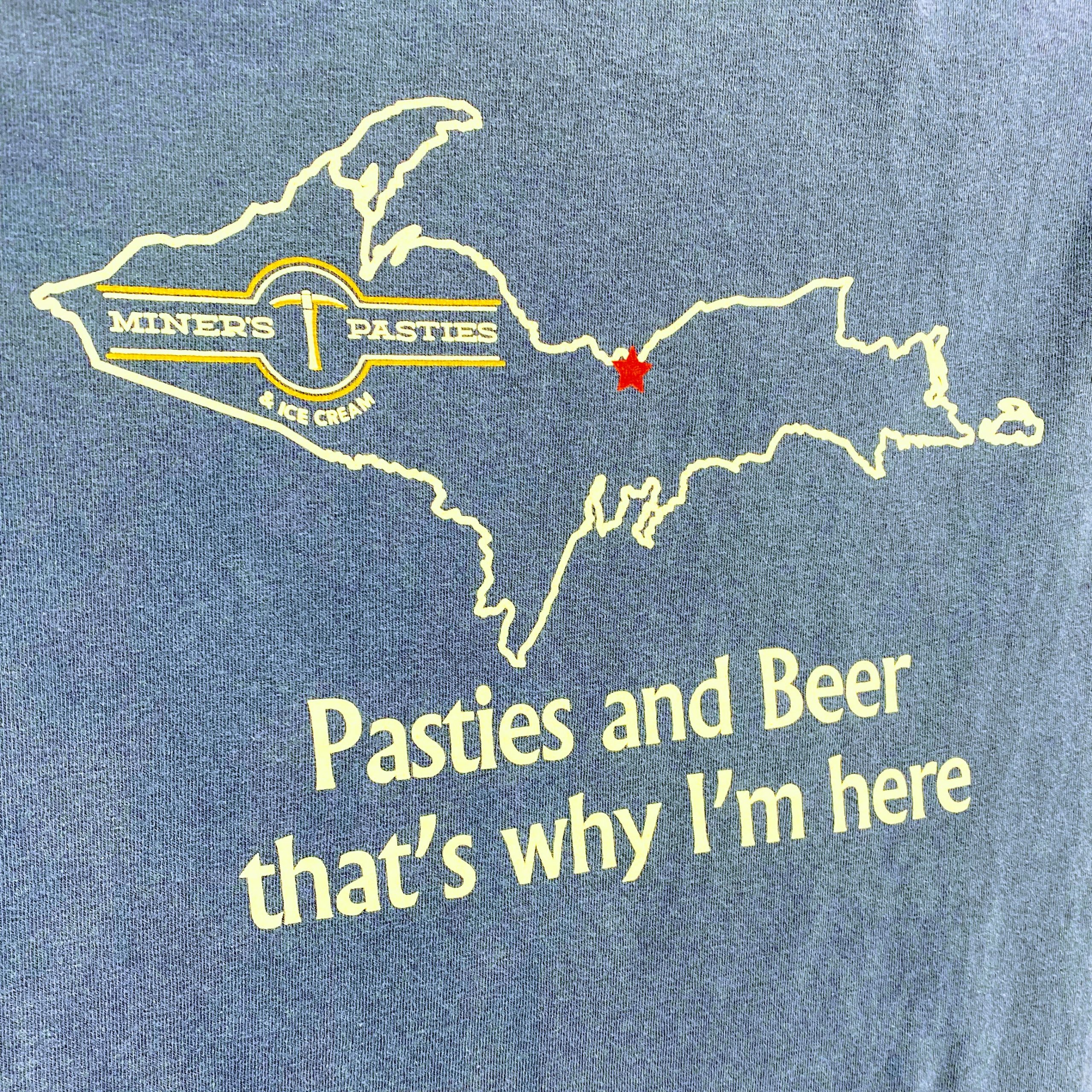
And also, these dishes don’t seem to be “industrialized.” While I’ve had mass produced pasties in the UK, grabbing something out from the West Cornish Pasty hut in Waterloo Station while running for a train, the pasties in the UP were much more — not “artisanal” because I don’t think anyone making pasties in the UP would use that word, but “family made”. At Miners Pasties in Munising, which came out top in our pasty ranks, the woman helping us at the counter said the lard pastry recipe came from the owner’s grandmother and only 3 people know it — the granddaughters and their niece. And only those three make the pastry each day. We sat back and enjoyed those pasties because we knew we wouldn’t be eating them again unless and until we found our way back to this bench again some day.
Closing
Closing music — Pictures of You by Evangeline
OK, that’s it, that’s the end of TravelCommons podcast #168
I hope you all enjoyed this podcast and I hope you decide to stay subscribed.
Find TravelCommons on Stitcher, SoundCloud, TuneIn, iTunes, Spotify, and Amazon Music. The links, along with the RSS feeds, are on the right-hand side of the TravelCommons website, under the heading Subscribe.
Right below that, in the Social Media section, are links to the TravelCommons Facebook page, and Twitter and Instagram feeds.
If you’re already subscribed, how ‘bout leaving us a review on one of the sites.
If you have a story, thought, comment, gripe – the voice of the traveler — send ‘em along, text or audio file, to comments@travelcommons.com or to @mpeacock on Twitter, or post them on the TravelCommons’ Facebook page, Instagram account, or website at travelcommons.com. Thanks to everyone who has taken the time to send in e-mails, Tweets and post comments on the website