Tag: road trip

  • Podcast #164 — First-Post Lockdown Trips; Travel Credit Cards

    Podcast #164 — First-Post Lockdown Trips; Travel Credit Cards

    Can I leave my house now?

    I broke Chicago’s containment for my first post-lockdown trip, a fast drive down I-65. We talk about hotels swapping hospitality for sanitation, Hertz’s bankruptcy, and tips for travel credit card usage from Brett Holzhauer, the travel card expert at ValuePenguin.com. All this and more at the direct link to the podcast file or listening to it right here by clicking on the arrow below.

    Here is the transcript of TravelCommons podcast #164:

    • Intro music — Warmth by Makkina
    • Coming to you from the TravelCommons studio in Chicago, Illinois, as the lockdown here is starting to lift. What’s open and what’s not is still a bit spotty, though I’ve managed to hit a couple of microbreweries with outdoor patios. The opening in Chicago is not dissimilar to what I experienced down in Tennessee last month. I was down in Spring Hill, south of Nashville, two weeks after the non-urban lockdown lifted — for every place other than the cities of Nashville, Memphis, Knoxville, and Chattanooga. It seemed that everyone was still trying to figure out what to do — the bar/pizza joint next to my hotel was fully open, but the local bar-be-que joints and the Starbucks were still only doing take-away. Which makes sense; it’s not like there’s a standard playbook on how to re-open an economy. And throughout my consulting career, I’ve learned it’s always easier to shut things down than to start them up.
    • The drive south on I-65 from Chicago is one that, I’m not gonna say I can do with my eyes closed, but I’ve been doing it for almost 40 years, starting when I was in business school at the University of Chicago and my family was living in Louisville, KY. I mean, there’s a clump of trees in the median between West Lafayette and Crown Point that’s a milestone for me; I know I’m an hour from home. Which just goes to show you how boring the drive through northern Indiana is when trees in the median are a notable feature.
    • The drive between Chicago and Nashville, while not the most exciting, especially through Indiana, it does usually require a bit of timing to thread through Chicago, Indianapolis, Louisville, and Nashville to avoid rush hour in each. On this trip, not so much. I left Chicago after breakfast and was driving 80 mph most of the way, maybe dropping down to 70 through the cities. And I was still getting passed by guys going aggressively faster. And the only time I saw police or state troopers was in front of big road construction sites, cars running with all their lights flashing in front of big barriers, more as a warning to speeders than an attempt to get them. It was, hands down, the easiest drive down I-65 I’ve ever done.
    • That wide-open drive may be one of the few things I’ll actually appreciate about this lockdown. Well, that and the $2/gallon gas along the way…
    • Bridge Music — Brilliant Day by Hans Atom (c) copyright 2014 Licensed under a Creative Commons Attribution Noncommercial license. http://dig.ccmixter.org/files/hansatom/47919 Ft: Lisa DeBenedictis

    Following Up

    • First up, thanks to the TravelCommons listener who goes by the handle Abe Froman, Ferris Bueller’s sausage king of Chicago, for dropping a 5-star review on our iTunes page. Abe writes:
      • “I have been a fan of this podcast for many years. If you are a road warrior or a mileage runner, you will love the tips to make your travel easier.”
      • Abe, thanks a lot for this.  I’m glad you’ve enjoyed the podcast
    • Last year in episodes 153 and 155, we talked about American Airlines’ retirement of their MD-80’s, the “Mad Dog 80”, the plane on which I earned my first Advantage status — Gold, and there wasn’t anything higher back then. Last week, Delta finally retired their last Mad Dogs — MD-88’s and -90’s. They were supposed to run through the end of the year, but with late ‘80’s technology and fuel efficiency, they were among the first planes in the fleet to be grounded when the lockdown hit. Delta said that “at their peak, the planes accounted for 50% of Delta’s arrivals and departures from” their Atlanta hub.  Which will be a relief to longtime TravelCommons listener Darren Mak, who tweeted at me back at the beginning of March, a picture out the window seat of a Delta MD-88 just in front of the engine cowl, thanking me for mentioning, in episode 155, that whenever I would end up in that same seat, I would wonder — if that engine blows up, will the shrapnel blow out or blow into the cabin. Well Darren, no more worries. We both survived the Mad Dog’s back seat.
    • We’ve talked in the past couple of episodes about the first post-lockdown trips would be by car — more schedule flexibility; no worries of a stranger in the middle seat exhaling 18 inches away from you.  CNBC ran a story last week analyzing the change in the number of requests for directions on Apple Maps in 2020. Using January 13th as the baseline for their comparison, requests for driving and walking directions dropped by 50% in the first month of the lockdowns, but had recovered by May 29th — the last day of the data series. Transit direction requests had dropped by 75% and were still more than 50% down by the end of May. Now, using January 13th as the baseline probably exaggerates the recovery — you’d think the number of walking and driving direction requests on a normal Memorial Day weekend would be hugely higher than for the second Monday of January when it was in or below the 30’s for about ⅔’s of the country — but I don’t want to kill a green shoot with too much skepticism.
    • American talked about their own green shoots last week, saying they would be operating 55% of last year’s schedule in July, up from 20% in April and May. Driven mostly by demand from states opening up — Texas, Florida, and Arizona — rather than cities like New York, Chicago, and San Francisco that are still under stricter lockdown orders. If I keep pulling on this trend line, I’m thinking by September all those voluntary capacity limits and empty middle seat promises will have faded away.
    • The absence of update emails from airline and hotel CEOs this week I think is another green shoot. If things are starting to look up, no need to send me an email extending a bonus award offer or cancellation fee waivers. This has cut into a new hobby of mine, though — comparing the use of “in these uncertain times,” “in these challenging times,” and “in these unprecedented times” in these emails. I have a stroke count going. Right now, “unprecedented” is the runaway leader, with “challenging” second, and “uncertain” third.
    • I’ve been a Hertz customer on and off over my 35-year travel career — mostly on. I started my business traveling when I was at IBM, and in the mid-80’s, they had negotiated a smoking rate with Hertz. In episode 144, I talked about getting to know the woman working in the little Hertz hut at SJC back then, when SJC was still an outdoor airport; and before Hertz Gold, that’s all I needed to get an upgrade. And more recently, I’ve, on balance, had good experiences with Hertz. So I was bummed for a moment when I saw they filed for bankruptcy last month. It wasn’t surprising, though. Hertz was still carrying a big debt load courtesy of a 2005 PE leveraged buyout, and we’ve talked in past episodes about how Uber and Lyft have been eating away at its core airport rental market. So, when travel stopped in March and used car auction prices cratered in April, Hertz tipped over. By now though, we’re kinda used to big travel companies cleaning their debt problems in bankruptcy — United and American Airlines the most recent examples. So I’m not too worried about losing the rest of my Gold points. In the short term, though, I will be paying more attention to the mileage on the Hertz cars in the Five Star aisle. That’s where I usually see signs of financial distress — a lot less 500-mile cars and a lot more 25,000-mile cars. And while 25,000 miles on a car doesn’t seem like a lot, remember that rental car miles are kinda like dog years — you gotta multiply them by, like, 7 to get to regular car miles.
    • And if you have any travel stories, questions, comments, tips, rants – the voice of the traveler, send ’em along — text or audio comment to comments@travelcommons.com — you can send a Twitter message to mpeacock, post your thoughts on the TravelCommons’ Facebook page or our Instagram account at travelcommons — or you can post comments on the web site at TravelCommons.com.
    • Bridge Music —  Natchoongi (New Hope Remix) by Suenjo (c) copyright 2007 Licensed under a Creative Commons Attribution Noncommercial (3.0)

    First Post-Lockdown Trips

    • As we talked about a few minutes ago, travel is starting to pick up as the lockdowns ease and people want to see something other than the 4 walls that have surrounded them since mid-March. 
    • TravelCommons listener Mark Skinner dropped me a line towards the end of May about his first lockdown trip. You may remember Mark from episode 157 back in November when he wrote in to tell us about his day trip from Washington, DC to Hong Kong — flying out Monday afternoon, returning Tuesday morning — to take a NASA cosmic ray detector on an over-the-pole flight.  This time, Mark writes –
      • So I had my first trip this past week, since the “before times”. On the way back, I was listening to your recent podcast. Yes, my first trip was via automobile, down to the outer banks of North Carolina. Dare County had recently opened up (the day before!) to allow visitors into the county. 
      • Stayed at the Hilton Garden Inn. No servicing of the room, and after a few days at this hotel on the beach, things were looking a little dingy. Tropical Storm Arthur squashed any hopes of long walks on the beach. Departed a day early because the storm wasn’t letting up. I thought this was a good use of Hilton points… Take-out only that week, and hotel not helping out by lending any china, glass or utensils. Ending up getting a couple of sets at a dollar store… I contrast this to my last trip in the before time, to Maui, just as things were buttoning up. The Grand Wailea was happy to provide all sorts of stuff to enjoy one’s take-out on the lanai! That trip got cut short as well, due to flights evaporating. 
      • A highlight of the trip was stopping for lunch in Virginia Beach, which had recently opened out-door seating at restaurants, and enjoyed lunch at a seafood restaurant at an outside table, by the ocean, and greatly enjoyed ordering food and having it brought to the table! The previous “normal” meal had been first evening on Maui, before they went take-out only. 
      • Next trip that is getting kicked around is Hilton Head in June…. that would involve flying. Crossing fingers about a trip to Austria in August…
    • Mark, thanks for sending that along. Your experience on the Outer Banks was similar to mine down in Spring Hill, TN. I went back and forth about staying in a hotel vs. an Airbnb. Airbnb — not as many people passing through the property and some time buffer (24 hours, 72 hours) between guests in the same rooms, but a major hotel chain should have the corporate resources to build out and maybe test a more thorough cleaning program for its properties; maybe with access to stronger, more industrial cleaners. Procrastination ended up making my decision — while I was going back and forth, the Airbnb property in Spring Hill I was looking at got booked for the front of that week, so I ended up in the Spring Hill Hampton Inn — another Hilton brand.
    • That Monday morning, right before I left Chicago, I checked in on the Hilton app. It even let me pick out my room. This may be old news to Hilton Diamond listeners, but I haven’t stayed in a Hilton for at least a year, and so haven’t been tracking their app improvements. When I arrived at 5:30pm, the front doors were locked, but opening up the app showed me a digital key that opened the front door and my room door. I didn’t have to physically check in at the front desk which only struck me odd later that night. Whenever I’ve checked in on a hotel’s app before, I’ve still had to go to the front desk so they could see my ID, which was why I’ve never paid much attention to app check-ins. But at this Hampton Inn with full check-in and digital keys, it worked the way I’d always thought it should.
    • My in-room experience was the same as Mark’s — nobody servicing the room, though a guy did stop by the room every now and again asking if I needed extra towels; no morning coffee or breakfast buffet, and eating mostly take-out in the room with some cans of local craft beer bought from the liquor store a couple of doors down. I was pretty rigorous about dumping the food trash right after eating. Waking up to the smell of 8-hour-old bar-be-que rib and cole slaw remnants is never a good start to the day. Hotels are saying it’s all about cleaning and sanitation, but I can’t say that I saw any out-of-the-ordinary efforts while I was there. Maybe what I was experiencing was the cost reductions to fund that behind-the-scenes deep cleaning.
    • While Mark’s highlight was his lunch in Virginia Beach, mine was being able to walk into a little family-owned craft beer joint in a strip mall on Spring Hill’s Main St, order a beer, and then sit down and drink it at the bar. I go into this place every time I’m there to visit my mother. Seeing them open was a nice little bit of normality — especially since Chicago didn’t start opening up until last week.
    • Don’t know my next trip yet, but I’m keeping my eye on Spain, hoping there’s no second wave before our trip to Barcelona at the end of September.
    • Bridge Music — Fistful of Dub (Feat. Snowflake and DJ Vadim) by spinningmerkaba (c) copyright 2016 Licensed under a Creative Commons Attribution Noncommercial (3.0) license.  Ft: snowflake and DJ Vadim

    Travel Credit Cards

    • As we start traveling again, we’ll start pulling out those travel cards — Hilton or Delta Amex, United or Southwest or Marriott Visas, American MasterCards — and so I invited Brett Holzhauer, the travel card expert at ValuePenguin.com, a site that goes deep into these cards, to give us some of his advice as we “un-lockdown” ourselves. First up, he reads out the results of a recent survey on travel planning, and then talks about travel cards
      • Mark: Brett, thanks for joining us on the TravelCommons podcast.
      • Brett: Thank you so much for having me. I’m excited
      • Mark: Brett, I wanted to talk to you about a recent survey that ValuePenguin.com has done on travel planning. And we’ve had sort of an arc through the past couple of episodes of the TravelCommons podcast around travel planning. As we think about post-lock-down/pre-vaccine where people are still concerned about coronavirus and Covid, but they gotta move on with their lives. So, in the survey that ValuePenguin did, where are people going?
      • Brett: One of the biggest notes was the amount of people going to Florida, and it’s a couple of reasons: 1) good weather; 2) it’s affordable; 3) there’s a lot of the older generation that lives in Florida, so maybe people are itching to see their parents or grandparents or just older relatives. So, it’s a mixture of all of those things leading to people wanting to travel to the beaches and get outside.
      • Mark: I think that kind of ties into some things we’re seeing, which is more of a focus on outdoors with the theory that coronavirus transmission is less efficient outdoors than indoors. As a travel card expert, as people begin to travel again, what are some of the strategies as far as being able to maximize the value of the travel credit cards? Because really most frequent travelers already have got them in their wallets, at least one if not multiple award cards, but they’ll tend to focus on maximizing award points.
      • Brett: So one of the biggest things that’s gonna eventually happen is huge bonuses. These companies like Chase and American Express. They’re gonna really incentivize people to get back on the road. So if you’re brand new into the Points and Miles game, this is a very good opportunity to start understanding how this whole thing works. So that way, when these big bonuses start coming out, you can find some really great bonuses to start your travels once again, maybe late 2020 or early 2021. So that’s one thing, Number two, obviously, the uptick in in travel insurance. People can get travel insurance through credit cards.
      • Mark: Typically, what are the travel insurance capabilities?
      • Brett: A lot of credit cards beyond the big sign-up bonuses have travel insurance, and a lot of consumers either don’t know that they have it, they forget, or they just don’t really pay too much attention to it. I’m going to use a personal example. My wife and I both have the American Express Platinum Card. It’s a $550 annual fee, and your first thought is — that’s a lot of money to invest in a credit card. Is that really worth it? And beyond all of the perks and the sign-up bonuses, the travel insurance through that specific credit card is comprehensive. You get trip cancelation, trip interruption. Also, you get rental car insurance, and so it’s it’s important to know the difference between primary and secondary. If you do have a credit card that has primary car insurance, that will go first so your personal car insurance will not be affected.
      • Mark: I’ve talked in a previous TravelCommons episode about my own personal experience with using the Chase Sapphire Visa that ended up covering an accident and St Andrews, Scotland. When I got back home, I filed with Chase. Took me a little bit, but I got full coverage on it.
      • Brett: There’s also baggage insurance. Those are kind of the big ones. There’s also emergency medical assistant. It’s important to know that consumers have these protections. I just feel that a lot of times we have these cards in our wallets. We’re overlooking the value proposition of what these cards can really do.
      • Mark: Let me pivot to your set up as a digital nomad. What are what are you up to?
      • Brett: My wife and I, we met in 2015. I knew on the first date that I was gonna marry her by some way, somehow and sure enough ended up happening.
      • Mark: Did she have that same sense, or was there some selling involved there?
      • Brett: No, we definitely sold each other. And we walked away from that first date knowing that what she sold me on was traveling. I had a traveler’s itch. She had the traveling bug. So really sold me on the idea of doing this full time travel. In July of 2019, we officially sold everything. We drove back to her parents house in Los Angeles. Then in August of 2019, we took a one way flight from LAX to Fiji. We bounced between 10 countries in 3.5 months. We returned home in December for the holidays from Japan back to Los Angeles. And we had the plan of leaving again in February, and everything unfortunately started to melt. So now we’re stuck in Los Angeles just itching to get back on the road. But yeah, we love taking advantage of rewards. If it wasn’t for credit card points of miles, we wouldn’t be able to afford these types of travels.
      • Mark: So, when do you think you and your wife will head out next?
      • Brett: Yeah, so our plan was to go to Europe. Obviously, that’s been immensely hit by Covid-19. So for us, luckily, so I’m 26 years old, she’s 24. We’re both very healthy, we’re of the mindset that life is a little bit risky, and you have to take those risks to get those rewards. So, we approach travel with that mentality that it is a risk. Everything in life is a risk — walking across the street, driving your car So, there’s always a risk to it. I think if I had to guess, probably August. But again, God forbid there’s a second wind of coronavirus. We might be here for extended period of time, But, you know, we are very blessed and very privilege that we have parents that will take us in. And we have a free place to stay, which is nice to save up more money for travel and pay down on my student loan.
      • Mark: Brett Holzhauer, travel awards expert from ValuePenguin.com Thanks very much for taking the time to join us on the TravelCommons Podcast.
      • Brett: Thank you so much

    Closing

    • Closing music — Pictures of You by Evangeline
    • OK, that’s it, that’s the end of TravelCommons podcast #164
    • I hope you all enjoyed this podcast and I hope you decide to stay subscribed.
    • Find TravelCommons on Stitcher, SoundCloud, TuneIniTunes, and Spotify The links, along with the RSS feeds, are on the right-hand side of the TravelCommons website, under the heading Subscribe.
    • Right below that, in the Social Media section, are links to the TravelCommons Facebook page, and Twitter and Instagram feeds.
    • If you’re already subscribed, how ‘bout leaving us a review on one of the sites.
    • If you have a story, thought, comment, gripe – the voice of the traveler — send ‘em along, text or audio file, to comments@travelcommons.com or to @mpeacock on Twitter, or post them on the TravelCommons’ Facebook pageInstagram account,  or website at travelcommons.com. Thanks to everyone who has taken the time to send in e-mails, Tweets and post comments on the website
    • Follow me on Twitter
    • “Like” the TravelCommons Facebook page
    • Direct link to the show
  • Podcast #163 — New World of Travel Insurance; Getting Medical Help on the Road

    Podcast #163 — New World of Travel Insurance; Getting Medical Help on the Road

    I think I put off finding a doc too long

    Though I’m still locked down on the shores of Lake Michigan, data shows that people are starting to do short car trips. What will people need to feel comfortable to do more extensive travel — spacing in aircraft, we talk with Erik Josowitz of insuranceQuotes.com about trends in travel insurance, and a story about finding medical attention while traveling through Southeast Asia. All this and more at the direct link to the podcast file or listening to it right here by clicking on the arrow below.

    Here is the transcript of TravelCommons podcast #163:

    • Intro music — Warmth by Makkina
    • Coming to you from the TravelCommons studio in Chicago, Illinois, probably 10 lbs heavier, half of which is beer (my doing) and the other half baked goods courtesy of Irene. While the coronavirus restrictions are beginning to ease in some parts of the US and Europe, everything is still locked down here on the shores of Lake Michigan. So my travels since the last episode have mostly been between the kitchen and the couch, and occasionally out in search of carbohydrate comfort foods — to grocery stores in an endless and fruitless search for King Arthur Bread Flour, and then running a circuit of Chicago microbreweries using curbside no-contact pick-up to collect 4-packs of whatever is new that week. A couple of breweries are even doing curbside sales of ⅙ barrel kegs — tempting, but seems a bit of overkill for a 3-person flat, though Amazon claims they can get a kegerator to me next week. Must be on Amazon’s essential items list. 
    • But with the lockdown easing in non-urban places like the exurbs of Nashville, I’m starting to prep for my first post-Corona trip that I talked about in the last episode, a drive down to Spring Hill, TN to see my mother. Got the oil and tires changed on the BMW to avoid any unplanned stops. Figure I’ll pack a lunch which’ll let me do the drive with just one gas stop. I also tuned up my Trek Madone road bike — cleaned and lubed the gears, re-wrapped the handlebars — to take that down with me. Haven’t been able to ride much after Chicago shut down the lake shore path, and so riding solo on small country roads would seem to be a pretty good match for “social distancing” criteria.
    • All this spare time has allowed me to be a bit more “planful” as one client used to say, one of those ugly adjective constructions meant to turn an activity “we need to do more planning” into a quality “we need to be more planful”. But anyhow, whether the lockdown allows me to be more planful about the podcast or to do a bit more planning, it has. Which, for this episode, means you’ll hear less of me, and more from informed people. First up is Erik Josowitz, an analyst at insuranceQuotes.com. Erik and I did an old-school remote interview — using Skype instead of Zoom — talking about what travel insurance looks like in the post-Corona world. And then Allan Marko returns with his wife Chris, following up our conversation in the January travel planning episode with a story from their Southeast Asia sabbatical last year; how they tracked down a doctor in Thailand when his wife became ill; a topic that could weigh on us more when we venture out into the post-lockdown/ pre-corona vaccine world that we’ll be in for the next 18-24 months.
    • But right now, for my Tennessee trip, I think I’m less concerned about finding a doctor, and a bit more concerned about reconnoitering open drive-thru Taco Bells along I-65.
    • Bridge Music — Sunset Boulevard by Doxent Zsigmond (c) copyright 2015 Licensed under a Creative Commons Attribution Noncommercial (3.0) license. Ft: Siobhan Dakay, unreal_dm

    Following Up

    • Videoconferencing is having its moment during the pandemic. Maybe it’s because people are looking for more of a connection in their lockdown isolations, or because we know that everyone is sitting at home in front of a video-equipped laptop and has no excuse not to video, nothing like “Can only call in because I’ll be running through airport security then.” I haven’t done a straight conference call in forever. Doing interviews for this episode, I hit the videoconference trifecta  – Skype with Erik, FaceTime with Allan and Chris, 
    • and then Zoom to be on the other side of the microphone on Steve Frick’s Back & Gone Again podcast.  This is the 15th year of TravelCommons; I started in May 2005, and here Steve and I talk about that first episode.
    •  We had a lot of fun, telling travel stories and talking about our current life-off-the-road. Give it a listen. There’s a link in the show notes, on the TravelCommons Facebook page, and in the Twitter feed.
    • Cate Rose left a comment on the Facebook page on the April episode.
      • “I don’t travel nearly as much as you do Mark but I enjoy your podcasts. These are unprecedented times. We arrived home from a month long rail trip from Italy, up to Sweden at the end of January just as this whole thing was blowing up. And now people, including us, are locked down all over the world. Unbelievable. And here you are with plenty of time to write, but no place to go! We are on Week 4 of social isolation in Western Australia and the novelty is wearing off a little 😉 but it seems to be working so all for the greater good. Thanks for keeping up with the storytelling and letting a crack of life into home isolation! Stay safe.
      • Cate – thanks for that note. Sounds like you just got out of Italy in time. If I remember correctly, they started locking down Italy in mid-February. Glad you made it back home safely. And it sounds like Australia and New Zealand have done the best in crushing the Covid curve.
    • In that same episode, when we talked about post-corona trip planning, I said I thought the first post-lockdown trip most people would take would be a car ride — more flexibility; easier social distancing. Turns out I was right — at least according to the company Arrivalist, a “visitation intelligence company” that has started publishing a Daily Travel Index measuring consumer road trips of 50 miles or more using data drawn from GPS signals. Road trips on Friday, May 1 were almost back to the pre-pandemic levels of February, with the number of trips in the 100-250 mile range higher than February’s number for the first time since the lockdowns started. You can go to Arrivalist’s website and play with the data yourself or read an analysis by Phocuswright, a travel research firm. Links are in the show notes and my Twitter feed.
    • I got yet another email survey, this time from United asking me what would make me comfortable to fly again, and to rank some of their plans. For me, it was pretty easy. I’m not excited about standing in a packed gate area, hearing the gate agent say “This is a completely full flight”, and then spend 2-3 hours shoulder-to-shoulder with a complete stranger, in effect letting that person into my family’s corona exposure space.
    • A couple of weeks later (not implying causation, only correlation), all the major US airlines announced that passengers and crew will have to wear masks, they’re moving to strict back-to-front boarding schemes to reduce the number of passengers passing one another, and that they’re blocking/not booking the middle seats, reducing capacity from what had been running over 80% at the beginning of the year down to the 60’s. It was then interesting to watch what happened after Frontier’s CEO did a round of TV interviews at the beginning of this week, saying that they too would block the middle seat — if a passenger bought a More Room seat for at least $39. Today, after getting a blizzard of red challenge flags from Washington, Frontier reversed course. Just kidding – “It was never our intent” they said, “to profit… from safety”. “ We simply wanted to provide our customers with an option for more space.” Yup. Frontier continuing to position their brand as the Ryanair of the US.
    • And if you have any travel stories, questions, comments, tips, rants – the voice of the traveler, send ’em along — text or audio comment to comments@travelcommons.com — you can send a Twitter message to mpeacock, post your thoughts on the TravelCommons’ Facebook page or our Instagram account at travelcommons — or you can post comments on the web site at TravelCommons.com.
    • Bridge Music — Memories (infiniti loop) by Vidian (c) copyright 2015 Licensed under a Creative Commons Attribution Noncommercial (3.0) license. Ft: TheDice

    New World of Travel Insurance

    • Interview with Erik Josowitz, an analyst at insuranceQuotes.com
      • Mark: Eric, thanks for joining us on the TravelCommons Podcast. Could you just give us a little background on yourself?
      • Eric: My name is Eric Josowitz. I’m an insurance analyst at InsuranceQuotes. We publish in-depth studies, data and analysis related to auto, home, health, life, and small business insurance. And my role is to study the insurance industry and provide tips and advice and insights that are relevant to consumers and small business owners.
      • Mark: The reason I asked you to join us today is, in the past couple of episodes, we’ve been talking about travel planning. If we continue this thread, what do travelers need to think about from an insurance standpoint in the upcoming post-lock down but pre-Coronavirus vaccine world, which depending on who you read, we’re gonna be in for the next 18 to 24 months.
      • Eric: Travel insurance was kind of a nice to-have pre-pandemic, except in cases of very, very large and elaborate trips where the investment and potential loss was substantial. And I think coming out of this, travel insurance is much more important. There are really two things that travel insurance gets you. One is protection for cancelations that might occur before you actually take the trip, which with the level of uncertainty, that’s pretty important. And the second thing, travel insurance provides benefits if things happen while you’re on the trip, ranging from interruptions and delays to medical issues that may pop up while you’re actually traveling.
      • Mark: When people are looking and thinking about travel insurance going forward, what are some of the key things that they need to look for and think about given in the past it was kind of a nice-to-have. It was a check box that showed up on the bottom of a website that three quarters of us ignored. And now we’re gonna pay a lot more attention to that.
      • Eric: I think that’s a great question. And I’m glad you mentioned checking the box or not checking the box before. I think as this crisis started to build and spread from the rest of the world into the US, I talked to a lot of people that had travel insurance but didn’t actually know what it covered because they had just checked the box. And so, I think one thing that that needs to happen moving forward is travelers need to actually look at the specific coverage and specific exclusions associated with travel insurance policy before they purchase it. And so those exclusions in many cases turned out to include communicable diseases; turned out to include cases where, for example, the US State Department has issued travel warnings or travel bans. Many people were also surprised to learn that if they decided to cancel a trip because they were afraid of traveling to an area that had higher risk, that their travel insurance didn’t actually cover cancelation in cases of fear. And so, one thing I would encourage everyone to look into is what’s called a cancel-for-any-reason rider or endorsement on their travel insurance policy. And what that in most cases will buy you is the ability to cancel for any reason, no questions asked. You know when you’re traveling, what you wanna look at on the travel insurance policy is to make sure that any medical issues or interruptions or delays that could occur while you’re traveling are covered, even though there’s been a declaration that this is a pandemic by the World Health Organization, there have been these warnings by the US State Dept. Make sure that those things are not specifically excluded in terms of the coverage that you can receive
      • Mark: As people need to read the coverage more closely now, any tips on how they should click through or where they ought to look for guidance on those terms?
      • Eric: I’ve had people say to me that they’re not able to easily find the specific terms and conditions when they’re using the click-thru form on, you know, a booking website. And so if they feel that they can’t easily access those terms and conditions, I would encourage them to actually search separately for travel insurance policies. And there are major carriers that offer travel insurance coverage on a regular basis who have packages of policies available for different types of travel, and they do have good frequently asked questions pages on their websites. They do have clearly outlined terms and conditions
      • Mark: Searching using the control-F function on your browser for things like communicable diseases. Try saying that three times fast and cancelation for any reason, as you mentioned before is probably some good search terms. Are you seeing any trends in pricing and coverage and riders? Has the travel insurance market reacted to Covid-19 coronavirus yet or is that still a work in progress?
      • Eric: Well, many companies have stopped offering travel insurance temporarily. And so, one of the indications that it’s perhaps safe to travel again is going to be the ability to actually purchase travel insurance coverage at that time. Now there are certain companies that are continuing to offer policies and many of those policies don’t have exclusions in the case of communicable disease, but they are pretty explicit about what they do and don’t cover right now. So that yes, the insurance companies are reacting to this crisis in near-real time.
      • Mark: Eric, thank you very much for joining us on the TravelCommons podcast. Great insights, good information, good suggestions. Again, thanks for joining us.
      • Eric: My pleasure, Mark. Have a great week.
    • Bridge Music —Dawn at the Top of the World ft. copperhead & Robert Seikawitch by Ivan Chew (c) copyright 2016 Licensed under a Creative Commons Attribution Noncommercial (3.0) license.

    Getting Medical Help on the Road

    • Back in January, long-time TravelCommons listener Allan Marko talked about the planning he did for the 9-week SE Asia sabbatical he and his wife Chris took last year. Fast forward 4 months, and health care on the road will now become much more important when traveling in the post-lockdown/pre-vaccine world. So let’s continue our conversation with Allan, joined now by his wife Chris, to talk about how they thought about getting health care when they were half a world away from home.  It started with the research before they left home…
    • Interview with Allan Marko and Chris Chufo

    Closing

    • Closing music — Pictures of You by Evangeline
    • OK, that’s it, that’s the end of TravelCommons podcast #163
    • I hope you all enjoyed this podcast and I hope you decide to stay subscribed.
    • Find TravelCommons on Stitcher, SoundCloud, TuneIniTunes, and Spotify The links, along with the RSS feeds, are on the right-hand side of the TravelCommons website, under the heading Subscribe.
    • Right below that, in the Social Media section, are links to the TravelCommons Facebook page, and Twitter and Instagram feeds.
    • If you’re already subscribed, how ‘bout leaving us a review on one of the sites.
    • If you have a story, thought, comment, gripe – the voice of the traveler — send ‘em along, text or audio file, to comments@travelcommons.com or to @mpeacock on Twitter, or post them on the TravelCommons’ Facebook pageInstagram account,  or website at travelcommons.com. Thanks to everyone who has taken the time to send in e-mails, Tweets and post comments on the website
    • Follow me on Twitter
    • “Like” the TravelCommons Facebook page
    • Direct link to the show
  • Podcast #162 — Post-Corona Trip Planning; Keeping a Travel Journal

    Podcast #162 — Post-Corona Trip Planning; Keeping a Travel Journal

    Early attempts at travel journaling

    Kinda tough to do a podcast that’s more about the journey than the destination if I’m not “journeying,” but I give it a go. We talk about cyberattacks on frequent flyer accounts now that we don’t have a reason to check them, planning for my first post-pandemic trips, and how re-reading my travel journals is pinch-hitting right now. All this and more at the direct link to the podcast file or listening to it right here by clicking on the arrow below.

    Here is the transcript of TravelCommons podcast #162:

    • Intro music — Warmth by Makkina
    • Coming to you, as you might expect, from the TravelCommons studio in Chicago, Illinois, going into what is either the 3rd or 4th week of Lockdown, depending on how one scores the executive orders. I usually kick off each episode talking about my travel since the last episode — which is going to be a very short conversation since I recorded the last episode at the end of Lockdown Week 1. Does make it kinda tough to do a podcast that’s more about the journey if I’m not “journeying”. Indeed, longtime TravelCommons listener Steve Frick pinged me on Twitter – “How are you holding up being off the road?” I told him I was taking some long walks to relieve the itching on the soles of my feet, but I’m not sure it’s working. 
    • I thought I could keep myself occupied by working out more; drop the winter weight a little earlier than usual; be in better biking shape for when the Midwest weather breaks. But I had to call an audible on that when the city closed all the gyms, and then the running and biking path along Lake Michigan. Now I’m trying out a lot of new in-room/no-weight workouts. There’s a lot of them out there, even the Wall Street Journal published “Five Home Workouts to Do During the Coronavirus Outbreak”. I’ve never been a big HIIT guy, high-intensity interval training, so things like squat jumps, burpees, and mountain climbers haven’t been in my repertoire. But I’m kinda liking it and thinking that, when I’m back traveling, this could be a great in-room workout for those days when the hotel gym is jammed, especially those Marriott Courtyard gyms, when all four of the ellipticals and treadmills are taken, and there’s a queue for the handful of dumbells. Of course, I might have to warm up with some furniture jenga — stacking the chairs and magazine table out of the way, maybe with one of the end tables — but most US hotel rooms should have enough open space, except maybe in Manhattan.
    • However, my other new workout — stair intervals, sprinting up the stairs in our 20-floor apartment building — might not translate as well to hotels, especially those 4-story Courtyards.
    • Bridge Music — Ianiscus by Javolenus (c) copyright 2013 Licensed under a Creative Commons Attribution (3.0) license. Ft: Wired_Ant

    Following Up

    • The waves of Covid-19 e-mails from travel companies have been interesting.  The first wave was at the beginning of March. I tweeted out a screenshot of what I received from United, but all the travel companies seem to be working off similar scripts — “We care about you; let me tell you about the great job that HEPA air filters do; we’re cleaning the planes a bit more every night; we’ll get back to you later on your elite status.” Then the second wave as travel started to crater a couple of weeks later — “We really care about you, so if you book a flight/room/car with us and give us money this month, we won’t charge you to change your dates if things are still mucked up… but we’ll keep your money; oh, and we cleaning the planes/rooms/cars real hard now”. This wave did get my attention. I mentioned in the last episode how the combination of change fee waiver and a smokin’ deal on American’s direct ORD-BCN flight got me to open up my wallet for an end-of-September trip. Friends of ours are saying we’re crazy, but I’m an optimist. And now, starting last week, I’m starting to get the third wave of e-mails wherein the dam finally broke — “Honest, we care a whole lot about you, so we’ve extended that change fee waiver for the next couple of months — so long as you give us money now — and, since we’re all sorta throwing in the towel on 2020, we’re giving you elites a push on your status — whatever you have now, you keep through next year — and extending your club memberships by 6 months; oh, and we’re still spraying disinfectant everywhere.” For me, hotel brands were the first — Hilton and Hyatt, and Marriott notable in its absence. Then, this week,  some of the airlines finally dropped — Delta, United, and Alaska, with American and Southwest notable in their absence. And then, in mid-week, Marriott finally gave it. It’ll be interesting to see how long American and Southwest feel they can hold out. The longer the travel shutdown, the more the pressure will build. Internationally, the trend for airlines seems to be a bit more of a hedge — not extending status, but reducing qualification levels by 25-30%. BA, KLM, Emirates all seem to be trying this. It’ll be interesting to see how long they can hold out.
    • As if this wasn’t enough, Marriott announced at the end of March yet another security breachthe second one in 16 months. This one was in a PMS, a property management system, used at some of the properties managed by Marriott. They estimate that 5.2 million guests are affected. We’ve said many times before, it’s gotten to the point with all these hacks that you gotta assume that you’ve been compromised. But the coronavirus lockdown adds a bit of a twist. A security firm, PerimeterX, says that, in the past month, they’ve seen account takeover attacks surge to as high as 80% of all login attempts on travel sites. Kinda makes sense — if we’re not traveling, we’re not hitting airline or hotel sites to book trips, or to check our account balances or figure out where we are on a status match. As we drop off, the remaining traffic — from the bad guys — becomes a higher percentage. And there is some money to be had there. I’ve said in past episodes that I tend to use 2¢/mile as the breakeven point between buying a flight or using miles, though that number might have drifted down to 1.5¢ with recent award chart changes. Crack and drain an account with 100,000 miles — not a high balance for a frequent traveler who’s getting elite bonuses and uses the airline’s credit card — and that’s $1,500. Would be nice if these companies used two-factor authentication, but I haven’t seen that with any of my accounts. So I make sure each account has a strong and unique password, and run the circuit — logging into each of them, or at least the ones with big balances — every month.  
    • And if you have any travel stories, questions, comments, tips, rants – the voice of the traveler, send ’em along — text or audio comment to comments@travelcommons.com — you can send a Twitter message to mpeacock, post your thoughts on the TravelCommons’ Facebook page or our Instagram account at travelcommons — or you can post comments on the web site at TravelCommons.com.
    • Bridge Music — In Peace (Somewhere Else Mix) by cdk (c) copyright 2015 Licensed under a Creative Commons Attribution (3.0) license. Ft: Snowflake

    Post-Corona Trip Planning

    • I took a survey from Conde Nast Traveler magazine, asking about my post-coronavirus travel plans. Good timing because, as I mentioned earlier, I’ve been thinking about just that topic, because this will be the longest stretch I’ve stayed home in I don’t know how long. And you can imagine that topic is hot across the travel industry — with airlines, hotels, trip planning apps — hence, probably the reason for the Conde Nast survey. But before you can plan, you have to know when the lockdown will be released and how. Nobody in Chicago or anywhere else in the US seems to want to talk about that quite yet, but some European countries are — Austria, Denmark, the Czech Republic, even Italy — and as you’d guess, it’s looking like it’ll be more of a gradual release than a big bang; and happen first in places less impacted by Covid-19 — rural before urban, then smaller cities; New York probably the last in line. 
    • If that plays out, then I’m thinking that leisure travel will be the first to come back. A lot of business travel is between cities, and when those lockdowns finally release, companies will first be figuring out who they want to bring back to their offices. And they’ll be looking to cut expenses going into the expected recession. So the weekend warriors may be on the move before the road warriors.
    • Pulling on that thread a bit more, I think it means that, for many folks, their first post-lockdown trip is going to be a car ride. With a car, you have more control than a plane or a train — more flexibility, no waiting for airlines to un-furlough their crews and spin up their route systems, and no worries about who you’re sitting next to. Maybe a drive requires a bit more planning — probably want to make sure the lockdown is lifted in all the places you have to drive through. But when I add low gas prices to this flexibility, driving is probably the way I’ll go.
    • OK, but to where? Probably not too far initially — not more than, say, a 6-8 hour drive, a day — so no “let’s re-trace Route 66” out to LA or beeline for the Florida beaches. Also, given some of the blowback around some of those pre-lockdown Spring Break antics, I gotta think that party places like Florida beaches and Nashville’s Lower Broadway are gonna be some of the last spots released from lockdown, and even when they are, they’ll be different places. Not every bar and restaurant will survive this lockdown. With still maybe a month to go, I’m already seeing places in Chicago give up and shut down for good.
    • But that doesn’t really impact my planning. The first trip I want to do after the lockdown wasn’t some bachelor party long weekend blow out. I think I want to go see some family first, not least because there’s still uncertainty about if and when future waves of Covid-19 might prompt future lockdowns. So I’m thinking, right now, that first drive will be down to Spring Hill, TN to see my mother. It’s an 8-hr drive, so about as far as I can get in a day. I’ll throw my bike on the back of the car; take some solo rides on the roads that thread through horse country, hoping to hit an open barbeque joint, and a taproom or two. 
    • Then some business travel comes back. People can only get so much done through Zoom and Microsoft Teams. Though we’ve pushed it off for 6-8 weeks, at some point people need to get together — physically — to close deals, do projects, work with employees. The ramp up will depend on how deep of a recession we find ourselves in. Maybe it’ll start up by cashing in some of those vouchers from cancelled March and April trips that airlines have been loath to refund.
    • Which, hopefully, works Irene, Claire and I up some trans-Atlantic trips in the late fall — Barcelona in late September and perhaps London over Thanksgiving. They’ll probably still be sedate — still some social distancing; not sure if we’ll be able to catch La Liga or Premier League matches. That’s OK, though. I’d be happy to walk again through the Gothic District, check out Cat Bar Cat, my craft beer hangout the last time I was in Barcelona, and to shop and eat through Mercado de La Boqueria. And then to walk through London streets for the Christmas lights. 
    • But if I’m going to do any of this, I’ll probably need to get a hair cut first.
    • Bridge Music —Blue Like Venus by spinningmerkaba (c) copyright 2012 Licensed under a Creative Commons Attribution (3.0) license. Ft: Admiral Bob

    Keeping a Travel Journal

    • One of the questions on the Conde Nast Traveler survey was “How are you getting your travel fix during the lockdown?” My initial response was curt “I’m not”. But I paused for a minute and then backspaced over that and typed “I’m paging through my old travel journals”.
    • Travel journaling is kinda at the core of the TravelCommons podcast or at least its creation myth. I had been writing a weekly business column for an alternative newspaper in Philadelphia. An editorial change dropped my column right about the same time my career change to consulting put me on the road just about every week. I picked up a small Moleskine notebook in SFO while waiting out yet another Northwest Airlines flight delay, found an empty bar stool, ordered an Anchor Steam, and killed time writing down some of the goofier travel stories that had happened to me or that other guys had told me. When I had just about filled it up, I thought about starting a travel blog. But right about then, the first wave of podcasting hit the mainstream. I’d been in radio during high school in Memphis, so thought I’d give it a go. And here we are, coming on 15 years later.
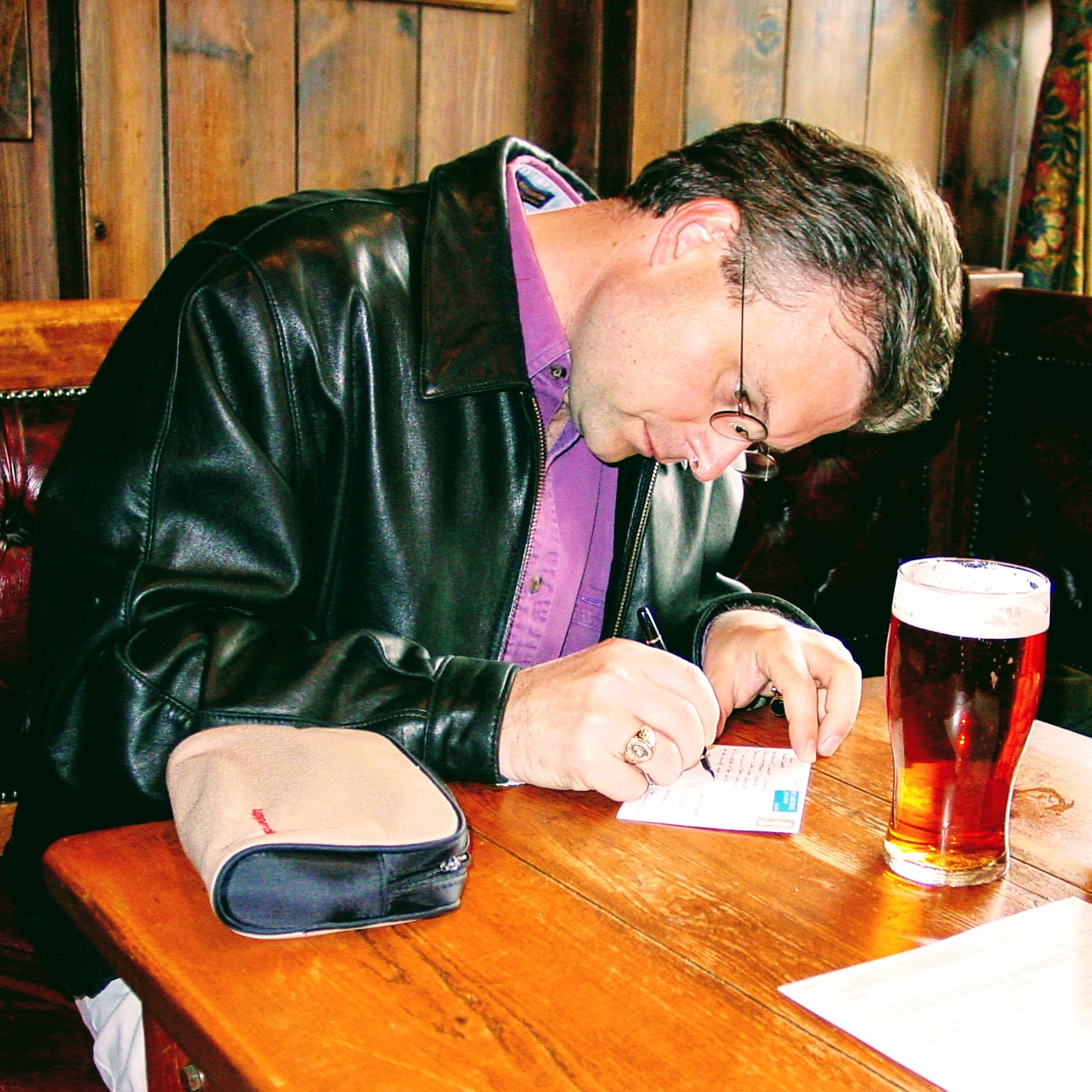
    • If I go back even further — before Moleskines became a thing — I might say I started travel journaling by way of postcards. If I was in a new or interesting place — think Tuscany or Lake Tahoe, not Dover, OH or Southfield, MI — I’d write postcards to my folks, my girlfriend-later-wife, the kids, usually while sitting at the bar having an end-of-the-day beer or wine. Irene saved some of those postcards. Flipping through them and my travel journals, I didn’t find diaries of my travel days — I did this, went there, ate at these dishes at that restaurant — but rather little vignettes of things that caught my eye, things like “the favorite pastime in Bologna appears to be trying on sunglasses at the corner stand and then checking out ‘the look’ in the side mirrors of parked cars” or “I was told by law, a Swiss office worker has to be within 50 ft of a window. Explains why all the buildings I see in Basel are thin or doughnuts” or “Roadside billboards in Detroit are different from anywhere else I’ve been. Rather than pitching hotels or consumer products, the billboards on I-94 in from the airport are all selling auto parts, punctuated by that massive Uniroyal tire”
    • I’ve pretty much stuck to an end-of-the-day routine; maybe that beer or glass of wine helps me reflect back on the day and ID the things that stood out; the things that taught me something, and then write it down. I don’t have a goal, trying to write X number of pages; I just let each day dictate. Sometimes it’s a bit prosaic, and sometimes it feeds TravelCommons. The journal pages from our Thanksgiving getaway to Santa Fe a couple of years ago turned into a 2,000-word blog post; and what poured out of my pen in frustration in France a year ago was at the core of the Travel Interruptus episode, what I called “A Greek tragedy where the travel gods toy with our anti-hero for fun and entertainment”.
    • But more than anything, right now when the lockdown is aggravating my wanderlust, reading the pages that I wrote some 2 or 10 or 20 years ago, reminds me of those places, those times, those experiences, and gives me the travel fix that I need right now in this lockdown.

    Closing

    • Closing music — Pictures of You by Evangeline
    • OK, that’s it, that’s the end of TravelCommons podcast #162
    • I hope you all enjoyed this podcast and I hope you decide to stay subscribed.
    • Find TravelCommons on Stitcher, SoundCloud, TuneIniTunes, and Spotify The links, along with the RSS feeds, are on the right-hand side of the TravelCommons website, under the heading Subscribe.
    • Right below that, in the Social Media section, are links to the TravelCommons Facebook page, and Twitter and Instagram feeds.
    • If you’re already subscribed, how ‘bout leaving us a review on one of the sites.
    • If you have a story, thought, comment, gripe – the voice of the traveler — send ‘em along, text or audio file, to comments@travelcommons.com or to @mpeacock on Twitter, or post them on the TravelCommons’ Facebook pageInstagram account,  or website at travelcommons.com. Thanks to everyone who has taken the time to send in e-mails, Tweets and post comments on the website
    • Follow me on Twitter
    • “Like” the TravelCommons Facebook page
    • Direct link to the show

  • Podcast #100 — Southern Road Trip; Breaking Up with American Airlines

    Podcast #100 — Southern Road Trip; Breaking Up with American Airlines

    One of the stops on my Drive South…

    Back in the TravelCommons studios after a 2,100-mile drive through the Mid-South. We genuflect quickly to the milestone episode number and then move onto the topics at hand — best piece of hardware schwag from Google I/O 2012, a slightly icky subway ride from downtown San Francisco to SFO, a grab bag of observations from my southern road trip, and why I find myself breaking up with American Airlines after almost 30 years of travel. Here’s a direct link to the podcast file or you can listen to it right here by clicking on the arrow below.


    Here are the transcript of TravelCommons podcast #100:

    • Intro music — Warmth by Makkina
    • Well, here we are at a milestone episode number — number 100 — 7 years and a couple of months after I started. It took me 1½ years to do 50 podcasts… and then another 5½ to do 50 more.  Looks like my podcast productivity is exponentially decaying…
    • But you people still keep hanging around! I do appreciate the kind words that you’ve sent along via FaceBook and Twitter. I am glad that so many of you find this podcast interesting/entertaining. It’s that more than anything else that keeps me plugging away.
    • Changes on the job front have kept me off the road for business travel, but I’ve managed to fill a couple of the weeks since the last episode with some personal travel.
    • At the end of June, the family and I headed off to San Francisco.  My son scored an academic ticket to the big geek-a-palooza Google I/O. I think this year’s event sold out in 20 minutes and there were a very limited number of discounted academic tickets, so getting one was a bit like getting one of the golden tickets in Willy Wonka and the Chocolate Factory.  So while my son watched videos of guys skydiving with Google virtual reality glasses, and dove into the intricacies of Google Maps APIs and the latest whizzy things that Chrome does, my wife, daughter and I did San Francisco tourist stuff — rode bikes across the Golden Gate Bridge, rode cable cars, hang out in hipster coffee joints — the sort of stuff that I’ve never quite found time to do in the 10-15 years that I’ve been going to SF for business.
    • I-65 From Louisville to Nashville

      And then last week, I decided to do a little trip on my own — a 2,100-mile loop through the South.  I ran I-65 from top to bottom — from its start in northern Indiana down to Louisville, Nashville, and Mobile, AL; across the Mississippi Gulf Coast on US-90 to New Orleans, up I-55 to Memphis, up US-51 to Dyersburg, then across I-155 to Sikeston, MO, and then finally up I-57 back to Chicago.  But more about that later in the show.

    • I have noticed though that whenever I travel for leisure, I don’t travel quite as sharp — I don’t feel as tightly wrapped, as “in the zone” as I do when I travel for business. On my flight out to SFO, I hit a new level of bad planning, of “non-preparedness.”  I had to reach for the SkyMall catalog before the plane even left the taxiway…
    • Bridge Music — Awel by Stefsax

    Following Up

    • I wrote a blog post last month about tipping. I received a link to a nice infographic from somebody from Hospitalitymangementschools.org — a web site that I still can’t quite figure out what it is. It seems like a legit web site with information about the hospitality management industry, but there’s no contact information — just a web submissions form, and the domain name is held in proxy by GoDaddy.  I dunno — it feels just a little fishy.
    • Anyhow, the tipping guide infographic was good, if a little wonky on the iPhone, and seemed to offer reasonable advice.  There is a surprising amount of emotion wrapped up in figuring out a tip amount. You want to appropriately acknowledge the service someone has just given you, and that then gets combined with the image you want to portray — am I a nice generous person, am I a sharp you-won’t-get-anything-by-me person?
    • Looking at on my own tipping, I think I do well when dealing with a service person face-to-face — a waiter, a car valet, a hotel bellhop — but not so well with tipping people I don’t see — like a hotel maid.
    • Rich Fraser is in the same place — both about not tipping cleaning staff and feeling slightly “off” about that
      • I agree with your take on tipping the housekeeping staff. I’m probably totally off base, but I always considered housekeeping to be a service inherent to my stay. I get that service whether I ask for it or not, as opposed to the bellhop, bartender or concierge, which are optional services.
    • And that’s just dealing with the US. Don’t get me started about international tipping — which countries it’s an insult to tip, it’s an insult not to tip, which countries you just round the tab up….
    • One of the highlights of our SF trip was, at the end of each day, seeing what schwag my son hauled back from Google I/O. These developer sessions have become quite the giveaway spree as companies try to recruit independent developers to their platforms. Microsoft gave away Windows 8 tablets at its last conference, but Google is the one that goes the deepest. Over two days, my son got an unlocked Samsung Galaxy Nexus phone, a Chromebox, the Google Nexus Q media streaming device slash bocce ball stand-in, and a Nexus 7 tablet.  $1,200 of hardware for a $300 academic ticket.  No wonder it sold out in 20 minutes.
    • The Nexus 7 tablet was the highlight of the schwag bag.  $200 for the 8 GB model, it directly competes with the Kindle Fire and blows it out of the water. It runs the latest Android version– 4.1 or Jelly Bean as the droid-heads call it — while the Fire sits at a custom version of 2.3 or Gingerbread. In those intervening versions, Google has smoothed off a lot of Android’s sharp edges and has significantly improved performance. For the first time, I could see an Android tablet being a real competitor to the iPad.
    • I also like the 7-inch form factor. Steve Jobs is famous for dismissing anything less than the iPad’s piece-of-paper size. I was surprised, though, how much easier I found reading and web-browsing on this much lighter device. And since most of what I use a tablet for is media consumption — rather than as an executive laptop replacement — I’m thinking I may downsize my next tablet. I’ll see if the rumored iPad “mini” appears and then, if not, I may head down the Google route too.
    • Can’t See the Dirt if Everything is Blurry

      And continuing on my periodic trains-to-airports thread, when leaving San Francisco, I took BART — Bay Area Rapid Transit — from downtown — we were staying at the St Francis in Union Square — to SFO for my flight home. It was a Sunday — the last Sunday in June — and a nice sunny, warm day — a rare event in SF — which brought out in full force the standard SF mix of street performers, cup rattlers, and tourists.  Getting through this melange with my rolling bag was my first challenge.  Once I got down to the station and in front of the fare machine, I got a bit of sticker shock — it was $8.25 to get to the airport. Sure, you pay a lot more for London’s Heathrow Express, but it’s a private train company with just one stope.  The BART fare is one of the bigger numbers I’ve hit for a subway system — Chicago is a flat-rate $2.25 from the Loop to O’Hare; Washington’s Metro is $3 from downtown to Reagan National. Sure, $8.25 is cheaper than a $40 cab ride, but still…

    • And that sticker shock only sinks in deeper when you get on the train and see how beat-to-hell they are.  They’re the same style trains as the Metro, but they’re in much worse shape. Who thought it was a good idea to put cloth seats on a public transit train?  I wished I had a plastic sheet to sit on.  And I made a bee line to a restroom once I hit SFO to I could wash my hands — it was just that disgusting.  I’m back to taxis when next in SF.
    • If you have a question, a story, a comment, a travel tip – the voice of the traveler, send it along.  The e-mail address is comments@travelcommons.com — use the Voice Memo app on your iPhone or something like Virtual Recorder on your Android phone to record and send in an audio comment; send a Twitter message to mpeacock, or you can post your thoughts on the TravelCommons’ Facebook page — or you can always go old-school and post your thoughts on the web site at TravelCommons.com.
    • Bridge music — Steam Train by John Williams

    Drive South — A Southern Road Trip

    • My "Great Circle" Route Through the Mid-South
      My “Great Circle” Route Through the Mid-South

      As I mentioned at the top of the show, I did a “great circle” road trip of the Mid-South earlier this month — me, a full-up old 30 GB click-wheel iPod, a list of restaurants and bars, and a suitcase of nothing more than shorts and polo shirts all loaded up into my Saab convertible.  I started off by running I-65 from top to bottom — from the Indiana Toll Road to Mobile, AL, with stops in Louisville, Nashville, and Birmingham.  I jogged over to the state line to Florida, passing the huge rebuilt version of the Florabama Bar & Grill, for a weekend on the Gulf at Perdido Key.

    • I then drove across the Mississippi Gulf Coast, past the re-built casinos in Biloxi, and then past the not-so-rebuilt towns of Gulfport and Pass Christian.  Here we are 7 years after the eye of Hurricane Katrina made landfall at Bay St Louis, MS and the vacant lots along the coastal road – US-90 — far outnumber the rebuilt homes.  Indeed, the For Sale signs on vacant lots — many of them hand-made with “Make me an offer” scrawled across the front” — outnumber the rebuilt homes.
    • I eventually ended up on I-10 and drove into New Orleans for dinner, reloaded on beignets and chicory coffee the next morning, and headed up I-55 with a lunch stop in Jackson, MS before landing in Memphis for a couple of days.  The final leg was Memphis to Sikeston, MO and then up I-57 back home to Chicago.  A 2,100-mile loop through what many people consider “fly-over” country.
    • The first reaction that most folks have to this itinerary is — Why? It’s certainly not on anyone’s top 10 scenic drives list. But it’s always been on my list of trips to-do — to stop off on “drive thru” cities and spend a little time exploring, even if only for a couple of hours. And to do a bit of a nostalgia tour — visit places I lived 25-30 years ago.  And to catch up with old friends — physically rather than just over Facebook. But while I’ve been thinking about it for a while, it’s always been on the “B” list — always getting bumped by something else.  Well, as I hinted at the start of the show, my professional situation has changed, providing me a bit of a summer sabbatical.  With a suddenly open schedule and nothing else planned, it’s the perfect time to work into that next tier of things to do.
    • I took a week to do this great circle route — not too fast, but not dawdling either. I had a great time. And came away with a few observations…
    • First, that drive is not as boring as you might fear.  Now, I don’t want to sugar-coat it — I-65 through northern Indiana and I-57 through Illinois are brutally mind-numbing — flat unending fields of corn and soybeans, the monotony of which is occasionally broken by a unending rows of wind generators (they’re just too huge to be called windmills).  But past that, the landscape does have character.  The low-lying clouds tight against the hills, resting in the valleys in Southern Kentucky.  Driving long causeways over the marshes and bayous heading south into Mobile on I-65 or coming north out of New Orleans on I-55.  The red clay of any turned over ground in Alabama.  The forests of Southern Mississippi.  It’s certainly not the Big Sur Coastal drive, but it’s not (except for Illinois and Indiana) hundreds of miles of sameness.
    • Second, with all that windshield time, I finally found a good use case for Apple’s Siri. I’ve seen the Samuel L Jackson and Zooey Deschanel commercials, but have never gotten Siri to be more than an annoyance — I can always find something faster myself than repeating my question 3 times.  But with both hands on the wheel and my eyes on the road, Siri was very good at reading and replying to the daily flow of text messages.  The results of “Read new message” was unintelligible only once, and given my sister’s tendency for random punctuation and abbreviations, it was understandable.  Siri’s still not the virtual assistant Apple keeps pitching her as, but she does have her uses on a long drive.
    • Today’s Selections at the Ham Bar

      Third, there’s good local food and beer everywhere.  Call it the “Brooklyn-ization” of America, but every decent sized city I visited had its own hipster neighborhoods with restaurants serving local artisan foods and local craft beers.  Louisville has its unfortunately named NuLu neighborhood, Memphis the better-named Cooper Young at the intersection of Cooper St and Young Ave, and New Orleans has the Bywater district a good bit away from the French Quarter.

    • You expect good food in New Orleans, but I had very good food and beer in every other place I stopped.  An example of that Southern local focus is restaurants using country ham in place of prosciutto — which makes sense if you think of prosciutto as just another kind of air-dried ham — but from Italy instead of Virginia.  At the Garage Bar in Louisville, they had a ham bar with a choice of country hams from farms in Virginia, Kentucky, and Tennessee.  At the Beauty Shop in Memphis — a great Twitter recommendation from @denrael — country ham, cantaloupe, and an arugula salad made a great appetizer on a hot day.  I also hit on a string of locally sour brown ales at breweries in Louisville and Birmingham. Definitely not lawnmower beers and as good as any I had in Brussels last spring. Finding these restaurants and breweries had the side benefit of taking me out of the normal tourist spots — leaving behind the French Quarter and Beale Street.  Just look for art galleries, record stores, tattoo parlors, and people in skinny pants riding bicycles without helmets.
    • Another observation — waiting for the last minute to book a hotel room with Priceline’s Negotiator app works — sometimes.  I’ve never used Priceline’s “opaque” pricing before — naming my price for an unnamed hotel room. If I’m traveling on business or with my family, I typically want things nailed down a bit tighter. I have a much lower appetite for risk; am willing to pay more money to insure a good experience. But on this trip, I’m by myself and am only looking for a clean bed and decent water pressure for the morning’s shower.  Seemed like the right time to give Bill Shatner a try.
    • My first try was Friday night around 7pm in Louisville.  Sitting in the Garage Bar after my serving of Kentucky country ham, I fired up the iPhone, got a sense of that the going rate at reasonable hotels was in the $75-110 range, and then bid $50 for a 3-star place near the airport. “Whoa, that’s a low bid” said a pop-up screen on the Priceline app.  Yup, that’s the idea.  After working through a few screens, I had a great room at a very nice Holiday Inn.  I ran the same play Sunday night driving into New Orleans and got a room at the Marriott on Canal St for $60.
    • Hoping Vegetables Cut The Pork Fat

      But during the week while in Memphis, no luck. No one bit on my lowball bids and I ended up in a very substandard Hampton Inn and not so clean Comfort Inn.  Apparently there was some Little League tournament in town.  Don’t know others’ experiences, but the risk-reward trade-off with Priceline bidding is real. Which confirmed my initial instinct — useful tool when traveling by myself with no rigid itinerary, but not so much for family or business travel.

    • And finally, if I do this trip again, I’m packing some statins, some Mevacor.  After my fourth straight day of barbecue, I could feel the pork fat thicken my blood.  Not that that kept me from ordering one last slab of ribs on the drive home…
    • Bridge music — Bubbly by Ruben van Rompaey

    Breaking Up with American Airlines

    • My relationship with American Airlines began June 1985 when I flew from Chicago to Dallas to start my first job out of school.  And now here I am, 27 years and about 2.5 million miles later and I’m feeling just done with them.
    • I wasn’t always like that. It’s easy enough to fly American out of DFW — indeed, it damn close to impossible not to.  But I went out of my way to fly American after I left Dallas — first back in Chicago, and then in Philadelphia.  Not too tough in Chicago; ORD is another AA hub. But sticking with them while flying out of US Air’s Philly fortress hub — that took some commitment.

    Tweeting Apologies

    • Over the past, say, 5 years, though, things have changed.  American’s competitors declared bankruptcy, cleaned up their balance sheets and bought new planes.  Lousy if you’re an investor with stock, an executive with options, or a creditor taking a haircut on loans, but for a customer it works out. American seemed proud of not going bankrupt, but as their planes got older and dingier, and fuel prices got higher, something had to give.
    • And give it has, not just renegotiating plane leases. At a time you’d think American would want to take extra care of customers, their service taken a dive. And they’ve gotten more aggressive with add-on luggage and seating fees.  And now combining older frequent flyer miles that had no expiration date with those that expire in 18 months. For me, it’s not a big number; it’s the change in attitude; the final break in what I thought I could expect from American.
    • Will I stop flying American? No, unless they go completely under. Or worse, merge with USAir. They’ll keep a big hub out of ORD and I have lifetime Platinum status with them — unless that too becomes a casualty of their new “take away” mentality.  What will stop, though, is giving American the benefit of the doubt, of having them be my “default” choice.  After 27 years, they’re just another uncomfortable plane seat.

    Closing

    • Closing music — iTunes link to Pictures of You by Evangeline
    • OK, that’s it, that’s the end of TravelCommons podcast #100
    • I hope you all enjoyed this podcast and I hope you decide to stay subscribed.
    • Bridge music from the ccMixter web site and from Magnatune
    • If you have a story, thought, comment, gripe – the voice of the traveler — send ‘em along, text or audio file, to comments@travelcommons.com or to @mpeacock on Twitter, or post them on our website at travelcommons.com. Thanks to everyone who has taken the time to send in e-mails, Tweets and post comments on the website
    • Follow me on Twitter
    • “Like” the TravelCommons fan page on Facebook
    • Direct link to the show