Tag: Tucson

  • My Best Restaurants, Bars and Taprooms of 2021

    My Best Restaurants, Bars and Taprooms of 2021

    It’ll take travel guide books a while to catch up with all the restaurants and bars closures caused by the COVID lockdowns. To help fill that gap, here are the best places I’ve ate and drank at during my 2021 travels. I’ll update this after each trip, so keep it bookmarked.

    • Chicago
      • NoodleBird at Fat Rice, 2957 W Diversey Ave (at N Sacramento), Logan Square — The lower price-point, post-pandemic reincarnation of Fat Rice, a perennial recommendation of mine. Like Fat Rice, NoodleBird’s starting point is the Chinese-Portuguese fusion cuisine of Macau and then extends to other Asian regions
      • Galit, 2429 N Lincoln Ave (just north of Fullerton), Lincoln Park — Great Israeli/Middle Eastern restaurant with a nice 4-course menu that let’s your table try a lot of dishes
      • High Five Ramen, 112 N Green St, West Loop — Small, hip basement ramen joint. Expect a wait, but have a beer and a Texas BBQ appetizer upstairs at Green Street Smoked Meats while you wait
      • MingHin Cuisine, 2168 S Archer Ave, Chinatown — It’s our favorite dim sum place. And they take reservations!
      • Birrieria Zaragoza, 4852 S Pulaski Rd, Archer Heights (near Midway Airport) — Small, family-owned place with a small menu focused on birria (stewed goat) from Jalisco. Warm service and phenomenal food. 
      • Bitter Pops, 3357 N Lincoln Ave (at Roscoe), Roscoe Village — a renovated slashie (bar + packaged goods) that has a great selection of Chicago craft beer
      • Revolution Brewing – Brewery & Taproom, 3340 N Kedzie Ave, Avondale — Great beers; wide range of styles; bring your own food
      • Maplewood Brewery & Distillery, 2717 N Maplewood Ave (South of Diversey), east of Logan Square — Small, neighborhood bar tucked up against the Kennedy Expressway
      • For more taproom ideas, check out this pre-pandemic TravelCommons taproom tour. Three of the four taprooms featured are still open — Marz, Whiner, and Lo-Rez. Only Lagunitas Brewing is still closed
    Sonoran Hot Dog
    • Phoenix
      • Pizzeria Bianco, 623 E Adams St — Thin crust pizza a short drive from the airport
      • Pane Bianco, 4404 N Central Ave — Great sandwich place by the same group further north
    Eppiq Brewing
    • New York City
      • Hummus Kitchen, 444 3rd Ave (at 31st St), Murray Hill — Well-executed Middle-Eastern food
      • Her Name is Han, 17 E 31st St (at Madison Ave), Koreatown — Home-style Korean food
      • Craft + Carry – Murray Hill, 440 3rd St (at 30th St) — Excellent selection of NY craft beers on draft and in cans to-go
      • Ted’s Corner Tavern, 523 3rd Ave (at 35th St), Murray Hill — Comfortable neighborhood bar with a great beer selection
      • The Pony Bar, 1444 1st Ave (at E 75th St), Upper East Side — Casual bar with a great beer selection. Been going there for 10 years
    • London
      • Behind Restaurant, 20 Sidworth St E8 3SD, Hackney — Focused on seafood and modern British flavors. The whole restaurant is a kitchen table experience, watching chefs prepare the dishes and then serve them to you. One of the best Michelin 1-star restaurants I’ve visited.
      • The Ginger Pig, Corner of Stoney St and Park St, Borough Market — Bought the best sausage rolls I’ve ever had from their walk-up display. Want to go back and try their meat pies.
      • NOPI, 21-22 Warwick St W1B 5NE, Soho — Fun Mediterranean/Middle Eastern fusion restaurant from star chef Yotam Ottolenghi. Sat at the bar and had a great late lunch.
      • Al Masar, 214, 216 Borough High St SE1 1JX — Strategically located near the Borough tube stop. Solid Lebanese wraps; exactly what I needed after a long taproom crawl down the Bermondsey Beer Mile.
      • Bermondsey Beer Mile, a mile of craft brewery taprooms that have set up shop in adjacent railway arches under a huge brick bridge carrying commuter trains in and out of London Bridge train station. Rob Cheshire, long-time TravelCommons listener and UK craft beer podcaster laid out a taproom crawl that started at The Kernel, the first brewery in on the Mile, and continued through The Barrel Project, Cloudwater, and Brew By Numbers.
      • Old Fountain, 3 Baldwin St (at City Rd) EC1V 9NU, Shoreditch — Tucked into a little side street, it’s a comfortable pub with a great UK craft beer selection.
  • Podcast #172 — Timeshares Without the Pitch; Notes on Tucson

    Podcast #172 — Timeshares Without the Pitch; Notes on Tucson

    Escaped the Chicago winter for a week of hiking in the mountains around Tucson and searching for good Sonoran food. We also talk with Mike Kennedy, CEO and Co-Founder of Koala about how he’s making it easy to rent timeshares without buying into them. All this and more – click here to download the podcast file, go over to the Subscribe section on the right to subscribe on your favorite site, or listen right here by clicking on the arrow below.

    Here is the transcript of TravelCommons podcast #172:

    This Week

    • Intro music — Warmth by Makkina
    • Coming to you again from the TravelCommons studio in Chicago, Illinois on, depending where you are, Fat Tuesday or Shrove Tuesday or Pancake Tuesday. Here in Chicago, with a big Polish population, it’s Pączki Day and I had mine for breakfast — Polish-filled donuts; I went for a raspberry jam and a custard one. What had been one of the mildest winters on record started reverting to the mean in February. The last day the temperature cracked freezing was almost 2 weeks ago and it has snowed 13 of the past 17 days. We were all waiting for this, veterans of Midwest winters. It got me thinking that maybe Irene and I should’ve delayed our trip to Tucson from the third week of January when the temperatures here were hitting the mid-40’s, to last week or this week when we could’ve enjoyed 50-60° temperature differentials.
    • But even without the guilty pleasure of posting schadenfreude-trolling Instagram pictures of sunshine and temperature readings, we had a good week in Tucson. The flights out and back on Southwest were uneventful, and not full; the Airbnb was fine; the desert hikes were great, and we hit some good restaurants and taprooms, which, as I talked about in the last episode, was the main reason we pivoted from original destination, locked-down/shutdown San Diego to Tucson. Probably our only disappointment was not finding a great margarita — which we fixed in the Amex Centurion Lounge in PHX while waiting for our flight home. I’ll talk more about Tucson later in the episode, but I also wrote up a blog post with all the details. If you go to the episode description in your podcast app, there’s a link that should be clickable to take you straight to the post.
    • Even though Southwest’s open middle seat pledge expired in December (Delta’s the last one standing), no one landed in our middle seat on our MDW-PHX flight. That flight was a lot longer than I remember it being last year. I think it had something to do with the mask. Before getting on the plane, I switched from my standard EvolveTogether surgical style mask to a Korean version of the N-95 mask, decided to dial it up not knowing if I was going to be shoulder-to-shoulder with a stranger for 3+ hours. The KN-95 wasn’t too uncomfortable, as masks go, so I didn’t swap it out for my other mask when the middle seat stayed empty. My strategy with Southwest’s open seating was to go ¾’s of the way to the back of the plane, about halfway past the exit row. I figured this would mean fewer people walking past us but far enough away from the rear lavs to avoid the in-flight queues. And, since people still want to deplane quickly, if the last boarding groups, the C groups, were left with just middle seats, they’d take them in the front of the cabin. As it turned out, I probably over-thought that a bit; I didn’t see any occupied middle seat in the front or the back.
    • Then, a couple of days before our flight home, I got the dreaded e-mail from Southwest — the flight “may not allow for an open middle seat next to you.” I waited until the night before to tell Irene. She’s a little more COVID risk-averse than me and didn’t want her stewing on it. But it turned out OK. She grabbed the 2-seat second exit row — aisle and middle seat; no window seat. And looking behind us, I didn’t see any row with an occupied middle seat, so either people swapped their flights after receiving that email, or the flight was just a shade over ⅔’s full with any occupied middle seats in the front of the plane. And, those margaritas from the Centurion Lounge helped the flight home go by just a wee bit easier.
    • Bridge Music — P.I.H.E. by Budapest BluesBoy (c) copyright 2010 Licensed under a Creative Commons Attribution license. http://dig.ccmixter.org/files/hepepe/26362 Ft: Inna Barmash – Zhurbin

    Following Up

    • The story of the guy who lived for 3 months on the secure side of O’Hare’s domestic terminals after getting off his flight from LA using an airport ID badge that an airport operations manager had reported missing back in October.  Shades of Tom Hanks’ character in “The Terminal”. Now, O’Hare is a big airport but it’s not “hang out for 3 months unnoticed” big. There are hundreds of TSA, Chicago Police, and airport security staff — not to mention all the airline gate agents, wheelchair porters, restaurant workers, and airport maintenance staff. And not one of them noticed this guy wandering around at all hours with an expired badge, even when passenger volumes are cut in half — until finally, 2 United Airlines workers asked to see his ID. This is bad — like Cats, The Movie-level bad, like Fyre Festival bad. Seems that, 20 years on from 9/11, “see something, say something” has faded. The TSA and Chicago Dept of Aviation should have to come up with some answers — but a month on, I think they’ll quietly drop the charges and bury this thing, hoping that the next guy is a bit more obvious.
    • In the last episode, I wondered what the airlines and hotels will do about elite status protection if travel continues to be slow through the summer and closed saying “it’ll be interesting to see what they offer come May”. Well, I was off by, say 4-5 months. Things are moving fast. A week after posting that episode, I got an email from Southwest saying they were extending my Companion Pass from June to Dec, and then offers from American and United for status qualifier accelerators. The slooow roll-out of coronavirus vaccines is cutting into what was an end-of-year travel planning spurt. ValuePenguin — we’ve talked to them in prior episodes about travel credit cards — they did a survey in December and found people getting rev’d up for travel — 16% of respondents booked travel as a result of vaccine approvals, 34% had bought plane tickets within the last month, and, in a turnaround from earlier in the year, 47% had increased use of travel credit cards to earn miles to fund their next trip. But two months on from that survey, you already hear some folks starting to write off the summer. Which, with airlines talking about new furloughs and hotel unemployment back up to 23% in January, isn’t great news for anyone.
    • I also got emails from Iberia and British Airways reminding me that I have Avios balances with each of them that are expiring; Iberia’s at the end of March; BA’s the end of the year (interesting difference in warning periods). Iberia and BA merged 10-11 years ago to form IAG which later bought Aer Lingus, and all 3 use Avios points for their frequent flyer programs but they keep their programs separate. So I have different Avios balances at all three. For most of these programs, you need to have some activity over 24-36 months to keep your point balance. Some airlines have extended these timelines for COVID, but apparently not Iberia or BA. In the past, the easiest thing to do was transfer over the minimum number of credit card points from Chase or Amex — usually 1,000 points — and that activity would reset the clock. I was about to run that play again, but something made me check out the rules first. And, sure as hell, the Iberia website says that transferring miles doesn’t count as activity. Now while Iberia’s and BA’s Avios programs are separate, you can transfer points between them if you dig hard enough — I talked about burning a Saturday afternoon on this back in episode #136. But they’ve made it easier in the intervening years; I scrounged around and found the page I needed to transfer all my Iberia Avios points to my BA account. I’ll give it a month to see if BA considers this transfer as enough “activity” to reset the 36-month clock. If not, I have until the end of the year to try an Amex transfer or, failing that, code a night’s Marriott or Hyatt stay to my BA account. Reminds me to make the rounds of my other odds-n-ends loyalty programs and see what else might be expiring.
    • I mentioned in the last segment that we hit the PHX Amex Centurion Lounge before flying home from our desert hiking week. I’ve talked in past episodes about how these lounges are head-and-shoulders above the regular US airline lounges — great food, open bars. The only problems — not enough of them and, because they’re a great deal, they get crowded. Or did pre-COVID. Walking into the PHX lounge, we saw maybe a dozen people. They’re still serving food, but they now have staff dishing it out for you from the buffet line. But we’d picked up a couple of sandwiches from Pizzeria Bianco, a great pizza and panini place, so we were just looking for drinks. I thought about a beer, walking up to the bar, the tequila bottle caught my eye, reminding me we hadn’t been able to find a good margarita in Tucson. The bartender solved that problem; she made two great margaritas. So good, that I wanted to squeeze one more in before heading down to the gate. I walked up to the bar; different bartender; I hoped her margaritas were as good. She looked at me for a moment and then said, “I have to be honest with you; I’ve never made a margarita before, but I’ll give it a try.” She was one of the girls from the buffet line standing in for the bartender while she was on break. I could’ve pivoted to a beer, but when she said “I’ll give it a try.” “No problem,” I said, “I’ll walk you through it.” Grab the shaker, fill it with ice. Take the tequila bottle, fill the large end of the jigger, pour it into the shaker. Now turn the jigger over and fill the short end with Cointreau. Pour that in. Now a short shot of lime juice. Now put the lid on and shake it. Now strain it into that martini glass; we’ll skip the salt rim. She was great; a little nervous, but game for it. We thanked each other — me thanking her for yet another good margarita; she thanking me… but for what, not being another miserable, entitled Platinum card holder? Absolutely my best Centurion Lounge experience yet.
    • And if you have any travel stories, questions, comments, tips, rants – the voice of the traveler, send ’em along to comments@travelcommons.com — you can send a Twitter message to mpeacock, post your thoughts on the TravelCommons’ Facebook page or our Instagram account at travelcommons — or you can post comments on the web site at TravelCommons.com.
    • Bridge music — ~aether theories~ by Vidian (c) copyright 2018 Licensed under a Creative Commons Attribution (3.0) license. http://dig.ccmixter.org/files/Vidian/57398 Ft: Gurdonark, White-throated Sparrow

    Timeshares Without The Pitch

    • For our Tucson trip, Irene ended up booking on Airbnb what turned out to be someone’s timeshare rental in a golf resort west of Tucson. It was a new one for us, and a little different than the typical Airbnb experience — we had to put down a credit card for incidentals, and then had to check-out and check back in halfway thru the stay — but it was a nice place and, better yet, we didn’t get trapped in a small room for an hour-long sales pitch.
    • And so when we got back home and I got a note from Mike Kennedy introducing me to Koala, the timeshare rental search platform he co-founded and launched last August, I asked him to come onto the podcast to talk about timeshare rentals and how they fit into the travel eco-system:
      • Mark: Mike, help us understand how timeshare rental fits into that spectrum of accommodations that travelers might be more familiar with. If I think about that spectrum, I could go from hotels to B & Bs to vacation rentals to private home rentals. Where does timeshare rental fit?
      • Mike: That’s a great question. There’s kind of a natural bifurcation in options when you’re selecting accommodations for vacations. You’re either going down the route of an Airbnb or a VRBO.  You want to rent a home because you want some space, or you want to stay in something that is a hotel. But in those two scenarios, you typically have compromises, and the compromise with hotels is that, especially if you have a family, you’re typically getting one hotel room in cramming your family in or getting adjoining hotel rooms. But you get the confidence that it’s managed by Mariott or Hilton, etc. Conversely, if you’re getting a home rental, it’s the opposite. You have the ability to rent a whole home. You don’t have to leave three times a day for meals. However, you don’t know who it’s being cleaned by, or what protocols are being upheld. And in today’s world, those things are really important. The timeshare product is the only natural hybrid product in the marketplace. You have all the benefits and features of your vacation rentals like the living rooms, the shared bedrooms, washer and dryer; all that space that you want from a vacation rental. But it’s managed by a Marriott or Hilton, and it has resort amenities like swimming pools, check-in desks; things like that that give you the confidence again in today’s world with that, people really want. Before us, the options to get one of these was to pay a lot of money on these OTAs, these online travel agencies through a rental, or to go and buy into one of these programs. And that’s not really either affordable or even appealing to a lot of people.
      • Mark: What does Koala offer travelers that, say, Airbnb doesn’t? I recently rented a Club Wyndham timeshare in Tucson from an owner on Airbnb. So how would that transaction be different/better/more optimized on Koala?
      • Mike: So, a couple things. One. You don’t see a lot of timeshare inventory on Airbnb for the reasons I’m about to discuss. And that is because it is not a platform that is built for that product.
      • Mark: What are some of the unique pieces that make Airbnb not optimized for timeshare rental?
      • Mike: If you own a home, you can open up a calendar for 365 and you can set different prices and different availability based off of that open calendar. If you own a timeshare, you typically own a seven-day interval.  And how do you fit that into some place where it gets visibility for someone that may not be searching for those exact beginning and end dates? So, what ends up happening is that a lot of people show up to the resorts and the reservations are incorrect or wrong, or just not there at all. You know, it is a system because there’s a little bit of a square peg in a round hole. Don’t get me wrong. It sounds like you had a fine experience, but they don’t manage that in a way that is designed to be managed. There’s a third party involved in this, the resort.  When it’s an Airbnb, it’s a host and it’s a traveler, and those two will figure out and arrange something. With a resort stay, there is a third party. There’s a guest certificate transfer that happens on the back end to ensure that your name as a traveler gets switched to the reservation ledger in the system to ensure that the guest gets to walk into that check-in successfully. We do all that. There are extra steps involved that we ensure. And we handle all of that.
      • Mark: So it feels like you’re acting as an OTA, an online travel agency like an Orbitz or an Expedia, to provide search, discovery and then booking.
      • Mike: Correct, yes
      • Mark: As you were working towards your August launch, what were some of the biggest challenges you faced in getting that inventory so that people could search and book?
      • Mike: That is the question, right? So, I know this from my time in Hilton Club that there was a problem in how people underutilize their timeshares but still had fees to pay. And that went from “I bought this thing; I don’t understand it” all the way up to “I loved it for 10 years; I’m just done with it and now what?” and everything in between. But at the end of the day, if you have a $2000 annual fee to pay, it becomes a problem. So, I knew that it was something that if we connected with these owners, we could help solve that problem for them. What we didn’t understand was that, in many cases, these owners don’t even know what they own. They don’t know where to start. It’s not like you have a vacation rental, and you’re like “Oh, here’s the house; I take some photos; I’m going to throw up a price and I’m going to rent a couple nights out, and I’ll adjust the cost per night based off of rentals.” You have this thing that is either a fixed week or it’s not; it’s a specific resort or it’s not. And in many cases, people don’t really know what they bought. And in some cases, they bought something and then upgraded to something else. So that was by far the biggest problem was getting people to understand what they own. How do you create an asset out of that and leverage that asset in a way that could earn you some revenue? It’s still a process that we’re going through, like really making it very, very simple. You know, we’re not really just tapping into this supply; we’re really empowering a whole group of people to understand this process.
      • Mark: Mike, last question. How did you get this idea? How’d you get started on this down this path?
      • Mike: Yeah, good question. I was a musician when I was in my twenties, and I kind of meandered into residential real estate. And the real estate market in 2007 in New York, everywhere was just kind of flat. So, one of my good friends was like, “You should come check out this condo hotel; it’s fractional real estate.” I ask “What the heck is fractional real estate?” “No, come check it out. It’s Hilton.” “Alright.” I went in there. I’m like, This is cool. There’s a lot of hustle and bustle. My office is kind of dead; this office is moving. So, I joined the team. Three weeks into training, I ask “Is this a timeshare?”  They’re like “Yeah…”, but I was already hired in the job. It really started to resonate with me — the more and more time I spent with people that I sold, after they’re coming in over and over again, and we’re trying to upgrade them into something else. It was cool, this product is great, but now people are looking for ways out, and I don’t have answers for them. The solutions weren’t there on the back end that I was hoping for. So, it really was a direct result of me being in touch with those situations that I felt like I could help. And yeah, I took the leap and I said, Look, this is where this is a problem we’re solving. I think the industry is great. I think there’s a lot of upside. I think it’s got a bad rap, but I think if we mitigate some of that and amplify what people love about this industry, I think it will go a long way.
      • Mark: Fantastic. Mike Kennedy, CEO and Co-Founder of KOALA. Mike, thanks for joining us on the TravelCommons podcast
      • Mike: Thanks, Mark.
    • Bridge music — The Long Goodbye by John Pazdan (c) copyright 2008 Licensed under a Creative Commons Attribution license. http://dig.ccmixter.org/files/flatwound/14476

    Notes on Tucson

    • As I said at the top of the show, Irene and I had a good trip to Tucson at the end of January — pretty much just hiking, eating, and drinking. I wrote it up in a blog post on the TravelCommons website — “Quick Notes on our Trip to Tucson”, though at over 1,700 words, I’m not sure it necessarily qualified as “quick.” But there are some pictures, and links to all the parks, restaurants, and taprooms we enjoyed. Also a link to the Tucson Instagram story on the TravelCommons Instagram page if you want to see some more informal pictures.
    • We flew into PHX rather than TUS because the non-stop flights were cheaper and there were more of them. I was going to rent a car anyways, so the 100-mile drive straight down I-10 seemed a good trade-off for better flights. The only hitch in that plan was the bus between the terminal and the rental car center. They limited capacity to 15 people, which made sense. However, they didn’t add buses to make up that lost capacity. Wasn’t a problem when we got on the bus at the terminal, but the queue at the rental car center stretched the length of the center; hundreds of people trying to get back to make their flight. I saw some folks bailing out and calling Ubers. Made a note to add an extra 30 minutes to our return time. Turned out we didn’t need it; walked straight from the Hertz lot onto a bus. But that was OK. I used that time for my margarita lesson — definitely a greater good.
    • Tucson sits kinda at the bottom of five sets of small-ish mountains; they’re an awkward size — bigger than hills, but except for the Santa Catalinas, don’t feel big enough to be “mountains”. Which was OK because all we wanted to do was hike, well really walk, the trails. To be outside under blue skies in the high 60’s/low 70’s; that’s what we really wanted to do; to take a break from grey Chicago and to be far enough away from people that we could walk around without masks. 
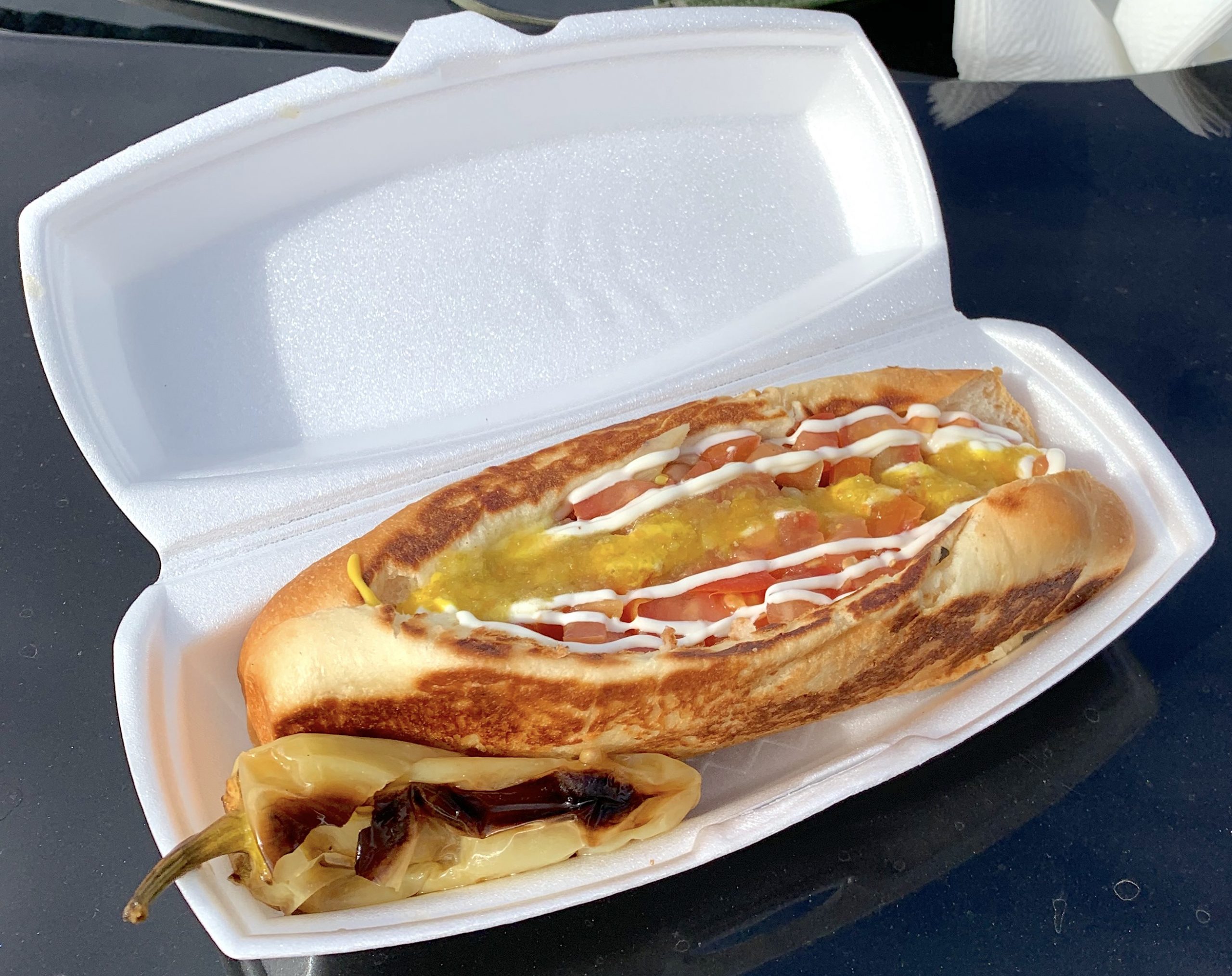
    • Back in episode #168, we talked about traveling for food, that food is one experience of a place that can’t be easily exported and bought on-line. In that episode, I talked about eating our way through South Philly and a pasty tour of Michigan’s Upper Peninsula. In Tucson, it was the hunt for Sonoran food, a type of Mexican cuisine that you don’t see much outside of, well, the Sonoran desert — Southern Arizona and the Mexican state of Sonora. It hasn’t “broken out” the way that, say, Tex-Mex and Baja and Oaxacan styles have. It’s all about beef, mostly carne asada grilled over mesquite and served in a thin flour tortilla that’s more like the wrappers you get with Chinese Mandarin food than the thick flour tortillas you get with fajitas. Cross-referencing a couple of local food blogs, I had a list of places to try. And honestly, it was a bit of hit-and-miss; mostly misses the first couple of nights, but then we hit gold at the end of our stay. Looking back, I think we tried the nicer places on the list first. They weren’t bad; they were fine, but not places I’d go out of my way to recommend. And after that — disappointment is too strong of a word, we kinda said, screw it. We found the Sonoran hot dog truck and ate a couple of $3 bacon-wrapped hot dogs topped with chopped tomatoes and onions, pinto beans, mayonnaise, mustard, and salsa verde off the hood of our rental car. And then drove over to a restaurant that’s website made it look very foody — scrolling photos of nicely plated dishes — but almost passed the building by; it looked like a repurposed Arby’s or Hardee’s with a vinyl sign pulled over the original one. But the food, especially the cabrito, the goat tacos, were phenomenal. Not all the dives were great; some disappointed, some were “meh”. But the ones that were great made it worth the “meh’s”.
    • But the absolute highlight of the trip? I was standing out on the back patio of our timeshare watching the sun set over the Tucson Mountains; it was beautiful; when I heard some rustling off to the right. What looked like a good-sized wild pig walked out from between two bushes and across the backyard. And then another one. They stopped, turned to look at me, and then kept walking. More kept coming – walking the same path across the backyard. They were javelinas, and Wikipedia told us that their groups are called “squadrons”.  Well, our squad looked comfortable here, like they were taking their usual end-of-day stroll back to wherever they bed down to stay safe from mountain lions. And the next morning, a couple came back sniffing around the patio door. I wondered if they smelled the egg and toast I made for breakfast. They reminded us to keep that patio door closed.

    Closing

    • Closing music — Pictures of You by Evangeline
    • OK, that’s it, that’s the end of TravelCommons podcast #172
    • I hope you all enjoyed this podcast and I hope you decide to stay subscribed.
    • Nothing new on the tech front this month, but I should have the website freshened up by the next episode. I’ve had the current look since the beginning of 2006 courtesy of TravelCommons listener Hilary Baumann and her Fascination Design firm. The change is absolutely not a knock against Hilary’s work. It’s just that, after 15 years, I wanted to freshen things up a bit. So look for that by the end of February or beginning of March.
    • Find TravelCommons on Stitcher, SoundCloud, TuneIniTunes, Spotify, and Amazon Music, as well as asking Alexa, Siri, and Google to play TravelCommons on your smart speakers. The links, along with the RSS feeds, are on the right-hand side of the TravelCommons website, under the heading Subscribe.
    • Right below that, in the Social Media section, are links to the TravelCommons Facebook page, and Twitter and Instagram feeds.
    • If you’re already subscribed, how ‘bout leaving us a review on one of the sites.
    • If you have a story, thought, comment, gripe – the voice of the traveler — send ‘em along, text or audio file, to comments@travelcommons.com or to @mpeacock on Twitter, or post them on the TravelCommons’ Facebook pageInstagram account,  or website at travelcommons.com. Thanks to everyone who has taken the time to send in e-mails, Tweets and post comments on the website
    • Follow me on Twitter
    • “Like” the TravelCommons Facebook page
    • Direct link to the show
  • Quick Notes on Our Trip to Tucson

    Quick Notes on Our Trip to Tucson

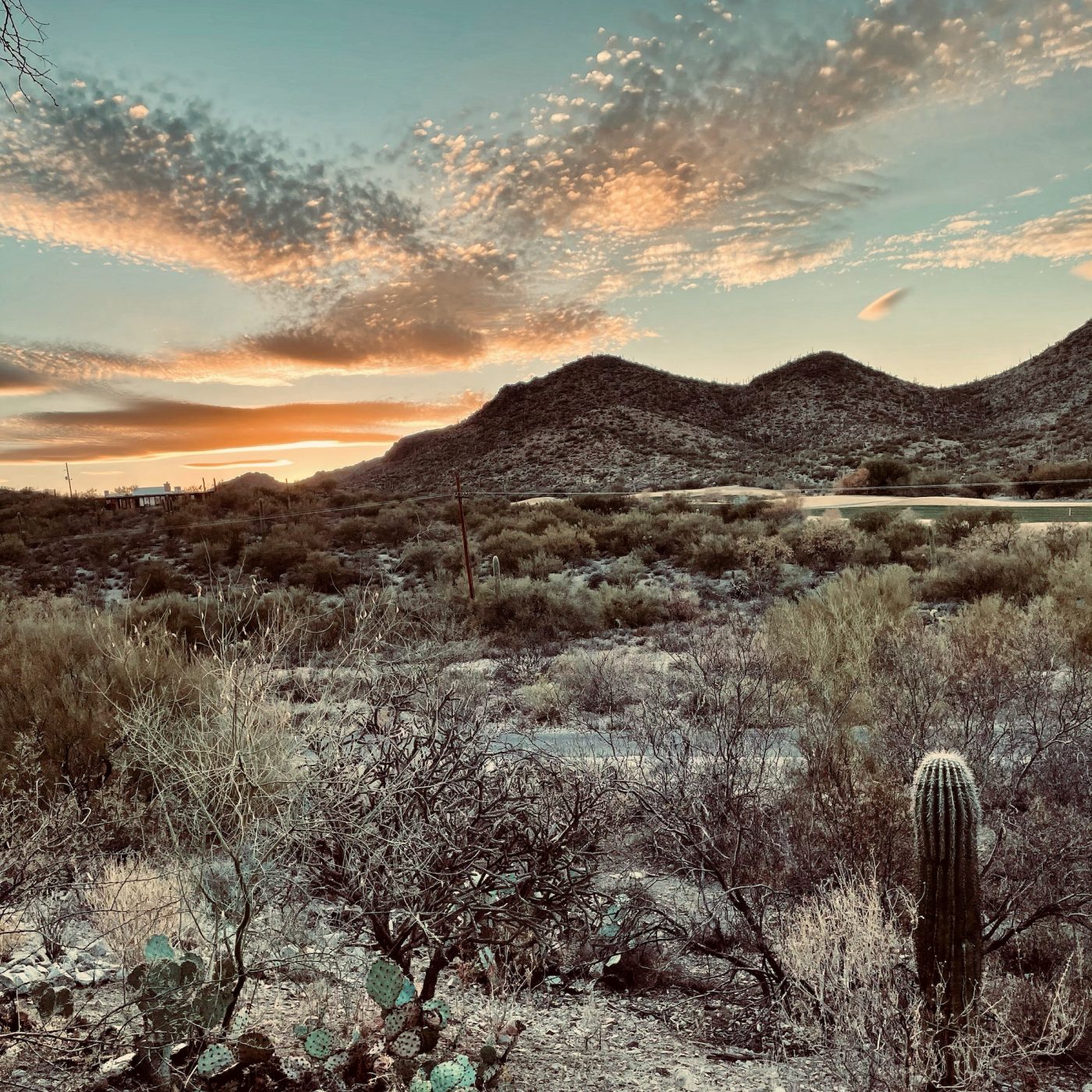
    I left my suitcase at the door of our West Tucson Airbnb and walked out onto the back patio to watch the sun slip behind the Tucson Mountains. The shades of red and orange on the undersides of a couple of clouds stood out in the pale blue sky. This was exactly what we were looking for when we left a cold grey Chicago nine hours ago.

    But then I heard a rustling from the far edge of the patio. A good-sized boar, a wild pig, walked out from between two bushes and walked across the backyard. Then another one. They stopped, turned to look at me, and then kept walking. More kept coming – another six followed the leaders, walking the same path across the backyard, stopping to sniff at a little tree. A quick Google search told me they weren’t wild pigs but javelinas, a New World relative of the pig. They range from southern Arizona all the way down to Argentina in social groups called “squadrons”. Our squad looked comfortable here, like they were taking their usual end-of-day stroll back to wherever they bed down to stay safe from mountain lions. A couple of them came back to check on us the next morning, reminding us to keep the patio door closed.

    To see a video of the javelina visitation and more, check out my Tucson Instagram Story on the TravelCommons Instagram Page

    Hiking

    As I mentioned in the last podcast, our plans for this trip were all about outside activities so any last-minute COVID closures or restrictions didn’t strand us in our Airbnb, aimlessly flipping through TV channels. Since Tucson is surrounded by five small-ish mountain ranges, we focused on hiking.

    Saguaro National Park is split into two physically separate areas, the Tucson Mountain District (TMD) on the west side of town near where we were staying, and across town to the east, the Rincon Mountain District (RMD). Our drive to the west district wound through the northern part of Tucson Mountain Park; two lanes twisting through gaps between the hilltops. The forecast said it would be the best weather of our stay, the highest temperatures and the lowest chance of rain, so we went for our biggest hike, an 8-mile loop that would take us to the top of 4,687-foot Wasson Peak.

    We planned to park at the King Canyon Trailhead, but it was filled with construction equipment that had completely torn up the parking lot. We hung a quick U-turn and, ignoring the warning signs, parked across the street in the far corner of the Arizona-Sonoma Desert Museum. We cut through some brush, crossed the street, and found the start of the trail. It was sand and larger stones that climbed up from a dry wash. The Park Service has done a nice job of marking the trail, carving out steps on the steeper parts, and putting up signs at the trail intersections. I was glad, though, that I’d downloaded enough off-line Google Maps data so I could double-check the signs when my mobile connection dropped.

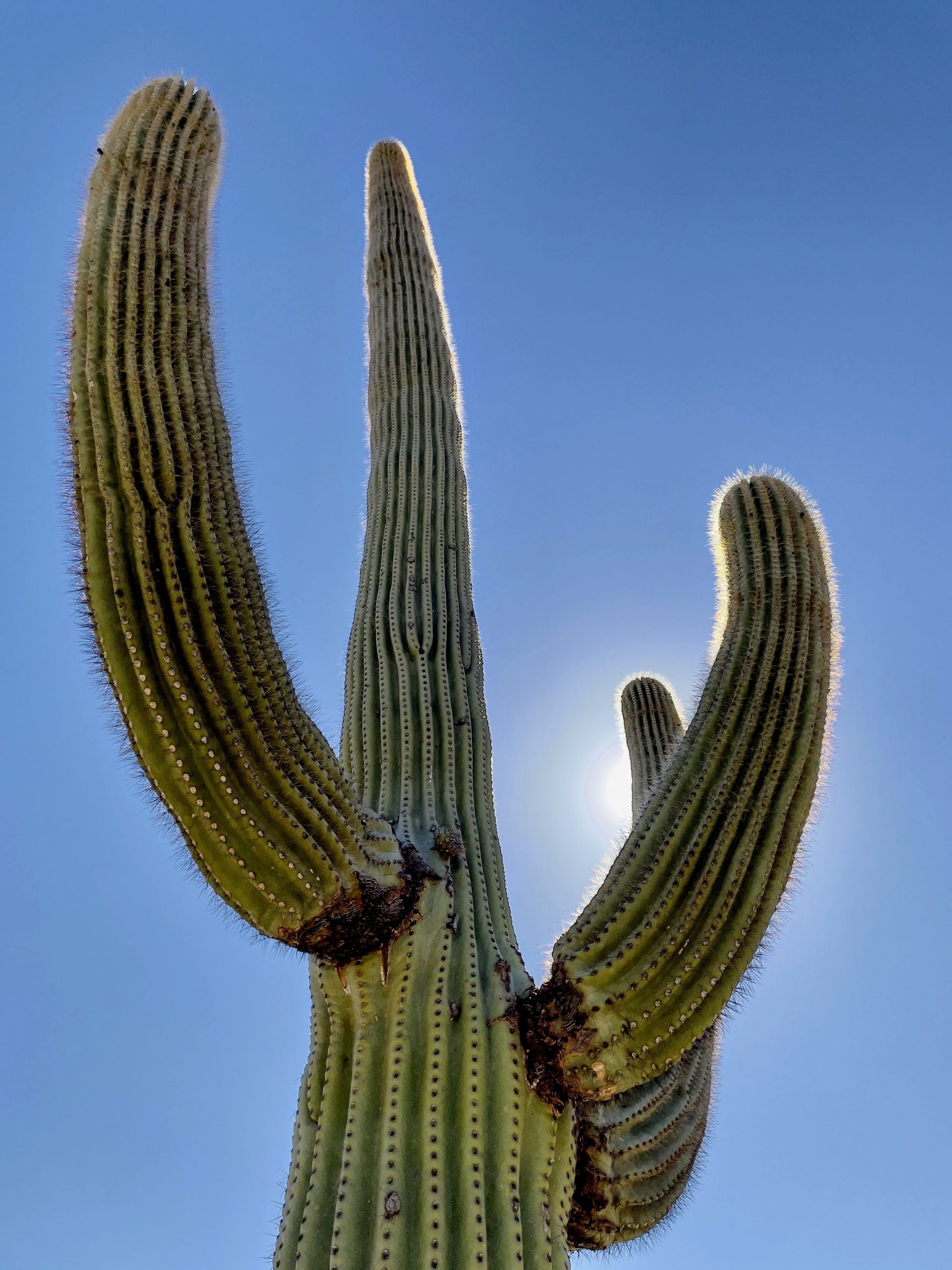
    We walked up through what seemed the cactus version of a forest. The hills were full of all sorts of cacti: tall saguaro, low-to-the ground prickly pear and barrel, and twisted, tangled cholla. The top of Wasson Peak gave a panoramic view of the rocky hills that jutted straight up from the desert floor, and of Tucson sitting at the bottom of them.

    Tucson Mountain Park is directly south of western part of Saguaro National Park. We walked 10 minutes from our Airbnb to the Starr Pass Trailhead. This hike was a 5½-mile loop around the valley floor, not as long nor as scenic as yesterday’s Saguaro hike, but more leisurely and certainly easier on the feet. We took a bit more time, looking up at the tall saguaro cactuses with all their different arm configurations, and then down at the barrel cactuses that were just beginning to show the light green shoots of new growth. There were more people using these trails; the level terrain made it popular with mountain bikers and runners. And here too, the trails were well-marked and well-maintained. It was a good afternoon’s hike.

    Sabino Canyon Recreational Area was our last hiking spot. It’s across town, on the northeast side of Tucson in the foothills of the Santa Catalina Mountains. It was much more crowded than Saguaro or Tucson Mountain, but I might not be making a fair comparison. At Sabino Canyon, we drove to the main visitors center to step off on our hike while our other hikes started at smaller, more remote trailheads. Here again, there was beautiful rugged desert scenery, looking up the mountains and down into the canyons. But the trails weren’t as well-marked as the other parks. We would lose the trail coming up out of a wash and then wander through cactus and javelina tracks trying to pick it up again. It was a pretty hike, but frustrating.

    Eating

    All the hiking freed up the caloric space we needed to get deep into Sonoran food, a style of Mexican cuisine that hasn’t yet broken out of its birthplace, in this case, Southern Arizona and the Mexican state of Sonora, the way that Tex-Mex, Baja, and Oaxacan cuisines have. Picking up the menus, I immediately saw some differences – it’s a burro, not a burrito; a caramelo, not a quesadilla; and tacos are garnished with chopped cabbage instead of the chopped cilantro and raw white onion that is the standard in Chicago. Beef, especially carne asada grilled over mesquite, is the default filling and it’s served in a thin flour tortilla that’s more like Chinese moo shu or Peking Duck wrappers than the thick flour tortillas you get with fajitas. Tucson Foodie and Andi Berlin, food writer at #ThisIsTucson, were my main guides to Sonoran food.

    Ruiz Hot Dogs food truck was our first stop. I’d read a lot about the Sonoran hot dog and coming from Chicago, another town with its own unique twist on a hot dog, I had to give it a try. The Sonoran dog is a bacon-wrapped hot dog topped with chopped tomatoes and onions, pinto beans, mayonnaise, mustard, and salsa verde, served in a slightly sweet split-top bun with a grilled yellow pepper on the side. We ate ours on the hood of our rental car. It was great and a bargain at $3. (1140 S 6th Ave at W 22nd St)

    El Taco Rustico was next on our list for tacos – more specifically, quesabirras and cabrito (goat) tacos. We tried the quesabirras first. They’re crispy tacos filled with beef birra (juicy stewed beef) and melted cheese, served with a little styrofoam cup of broth, a sort of “Mexican a jus,” for dipping. The broth, with a deep roasted dried chile flavor, pulled everything together. What the quesabirras didn’t soak up, we drank like a chaser from a styrofoam shot glass. Next were tacos. We had cabrito and pollo asado (grilled chicken) tacos, and they were a revelation. The taste of the meat, the mesquite smoke on the grilled chicken and the tang of the goat, punched through the condiments and the tortilla. That this made such an impression on us is a credit to Chef Juan Almanza but also a sad commentary on how the meat at too many taco joints is just an underseasoned carrier for the salsa and garnish. (2281 N Oracle Rd)

    Tacos Apson was our last stop, down in South Tucson across the street from a high school, and the best stop. We smelled the mesquite coming off the grill when we opened the car door. We walked up to the window and ordered two burros, carne asada and haas, which is a mix of asada, cheese, and roasted green chiles. Then scanning the menu, I added a couple costillas tacos, grilled beef ribs. Back at the Airbnb, I cut burros in half. The thin flour tortilla was wrapped around nothing but the meat; none of typical burrito fillings, no rice or beans or lettuce or crema. There was nothing to mask the mesquite on the carne asada or the beef ribs, and the cheese and green chile in the haas burro accentuated rather than overwhelmed the beef. (3501 S 12th Ave)

    Drinking

    I can’t hike and eat Mexican food without beer. Tucson isn’t on anyone’s list of top beer cities, but I found a couple of solid microbreweries to recommend.

    1912 Brewing Menu Board

    1912 Brewing Company is in a strip of nondescript light industrial buildings just west of I-10, a quick 5-minute drive from El Taco Rustico. They have 20 taps and turn out good beer over a wider variety of styles than most places – goses, saisons, and some German styles in addition to the usual IPAs. (2045 N Forbes Blvd, Ste 105)

    Pueblo Vida Brewing Company is in downtown Tucson. After navigating one-way streets and dodging street car, we found parking and walked over to the taproom only to find that the taproom was still closed due to COVID restrictions. But they were selling cans from a walk-up window. We had a nice chat with the woman helping us and bought a mixed 4-pack to go with our Tacos Apson take-away – a Vietnamese-inspired rice lager, a couple of hazy IPAs made with local Sonoran white wheat, and what I was most excited for, a black IPA. They were the best beers of the trip. (115 E Broadway Blvd)

    Resources

    • Travel and Lodging
      • We flew Southwest Airline to Phoenix Sky Harbor Airport (PHX) from Chicago Midway (MDW). Prices and flight selection were much better than flying into Tucson (TUS).
      • We rented a car from Hertz at PHX and drove the 115 miles down I-10 to Tucson. It was an easy drive that took us an hour and 40 minutes. PHX is on the south side of Phoenix right by I-10, so we didn’t hit any Phoenix traffic on the drive.
      • Our Airbnb was a one-bedroom time-share suite at Starr Pass Golf Suites. It was a nice resort though we didn’t get around to using any of the amenities (pool, golf course, restaurant). We’re glad we stayed out near the Tucson Mountains rather than a downtown hotel. Tucson isn’t that big, so we weren’t more than 25 minutes from anywhere we wanted to be.
    • Hiking
    • Sonoran Food
    • Craft Beer